Tuesday, February 28, 2017

Expensive Tech, An old transistor and a revolution.


IBM 0663 CorsairImage result for 1947 transistorImage result for 6700kImage result for transistor

Many of you readers would agree with me that technology is really a revolution. It has changed SO much in the last few years. Take storage for example.  In 1991, (26 years ago), a hard drive (Photo on the right) held a grand total of 1 GB. Nowadays, you can get a 10 TB drive (10,000 times more data can be stored) that's half the physical size of the 1GB Drive!


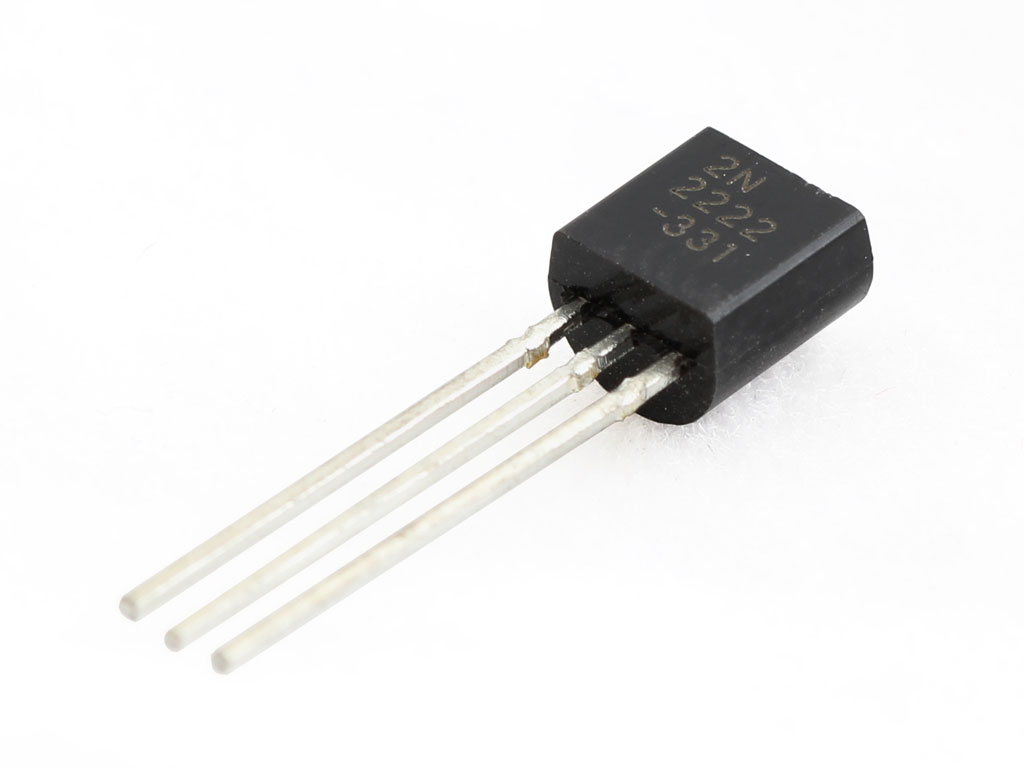
Hard drives are really not that interesting, so I have another example. 70 years ago, in 1947 the first transistor was invented. Transistors are electronic components that direct the flow of electricity. They run your computer, router, microwave, tv, pretty much anything that is more complicated than a lamp. In 1947, a transistor looked like the big clear thing on the top left. Of course one of those isn't in your microwave. The transistor on the bottom right is a modern day version of what the giant transistor was in 1947. One of the transistors on the left would cost about 25 cents today. What about transistors in computers? Is my computer filled with little black components with three wires sticking out? Well, no. The device on the right is a modern-day CPU (Central Processing Unit) In fact this is the one that is in my computer right now. This package, while larger than the single transistor on the right, this component has 1.75 Billion transistors inside! This chip costs around $300, but the number of transistors inside is insane. If you're willing to pay a little (a lot) more, $1700 to be exact, you can purchase the Intel 6950x, a CPU with a whopping 3.4 Billion transistors!

So what? Why does it matter how many odd-looking clear plastic things are in a computer? Why does it matter that they are smaller now? The answer is speed. My old computer had 1.3 Billion transistors, and while not even half a billion might not seem like a huge difference, the new machine feels so much faster. And it really is! In terms of raw speed, measured in Gigahertz (The more GHZ the better) the 0.45 transistor difference makes my current computer 145% faster than the old one. Transistor count doesn't mean everything however, my CPU beats the $1700 one by 25% in raw speed.

Now on to how the technology revolution has affected me. One example of the technology revolution is again, my computer. The 1.3 Billion transistor CPU came out in 2013. I built my current one over winter break, 6 (almost 7) years difference, and the chip is 145% faster? Thats amazing! (Both computers cost roughly the same at the time when I got them) The speed has changed so much in the span of just a few years! Another example of something that has changed a ton in the last few years, is cell phones. The first iPhone was released in 2007. Apple doesn't really like to tell anyone how fast their products are, aside from the possibly false claims about their products being "Light years ahead" (Check out Kamran's article for more on that) They really don't give me a lot of technical details that I can actually compare to their newer devices. One thing that they do give us is the storage capacity. The first iphone came in 4, 8, and 16gb versions. The newest iPhone comes in 32, 128, and 256gb options. If you don't have a reference of what a gb can actually hold, A 2 hour movie or or 345 songs is about 1.5gb.

I sure hope that technology keeps improving as fast as it has, because I sure am excited when the day comes where I can hold 10 Billion transistors in my hand.

Innovations Of The Chicago's World Fair 1893


The Fair Of The Future


The Chicago's World Fair of 1893 celebrated the 400th year since Columbus made his first voyage to the new world. This world's fair was famous because it was not only a huge celebration, but it also produced many firsts to the world.

Over 26 million people visited the fair over 6 months time, and enjoyed sights and experiences that they had never seen before or experienced before. This fair was the first time that foreign countries from all over the world could have their own pavilions that displayed their cultural arts, industry, etc....

The fair was futuristic and many inventors all over the world displayed their inventions. The tourists were awed by new technological advances that they had never seen before, such as neon lights, electric railway, washing machines. Another wonder that impressed them was the fact that the city of the fair was completely electrically light at night and this was something that they had never seen before.


This fair had the worlds first Ferris Wheel which was invented by George Washing Gale Ferris Jr. It was 60 m tall and the rides lasted 12 minutes. People rode in capsules that could hold several passengers. This was considered a very daring ride and some of the passengers would panic and crawl at the walls screaming. The Ferris Wheel ride was so popular, that was how the fair made so much money.

Besides being famous, the fair is infamous because murders happened there. A man named Patrick Prendergast assisnated Chicago's new mayor on closing day (the celebration had to be canceled). More shocking is during the fair a serial killer named Dr. H.H Holmes, lured unsuspecting guests to his hotel, The Castle. His hotel was littered with traps to kill and torture people. After the fair police found lime pits filled with skeletons and parts of bodies in the furnace. Police confirmed 9 kills, he confessed to 27 but, it is suspected that he killed up to 200 people in his hotel.


https://en.wikipedia.org/wiki/World's_Columbian_Exposition


Monday, February 27, 2017

The evolution of fashion


Today, fashion is all over the world with famous designers, Coco Chanel, Marc Jacobs, Givenchy etc. Have you ever wondered who the first fashion designer was? His name was Charles Frederick Worth. He founded the House of Worth, one of the most famous fashion houses back in the 19-20th century. If it wasn't for him, fashion wouldn't be this famous today or might even be unrecognizable.

Charles Frederick Worth grew up in Bourne, Lincolnshire, England in 1825. As a young man he worked for London textile merchants, just long enough to know enough about fabrics and dress supplying. Most of Charles Frederick Worth work was to produce dresses for shops in Paris. Some of his first work was inspired by paintings he saw at The National Gallery.

He later became a leading salesman, and opened his own tiny dressmaking shop. He later became a professional dressmaker. His award winning designs were later displayed in the Great Exhibition in London (1851). This success leaded him to opening his own firm with business partner in 1855.  Charles Frederick Worth work opened up people's eyes to Paris with his fashion, which made it a showpiece of Europe.  If it wasn't for Charles Frederick Worth Paris wouldn't be the huge hit for fashion it is today.


Over the years fashion has evolved hugely. With new company's coming into the market, new ideas start emerging. Especially the clothing lines for teens. Every year the company's who design clothes for us are competing to think what will get the most attention/appeal. Certain trends may start in a weird way as well. Maybe someone that a lot of people look up to starts to wear a certain brand/clothing line and other people like the way it looks. More people will buy it and all of the sudden its a huge trend that everyone seems to wear. More and more people will buy it till everyone has it. But then all of the sudden the huge amount of popularity for that item drops. Company's then again have to find another idea that will appeal/get attention. This is how trends start and stop. Over the years you can imagine how many trends have come and gone, and how fashion was like back then and how it is now.

Fashion interests me a lot. I enjoy shopping and designing, and I want to become a designer when I grow up as well. I always thought how people came up with trends was so cool and I wanted to be able to do something like that one day as well. My uncle is a designer for Nike, so I get to work with him on designs that i'm interested in, and he helps me through the process of designing something. The process is much more complex then you would think and the tiny detail in every step is very important. Im so glad that Charles Frederick Worth lived out his passion, otherwise I wouldn't be able to live out mine.

Sources:
http://www.metmuseum.org/toah/hd/wrth/hd_wrth.htm

How Chess has Changed Over the Years

When people first started playing chess is was a game of style rather than a competitive game like has been in recent years. A great example of this is one of the most famous games ever played in chess history. The game nicknamed The Immortal Game because Adolf Anderssen, playing with the white pieces, sacrificed his queen to win the game with style rather than a safer and more straightforward approach to winning. This is what people tried to do back in 1851 and it's good for an exciting game to watch but is not a safe option to win.

People didn't only play differently, they also had different rules. One of the most noticeable ones is how people promote their paws. How do you promote a pawn? How you promote a pawn is pushing it all the way to your opponent's back rank. What this does is now you can turn it into any piece in the game, but how it used to be was it would only turn into the piece who's file its on. If you promoted a pawn on the side of the board, it would turn into a rook because the rook starts on the side. Another promotion change was you used to be able to promote to your opponents pieces. You would usually not want to do this but it was useful in some situations like this one.


This position has white mating black in one move before the promotion rule change.

The answer is pawn to b8 promoting to a black rook checkmate.

Many rules are local rules. In India, it used to be that pawns could only move one square at a time, and in some other places, pawns could only move by capturing your opponent's pieces. Rules only became universal when people from different regions played each other competitively in 1834.

When I first started to playing chess, all I would do was attack and try to find ways to break my opponents position down. This is how people first started playing chess in the 1700s and for some of the 1800s. They played simply by attacking and trying to charge in and break their opponents pawn structure and attack head on. It makes sense that they would play this way and develop better strategies over generations because a single chess game can have over 288 billion different possible positions after only four moves each so it would take many years for people to find the best moves. The fundamentals have stayed the same for the most part but it is a relatively new thing to keep your king safe early on in the game.

Let me give you an example of one of the games I've played:
https://en.lichess.org/Hxvcr0Hu5z98

This is a game I played online and I played an opening called the stonewall attack. This is where I control the center of the board so I have the option to attack either side of the board. I messed up in the mid-game when I left my queen hanging on b4. Because I made this mistake, I have to take some chances or I'll eventually lose the game to his superior pieces. I attack with my rook on the queen's side which distracts him so my knight can then get a fork on his king and rook with my knight on the king's side on move thirty-four. Because he had sacrificed three pawns and a bishop for my queen, I am now up three pawns and can just push them down the queen's side and win the game.

Sources:
http://io9.gizmodo.com/how-chess-has-changed-over-the-last-150-years-1707692642
https://www.google.com/search?q=how+many+moves+in+a+chess+game&oq=ho&aqs=chrome.0.69i59l3j69i61j69i60j69i61.1457j0j7&sourceid=chrome&ie=UTF-8
https://www.google.com/webhp?sourceid=chrome-instant&ion=1&espv=2&ie=UTF-8#safe=active&q=immortal+game&*

Basketball

Basketball

        Basketball is my favorite sport. I have been dribbling and shooting since I was three. Basketball is a fast and quick sport. When you play you have to be energetic, quick, and aware of everything around you.
        Basketball is usually played in the fall. I play year round so I can get better. I play for a club team named Maeko. We have won multiple tournaments but have also lost some too. My favorite teams in the NBA (National Basketball Association) are probably the Oklahoma City Thunder or the Golden State Warriors. Basketball is a sport played all across the world and is the third most played sport in the world.
        In my opinion, I would say the US is the most competitive for basketball. We have the best players from across the world. Basketball is very competitive in our age group. In the sport, you will get hit and tossed around but you learn to toughen up. You also learn to flop. Flopping is a key part of the game for some people. If you are good at it then you could get some pretty unfair calls made in your favor, but you do not want it to be obvious.
        If you are one of the best, then, like plenty of other sports, you will get a scholarship. Scholarships are very good but you need to really show the team that you are worth it. If you do then you might get drafted to the NBA. It has been my dream since I was in 3rd grade to get drafted into the NBA, and I have been working towards this dream of mine ever since.
        Basketball is my favorite sport. I have been dribbling and shooting since I was three. Basketball is a fast and quick sport. When you play you have to be energetic, quick, and aware of everything around you.

Think Like A Revolutionary, Act Like a Citizen

Somewhat lost in the transition from the Obama to Trump administrations was President Obama’s positive call-out and clarion call to our generation, Generation Z. Toward the end of his farewell address in Chicago, he said,
This generation coming up – unselfish, altruistic, creative, patriotic – I’ve seen you in every corner of the country.  You believe in a fair, just, inclusive America; you know that constant change has been America’s hallmark, something not to fear but to embrace, and you are willing to carry this hard work of democracy forward.  You’ll soon outnumber any of us, and I believe as a result that the future is in good hands.
President Obama knows a thing or two about our generation, having two Gen Z daughters. I’ve spent the last four years studying the attitudes and attributes of Gen Z and believe he’s nailed what makes our generation different and better. In fact, I see our generation as a group of 21st century revolutionaries and the next “Greatest Generation.” The reason for my optimism relates to the intrinsic values of our age cohort and the amazing tools at our disposal to be change-makers. Think of us as super-citizens.


Born beginning in 1996, Gen Z has been shaped by the times into which we were born. The great recession hit just prior to our teenage years and the iPhone debuted when the oldest members of our generation were 10. I see our generation as clearly different from the Millennials that came before us. Most importantly, we are much more optimistic, and that’s what gives us the opportunity to feel bullish about changing the world. I see Gen Z’s key attributes as follows:

  •       We are technology natives. We’ve never known anything but a high tech existence and we are at ease with technology, putting it to work for us effortlessly to make us super-creative and super-productive.
  •       We are an entrepreneurial generation. Powered by technology and hubris, we are creating businesses and nonprofits at an unprecedented rate.
  •       We have a high level of community consciousness. Ours may be the first generation that was required to do community service, but that requirement has morphed into legions of young people setting out to change the world.
  •      We are non-partisan but pro-world. If you grow up in a world of sharp partisan divides, you take refuge in focusing not on parties but issues. Gen Z engages seriously with the world, not stopping to argue about whether climate change is real, but looking for how to play a role in finding a solution to the problem.
  •       We crave experiences. We are bad spectators – we like to be where the action is, in fact, we like to be in the action. Our interest in experiential activities grows out of our commitment to community and to problem solving.
  •       We are post-race and post-gender. The battles that adults, much to our regret, are still fighting seem silly to us. We matured and live in a world where sticking to the socially constructed binary is no longer the norm and where gender fluidity and racial diversity, tolerance, and acceptance are celebrated.


If you put all of those attributes together, you have a powerful amalgam poised for revolution, which is clearly what President Obama was anticipating and calling for from all of us. The good news is that having an impact has never been easier. There are amazing tools for identifying issues and figuring out how to have voice where it matters.

One emerging enabler of civic engagement and activism is the Indivisible movement. Using the techniques employed by the Tea Party movement in 2010, Indivisible sprung up in reaction to the election of Donald Trump. Thousands of Indivisible chapters have sprung up, all using a handbook created by 30 current and former Congressional staffers. Indivisible chapters target issues and elected officials and seek to have their voices heard.

The work of Indivisible has been greatly enhanced by the work of Nathan Harrison, a Portland-based political activist, and his Town Hall Project. Harrison and his grass roots team created, almost overnight, an easily accessible list of elected officials and a constantly updated, highly searchable list of town halls and public appearances planned by those politicians. Armed with the information generated by Harrison and his team, Indivisible has facilitated face-to-face encounters between elected officials and their constituents.


The work of Indivisible and the Town Hall Project extends the tradition of two centuries of political activism and civic engagement in the United States. Existing organizations, like Portland’s Bus Project, have long been providing a means for interested young people to work on issue-based politics, voter registration, and get-out-the-vote campaigns. In the words of President Obama,

Ultimately, that’s what our democracy demands.  It needs you.  Not just when there’s an election, not just when your own narrow interest is at stake, but over the full span of a lifetime.  If you’re tired of arguing with strangers on the Internet, try to talk with one in real life.  If something needs fixing, lace up your shoes and do some organizing.  If you’re disappointed by your elected officials, grab a clipboard, get some signatures, and run for office yourself.  Show up.  Dive in.  Persevere.  Sometimes you’ll win.  Sometimes you’ll lose.  Presuming a reservoir of goodness in others can be a risk, and there will be times when the process disappoints you.  But for those of us fortunate enough to have been a part of this work, to see it up close, let me tell you, it can energize and inspire.  And more often than not, your faith in America – and in Americans – will be confirmed. 

Now is the moment for Gen Z to rise to the challenge issued to it by President Obama – to use its commitment to community, its skill with technology, and its interest in issues to tackle the major problems facing our country. If Gen Z does so, it can be America’s next “Greatest Generation.”
Image Sources:
https://www.gfs.com/sites/gfs.com/files/how-to-manage-the-gen-z-workforce.jpg
https://www.alltruckjobs.com/blog/wp-content/uploads/2016/08/TruckDriverRecruitmentGenZ.png
http://www.mrctv.org/sites/default/files/uploads/Monica/May/Screen%20Shot%202016-05-26%20at%2011.34.48%20AM.png
https://cbsboston.files.wordpress.com/2017/01/obama-wave.jpg?w=628&h=353&crop=1
http://www.commondreams.org/sites/default/files/styles/cd_large/public/headlines/trump_protest_2.jpg?itok=HDYL4IAI

Saturday, February 25, 2017

How video games influence our social life and culture.


Video games, we all know what they are, you probably have played them once before.  Right now I will discuss my options on how they affect us in good ways, and in bad in our social life and culture.
Many people regard video games as a new impressive technology, but 26% of adults think that most video games are a waste of time (according to pewresearch.org).  Many adults dislike video games and gamers because most of them when they were born they were not exposed to such a high amount of screen usage.  My parents and many other parents who have kids at my school, did not grow up with video games in their lives.  Video games are now getting increasingly more violent and I think a lot of parents are opposed to having their kids play shoot ‘em up games. Even if video games get less violent parents would still prefer that their kids spend more time away from the screen.
155 million americans play video games regularly (this statistic was found on bigfish.com, and includes mobile games) this means 3 to 4 hours each week.  This shows that video games are becoming more and more popular in the world, with the Call Of Duty franchise’s net worth at over 3 billion dollars in 2009.  Many people love video games and even enjoy watching others play them in “let's play” videos, these are videos where you watch someone else play a video game.
Many people have heard of mass shootings or issues of violence in our country, and many try to link those to violent video games.  Also people say that video games glamorize guns, weapons, and killing.  I believe that a mere simulation could not drive someone to take someone else's life.  All though video games can be linked to aggression and being anti-social.  For example when you go play a video game like CS:go or call of duty, a game with a voice chat.  You will notice that people usually yell rude words and curse at you.  I think this is linked to using screens a lot.  Also there are some gamers who are very polite and don’t get mad at people.  Even though many parents and adults dislike video games, the industry is continuing to grow.


Friday, February 24, 2017

The positive effects of video games


Note: Before I get started, it’s important to say that too much of anything is bad, even oxygen

When people think of video games they think of someone sitting with a controler in front of a screen. People think of video games as an anti social hobby that only introverts do. In a research study over half of people said that none or only a few of video games were helpful with half of those people saying that they were entirely a waste of time. The easy retort to this is educational games. Students that play “Pre-social” games are more likely to help others in real life situations. Games can help students learn not to do drugs, or let students explore a simulated environment, and games to teach geography. 70% of teachers reported an increase in student engagement while using educational games
However not all games are educational, in fact most aren't. However that’s not to say that everything other than educational games are bad. They notably improve hand-eye coordination, and multitasking. Doctors who regularly play video games are better at laparoscopic surgery than those who don’t play video games. Video games can help improve confidence, in the form of achievements or other in game activities. Video games also promote group and team play. For example the game Overwatch gives users 20% more in game experience points for playing in a group, and game consoles have features that allow people to chat with their friends while they play.
Aside from all of this video games can offer a great bonding activity for parents and their kids, especially as parents are approaching their kids on their own turf. Seeing as the average age of video game players is 37 a whole new generation of parents is having kids while knowing the world of gaming. And hey guess what, those positive effects I was talking about. They work for adults too! Research done by ONR show that adults that play video games can process information faster and improve in their abilities to solve problems and reason.
There are other activities that can provide the same skills, but video games are fun. Many people will say that games are addictive, and I am not here to argue against that. All I will say of the matter is that video games don’t use chemicals or hormones to trigger releases in the brain.
I know personally for me video games can be an escape. Have you noticed the world we are inheriting. A video game is a work of art whether you view it as “high art” or “low art” is your choice. I don’t use video games to improve my reaction times or things like that. I use video games to have fun. My personal purpose of this was not to prove that videogames are good. I wanted to prove that they aren’t bad. Video Gamers still face stereotypes as fat boys living in their parents basement. This is extremely far from true.  Video games are for all, and to be played by all.

How PCs are the Ultimate Gaming Machine, and Consoles are Misleading


Video Games. One of the most profitable, and most popular forms of entertainment. A form of media where the most different of people can sit down and have a good time. However, nothing can be without controversy, and the catch of gaming is that before you play, you have to choose a console. Most people just blindly buy a PlayStation or Xbox just because they've the names in advertisements, and while I do admit that once described me, I have discovered that PCs are ultimately superior in every way. But why have so many people fallen into the trap of console gaming? How can so many people be oblivious to all the wasted dollars they're throwing down the drain?
                                                                                                                                                        This all boils down to anti-consumerist companies such as Sony, Microsoft, and Apple spreading false information. I won't go too in-depth into Apple, because that has already been covered by Kamran's blog, Is Apple Scamming You?. "How are those companies anti-consumerist?" you might be asking, "They bring powerful gaming at lower prices." This is exactly what these companies want you to think. You see, this is what Microsoft and Sony do,they pander to the majority of gamers. Casual players who don't want to be spending too much. They lure you in with shiny plastic buttons, and trick you into thinking this is "powerful gaming", when a GTX 760, a $150 graphics card card from 3 years ago, can out preform the Xbox one S, and the PlayStation 4 Pro, both new consoles that have only been released a few months ago


Image result for gaming pc
Source: CyberPowerPC.com
One of the ugliest truths of console gaming is the joke that is premium memberships. Sadly, I first learned about this just after I forked over my last twenty dollars. Basically, as multiplayer games such as Call of Duty, and Battlefield became increasingly more popular, consoles saw this, and starting charging players $10 a month ($120 a year) to play their favorite games online. While this service is completely free on PC, console gamers see no problem with this, even going as far as to defend this obvious scam, saying that money is being used properly maintaining the servers. News flash, servers don't cost anything for the companies making the consoles anymore. Companies such as Blizzard or Activision handle the servers for their games.


It is believed that consoles have more exclusives, and PCs just get the salty backwash of games that are already on Xboxes and PlayStations. This is quite the opposite, actually, as PCs have hundreds, maybe even thousands more than consoles could even dream of, and most of the time they're of a higher quality than your average Halo clone. Games on PC are also much cheaper, with services such as Steam having huge sales very frequently. Just last month I bought Just Cause 3 for $10 (normally $40). Not to mention, games on PCs drop in price much quicker, whereas console games usually linger above $40 for about a year. This doesn't even include bundles. A new way of purchasing games on PC, bundles allow you to pay a single dollar to get upwards of ten different games. I can't even count the amount of money I've saved using sites like Bundle Stars, or Humble Bundle.


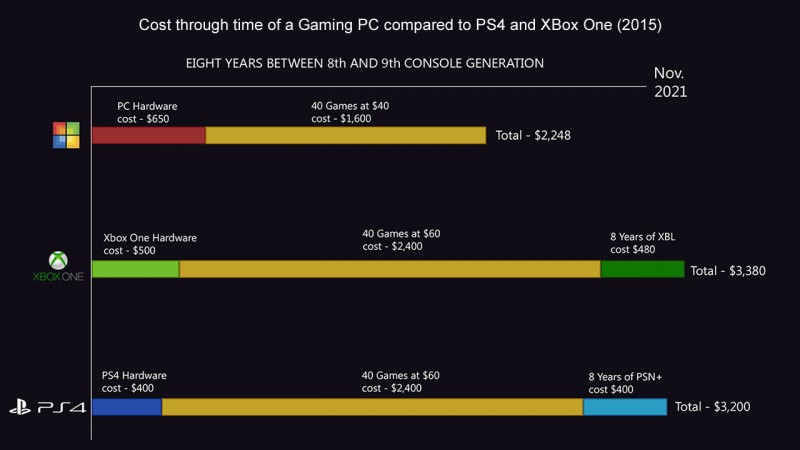
Image result for pc vs consoleThe most common factor I hear spoken about when defending consoles, is the initial price tag of a PC. Most starting builds, gaming-wise, are usually going to range in price from $450-$700. Now while this is slightly more expensive than the $400-$500 of a console, PCs are much cheaper in the long run. The graph to the right (created by Andrea Brandi on stari.co), shows the total price a PC, a PlayStation 4, and an Xbox One over the span of eight years, if you buy 40 games, and eight years of an online subscription. Eight years, is also about how long it takes until a new generation console is released, so theoretically it could cost you even more to play on consoles than the graph shows, if you buy a new one each time one comes out. The same could be said for PCs if you upgrade your hardware during that time, but upgrading one small component for a PC would cost way less than buying an entirely new console.


That isn't even close to the entire story, I haven't discussed controllers, and how it's nearly impossible to use them, fauly hardware, the fact that PCs can be used for more than just gaming (work, music, and internet, just to name a few), the insanely huge modding communtiy on PC. I could go on and on about why consoles are plain bad, but in the end, what's really at fault is the anti-consumerist, all for profit ideology that's ruining companies, and the commercial market as a whole. In theory, consoles could be great for the consumer, and for the company, but after years of milking gamers for everything that they can get, consoles and their respective companies have sunk to the spot they're at now. A laughing stock for the PC community, and just flat out not worth the money

How Memes are Taking Over the Internet


Writing the Emancipation Proclamation political cartoon

        Memes: You've probably heard of them, seen them, or even made them, but where did they come from? Why are they called memes? How do you make them? In this blog I will dive into the history of memes, and share the information with you.


  Memes go much further back than you might expect them to. The term meme wasn't invented until 1976, but far before then there were cartoons, comics, and drawings that were the memes of there time. For example, during Abraham Lincoln's presidency, a lot of Americans made fun of him through political cartoons. One political cartoon that got very famous was a photo of Lincoln writing the emancipation proclamation. This photo went viral because of how it showed that being the president wasn't a smooth or easy job, and a lot of people found it relatable to their lives.

      Most memes these days are nothing like they were back then. Back then a lot of them were drawings about political events, usually without "funny" or "relatable" captions. There wasn't such thing as the internet back then, so most of them weren't as widespread as they are now. Memes have changed a lot. The definition of an internet meme is "a concept or idea that spreads "virally" from one person to another via the Internet." -webopedia.com. They are usually a photo or video with a funny,
sarcastic, or relatable caption. 
The popular Blurry Krusty Krab meme
 Some notable examples of modern 
day memes are Pepe the frog, 
the Catch Me Outside girl,
and the blurry krusty krab. 
Some people have made livings out of running  
meme accounts, with millions of followers, 
and lots of ad revenue. 


          The word meme came from the biologist Richard Dawkins 1976 book where he says:
"We need a name for the new replicator, a noun that conveys the idea of a unit of cultural transmission, 
or a unit of imitation. ‘Mimeme’ comes from a suitable Greek root, but I want a monosyllable that sounds  
a bit like ‘gene’. I hope my classicist friends will forgive me if I abbreviate mimeme to meme. 
If it is any consolation, it could alternatively be thought of as being related to ‘memory’, or to the
French word même. It should be pronounced to rhyme with ‘cream’."
I don't know about you, but I wasn't expecting this to be where the word 'meme' came from.

      In my opinion, memes are a great thing. If I'm ever sad, I'll look at some memes, and if I ever want to cheer other people up, I'll make one. There are lots of ways to make memes, and I'll share two of them with you. The first one is simple: Use twitter. Most memes that you see these days are just a picture with a twitter caption above it. Just screenshot the twitter post and crop your username out of it. Here is an example:

Cropped version of Twitter post
Screenshot of Twitter post


      The second way to make them is download and app to make them. Some good apps are PicMeme, Mematic, and Meme Design. Once you have an app you can easily follow the instructions, find a good photo, and come up with a good caption. If you want to know some more about making memes,
feel free to check this awesome website that I found out: http://bit.ly/2lDg8cW


        In my opinion, there is nothing bad about memes: they are funny, witty, and relatable all at once. They make me laugh, and I feel like they are a good little distraction from all of the hate and negativity in the world right now. 


Sources:

Writing the Emancipation Proclamation. Digital image. Abrahamlincolnsclassroom.org. N.p., n.d. Web.

Blurry Krusty Krab. Digital image. Smosh. N.p., n.d. Web. 24 Feb. 2017.

"Where the Word Meme Comes From." Today I Found Out. Today I Found Out, 03 Dec. 2012. Web. 24 Feb. 2017.

Beal, Vangie. "Internet Meme." What Is Meme? Webopedia Definition. Webopedia, n.d. Web. 24 Feb. 2017.


 Memes, Dank. "Dank Memes (@DankMemes)." Twitter. Twitter, 24 Feb. 2017. Web. 24 Feb. 2017.