Showing posts with label Inventions. Show all posts

Monday, February 10, 2014

Coal and Steam Engines

coal mine
Before 1712, people had to use wood for fuel. The outburst of coal mining started the Industrial Revolution, and men driven by the idea of making profits started to invent steam engines. The first ever steam engine, designed by the Spanish inventor Jerónimo de Ayanz y Beaumont, was patented in 1606. This started a series of non-practical attempts to create steam engines.

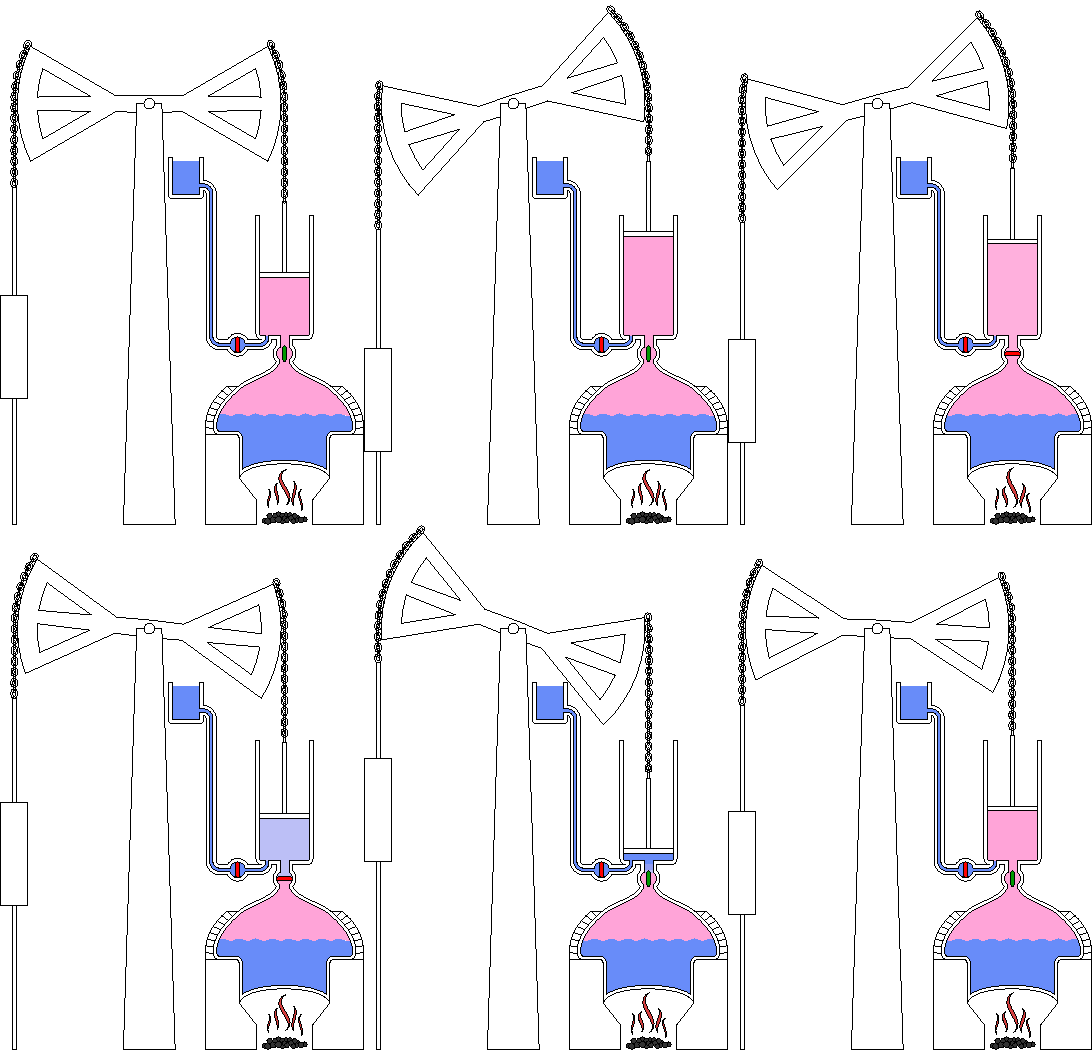
Newcomen atmospheric engine


In 1712, the first commercially successful steam engine, Thomas Newcomen’s atmospheric engine, was invented. It was used mainly for pumping water out of mines, and did the work of 20 horses. Operating the Newcomen atmospheric engine was expensive, so James Watt improved on Newcomen’s engine. The Watt steam engine came to be more efficient, and is better known then the Newcomen atmospheric engine today.
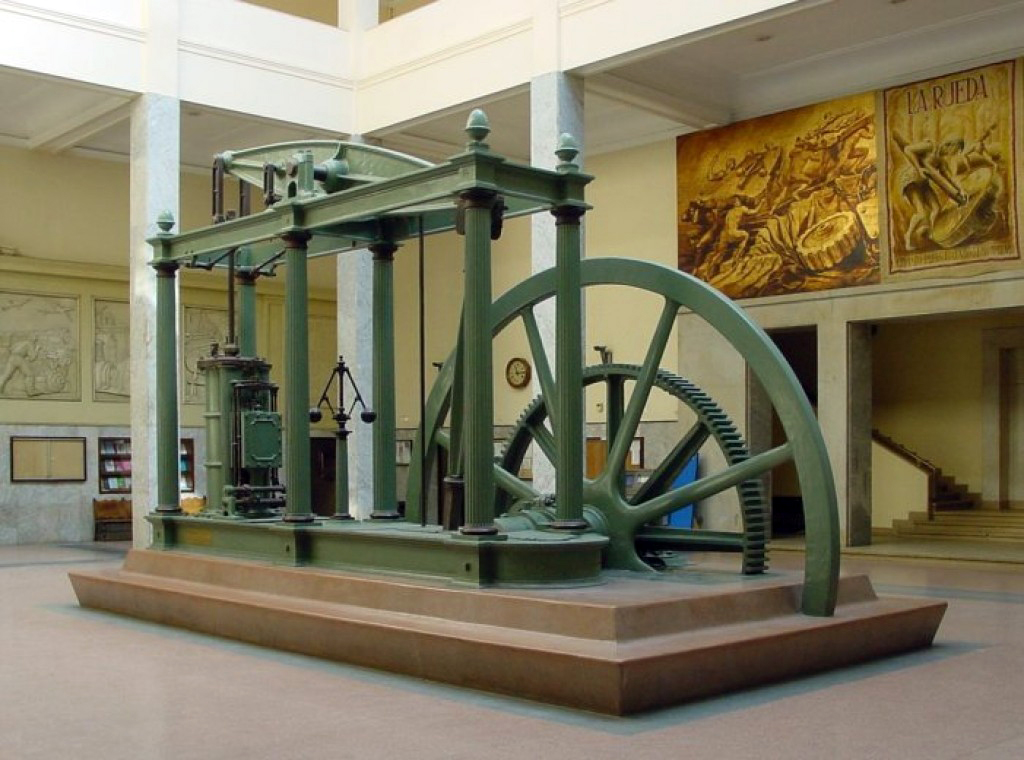
Watt steam engine

sources:
http://www.bbc.co.uk/history/0/20979973
http://en.wikipedia.org/wiki/Industrial_Revolution
http://www.historylearningsite.co.uk/coal_mines_industrial_revolution.htm
http://en.wikipedia.org/wiki/Newcomen_atmospheric_engine
http://en.wikipedia.org/wiki/Watt_steam_engine
http://en.wikipedia.org/wiki/Steam_engine

Tuesday, February 12, 2013

The Steam Engine

The Steam Engine
Will Harmon

The steam engine was a very important invention. The steam engine powered many things that were important to the people at that time, such as the train, the mill, and the boat. The steam engine came before the combustion engine, which used the some of the same basic principles. The steam powered idea is actually still used in nuclear power plants today. The steam engine was an invention important to the evolution of engines.

Some people recognize inventions by how they looked and what they did, not what they were made of. The train, a very significant invention, is an invention most people look upon as one of the greatest inventions of its time. What most people don't realize, however, is that the train is powered by the steam engine, which is definitely an invention that greatly surpasses the train in importance. The steam engine used in the train and the boat helped people travel much easier and much faster. Without the steam engine, none of these inventions would have ever been invented.

The steam engine was an advanced piece of machinery at its time. It consisted of two main parts: the steam-making device (the boiler) and the machinery. The boiler works by heating up the water so it turns into pressurized steam. The machinery is usually a piston or a turbine that uses the pressure of the steam to turn a shaft. Then, the turning motion of the shaft powers whatever it is connected to.
Here is a very simple diagram of how a steam engine in a train works.

Before the useful version(s) of the steam engine, various people had done experiments with the idea of steam powering something. One of these was the aeophile, a device described by the Greek mathematician Hero of Alexandria, which used a ball filled with steam where the steam shot out of angled tubes, rotating the ball. One of the first commercial steam engines was the water pump, first used in the late 1600's. The main era of the steam engine, however, was between the 1800's and the 1900's, when they were mostly used in trains and boats. The steam engine had many important uses back then and even now, when efficient high-tech nuclear-heated engines are in use.
A more complex diagram of how a nuclear reactor uses steam power today.

The steam engine changed how the world got around, used energy, and used resources. It was one giant step toward the way we are today. The steam engine sped up travel extremely fast, and it was a major convenience in many ways. Variations of the steam engine are even still in use today. Without the invention of the steam engine, the world would not be how it is today.


Works Cited
"External Combustion Engines." External Combustion Engine Lesson & Worksheet. N.p., n.d. Web. 12 Feb. 2013. <http://www.myschoolhouse.com/courses/O/1/142.asp>.
Gore, Albert. Our Choice: A Plan to Solve the Climate Crisis. Emmaus, PA: Rodale, 2009. Print.
"How Nuclear Power Works." HowStuffWorks. N.p., n.d. Web. 12 Feb. 2013. <http://science.howstuffworks.com/nuclear-power2.htm>.
"Steam Engine." Wikipedia. Wikimedia Foundation, 02 Oct. 2013. Web. 12 Feb. 2013. <http://en.wikipedia.org/wiki/Steam_engine>.

Thursday, February 23, 2012

The Effects of The Cotton Gin

            Change is inevitable in our world. People continue to invent great things that cause our world to change. Some of these inventions cause change for the better, and others cause change for the worse. Some inventors do both, without meaning to. When someone invents something revolutionary, they are usually trying to make life easier or better in some way. They have no idea that their invention could negatively affect peoples lives at all. 
One of those inventions is the cotton gin. When Eli Whitney invented it in 1794, all of the cotton owners agreed that it was a magnificent, revolutionary invention. It caused major changes in the cotton industry. People no longer had to pick the cotton seeds out of the cotton by hand, which was a very slow and tedious task. People could simply put the freshly picked cotton with the seeds in it in one end, turn the handle, and the cotton would come out the other end with no seeds in it! Although this may not sound very amazing to us, because of all of the incredible inventions from our time, this invention shaped more than just the cotton industry. Cotton could be separated 50 times faster with the cotton gin than by hand, which caused the industry to explode. 
For many families in the South during the 1790s, cotton was their livelihood. Children grew up on cotton plantations, and many would eventually become the owners. Families depended on cotton for their income. If I were growing up in a family like that, the cotton gin would have been an important, exciting invention for me. My family would be able to process cotton 50 times faster, and expand our plantation. But more cotton means more work. We would have to hire people to help us, and the only solution to that would be hiring slaves. 
    I and many other southern cotton owners were against slavery, but it was a tough decision to make. People had to support their families, and their only means of doing that was with cotton. Eli Whitney’s cotton gin caused such a massive explosion in the industry, that cotton owners had to keep up with everything by growing more and more cotton. They needed slaves to work in order to support their families. What would they do?


    Many people, even though they were against slavery, chose to give in and hire slaves in order to expand their plantation and support their families. More and more slaves were hired everywhere in the south. This affected all of their lives, and many people who were against slavery were forced to hire slaves.
     Although Eli Whitney’s cotton gin really was a revolutionary invention, there were some negative affects from all of this change. When Whitney invented the cotton gin, he most likely wanted to make it easier to process cotton. He did not expect that his invention could change so many people’s lives in good and bad ways. It is amazing that one invention could change so much.