Showing posts with label ballet. Show all posts

Friday, February 19, 2016

To Float Like a Swan


Ballet is amazing.  You can let go of all your worries and soar like a swan across the stage.  I have been dancing since I was 4 and currently dance at Portland Dance  School (Portland Festival Ballet).  Before class, I watch the trainees (they are very serious about ballet and do online school so they can do ballet all day) and I am entranced as they glide across the room leaping and twirling in their pointe shoes.  Ballerinas go through excruciating pain and hard work to get where they are, but some people just think ballerinas are fragile and that ballet is not brutal enough to be a sport.  A person at my ballet studio once performed 10 shows with 4 broken toes on one foot.  This shows endurance, dedication and determination.  Sometimes when I watch ballerinas flutter and float across the stage, I think about all of the other people who danced that role.  Who were they? Where did they come from?  Was ballet what did they did for a living?  I wonder about the first time a ballet was ever premiered and how someone even choreographed everything in it.   One ballet that initially failed and is now is one of the most popular ballets is Swan Lake.  
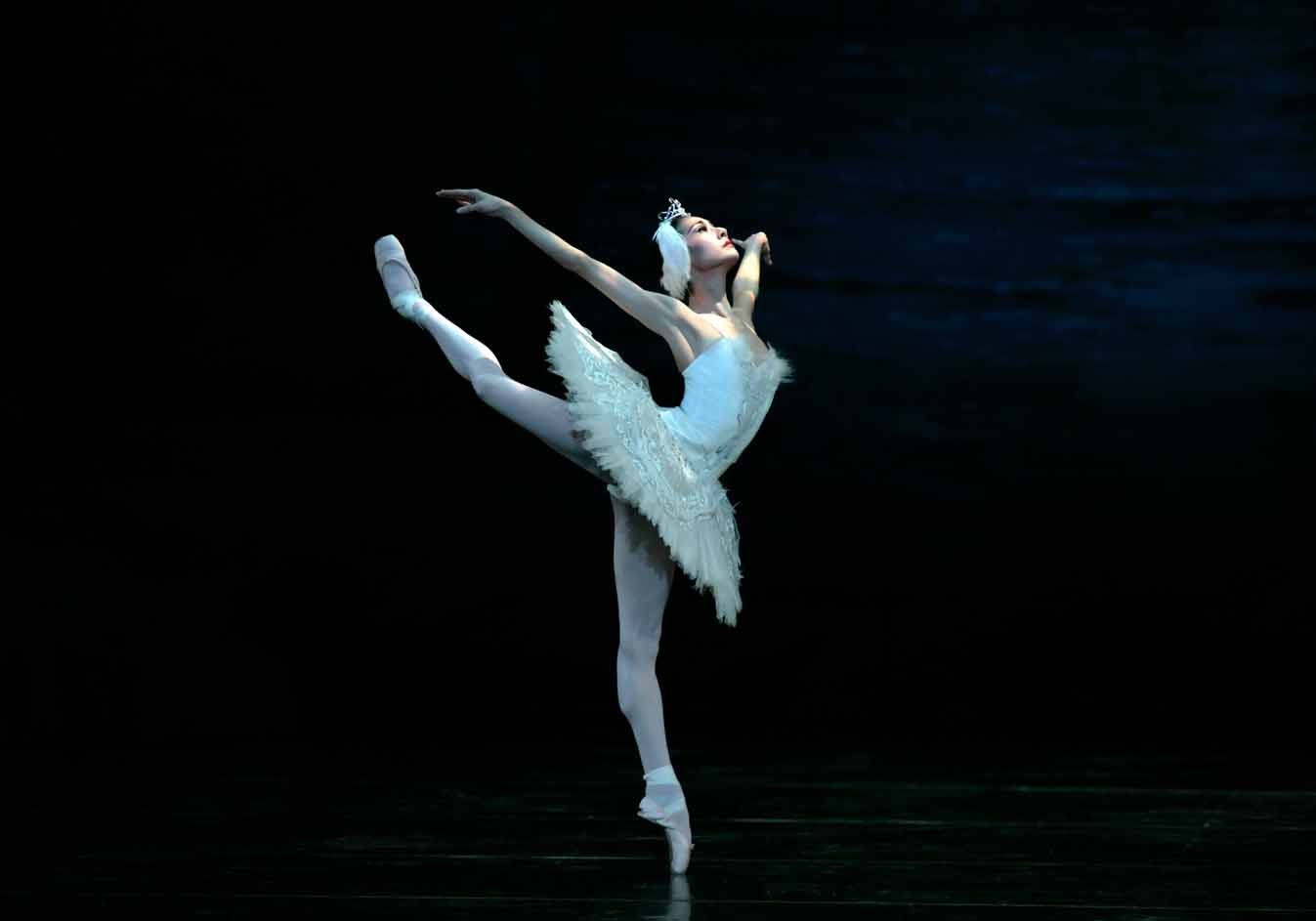
The music of Swan Lake was composed in 1875 - 1876 by Pyotr Ilyich Tchaikovsky.  Swan Lake tells the tragic story of a young princess named Odette, who was transformed into a swan by a curse casted by an evil sorceress.  On Friday, March 4, 1877, Swan lake was premiered.  The role of Odette was performed by Pelageya Karpakova (Polina Karpakova).  It was originally intended to be performed by Anna Sobeshchanskaya,  however she was removed from the performance after a governing official accused her of  receiving a few items of expensive jewelry from him, only to sell the items of jewelry for cash and marry a fellow danseur.  The premiere was not well-accepted, and there was almost unanimous criticism concerning the orchestra, the stage sets, and the dancers.  The “failure” of the production was said to be due to a few other reasons.  One issue was regarding German origins of  the Swan Lake story.   Another reason was that the ballerina that danced the role of Odette (and possibly Odile) was “not particularly convincing” and was a secondary soloist.
 During the early 1890s and late 1880s, Vsevolozhsky and Pepita were conversing with Tchaikovsky about reviving  Swan Lake.  Unfortunately, on November 6, 1893, Tchaikovsky died just when the plans for the revival of Swan Lake were about to be fulfilled.   As a result of the tragic death, Drigo had to revise the score by himself.  Two memorial concerts that were planned by Vsevolozhsky were given and yielded in honor of Tchaikovsky on February 1894.  In the production, the ballerina who danced as Odile and Odette was Pierina Legnani, the Italian virtuoso.  The revival prospect of  Swan Lake had been planned for Pierina’s 1894-1895 season benefit performance because of her amazing talent.  
Her performance during her début in Cinderella with the Imperial Ballet demonstrated her phenomenal technique.  During the grand pas, in her variation, she executed thirty-two or more fouettés en tournant (turns on one foot) which at that time that was the most ever performed.  At the beginning of  1895, on Friday January 27, the revised Swan Lake was premiered.  The premiére of  the revival was a huge success.  Today it is the revised Tchaikovsky’s score  that is used when many ballet companies perform Swan Lake.
There are so many talented ballet dancers who have come before us and future rising stars that will come after.  Many of them may have endured similar hardships and criticisms in the harsh world of ballet.  Now when I am on stage, I look out into the ocean of people in the audience and through the blinding stage lights, and wonder...


Sources:


  • http://24.media.tumblr.com/tumblr_mbl7rkbPTK1qmy8oho1_500.jpg
  • http://warmjello.com/wp-content/uploads/2015/06/misty-copeland-swan-lake-103.jpg
  • http://24.media.tumblr.com/tumblr_mbl7rkbPTK1qmy8oho1_500.jpg

Tuesday, January 27, 2015

So, whats the Pointe?


So, whats the Pointe?


A pointe shoe is a complex piece of equipment. It may not seem so at first, because on the surface, you see everything we want you to see: effortlessness, elegance, grace, all wrapped up in the light pink satin of the shoe. But if you look closer, you'll see there's much more to it than just a pretty shoe. The inside of the shoe is lined with layers of plaster and netting as well as hard plastic, suede and canvas. It is built this way to support the weight of the dancer. Pointe shoes are one of the most important aspects of the female dancer’s life. I know this from experience. I may not be a principal dancer at New York City Ballet, but I know what it’s like to depend on a pair of pointe shoes, so that is what I am here to talk about today: Pointe shoes, and what I’ve learned from them so far.

Thursday, February 13, 2014

Ballet in Revoltionary Times

Ballet in Revolutionary Times
by Rowan Treece
Louis XIV in an original costume
Ballet, as we know it, began in the court of Louis XIV in the 1640s. It flourished under his attention, and he opened the first organized ballet school, The Royal Academy of Dance, in France. He was a great fan of ballet, a performer and student himself, and often put on lavish performances for his court, sometimes 12 hours long with magnificent sets, costumes and music. As ballet transitioned from the court to the theatre, it became intertwined with opera, often having ballets staged between the acts. In the build up to the French Revolution, ballets and operas were used as propaganda for the “New France” that the revolution promised. When the revolution began however, in 1789, the opera and the ballet were shut down and the performers were safeguarded with the King and his court. When the theatre reopened in 1837, it marked a new age in the development of ballet throughout Europe. 

A promotional picture for an old ballet
1837- 1870 is considered the romantic period of ballet. During this time, Jean-Georges Noverre, a noted choreographer and teacher in France, created l’ballet d’action, or the ballet of action, known to us now as the story ballet. These ballets were no longer extravagant but pointless ramblings with no definitive plot, but instead took their origins from Latin pantomimes and folk tales. He professed that ballets should unfold through dramatic movement and relations between characters. He encouraged artistic development, refined costumes, capitalization upon natural talents, relevance of the set, music and lighting to the story, and the logical development of the story. He revolutionized the training of dancers by changing the entire point of the performance. He made ballet an art, instead of a display of wealth and royalty.
While this was happening in France, ballet grew all over Europe. Marius Petipa, a French dancer, choreographer, and teacher, choreographed arguably the most long lasting, well known and influential ballets to ever grace the stage, with the help of Lev Ivanov, for the St. Petersburg Imperial Theatre in Russia. His most enduring works are the first versions of  Le Corsaire, Giselle, La Esmeralda, Coppélia, La Fille Mal Gardée (with Lev Ivanov), and Swan Lake (with Lev Ivanov), all of which have been remade “after Petipa” many times. The most recent of these reproductions was by a pair of Russian figure skaters in the ice dancing competition in Sochi at the Olympics. They skated in the theme of Swan Lake, though obviously not at all like the ballet. 
Modern Swan Lake
During the 18th and 19th centuries, ballet became a central social point in both courts and theatre, and created lively cultural exchange in places such as Venice, in the famed Teatro San Benedetto, Spain, Portugal, Poland, Germany, and Hungary. Ballet schools sprang up in many different places, and the theatre became a high class locale. Ballet continued to develop but the foundation was set to place ballet as a high art in the modern world. But it’s not over yet. To this day, ballets are performed throughout the world by thousands of companies and schools, new ballets are created, ballet is fused with other dances and arts, it addresses social issues and modern problems, it continues to grow. The art that began in the revolutionary times will outlive us all.

Monday, February 18, 2013

Swan Lake

The Revolution of Swan Lake
By Gracie Rosenheim


            Swan Lake is one of the most well known ballets through out the world, and yet very little people know the history about it. In the late 1800s Poytr Ilyich Tchaikovsky composed music for many famous ballets, Swan Lake being one of them. The music contained many different tempos and sounds, but the music still flowed beautifully throughout the theatre. Once the music was composed, the ballet was soon choreographed by Julius Reisingner. He choreographed a full four acts, adding up to a total of three hours. Every other act, he went from the castle, then to the lake, and then to the castle again, and finally ending the show at the lake where Odette, the white swan, dies.    
            In the first act, Prince Siegfried is celebrating his birthday with                    
his tutor, friends, and peasant people. Every one at the party is having a wonderful time until the Queen comes to the party, with four ladies in waiting. She gives him a wooden cross bow for a birthday present, and tells Prince Siegfried that he must marry one of the ladies in waiting. The prince doesn't agree with what his mother says, which makes her leave. As she is walking away, she tells him the he must choose a bride before the royal ball the following evening. Once she leaves, the party continues, and the peasants dance along with the waltz couples. Slowly the guests start leaving, until only Prince Siegfried and his friends are with him. They see a flock of swans flying over head, and decide to take the Prince's new cross bow out, and go hunting for the swans.
            When act two begins, the Prince has been separated by his                friends. He finds a clearing by a lake, and decides to stay there. As he is waiting, the flock of swans he saw earlier, lands nearby the lake. He aims his cross bow at one of the swans, but freezes up when it turns into a beautiful lady. At first, the lady is terrified that he will hurt her, but when he says that he won't, she tells him that her name is Odette, and she is the Swan Queen. She explains to him that she and the other swans have been cursed by an evil sorcerer Van Rothbart, to be swans by day, and humans at night. She tells him that the only way the curse can be broken, is if someone who has never loved anyone else before promises to love her forever. As the night passes on, Siegfried soon realizes how powerful love is, and how much he loves Odette. It soon becomes dawn, and Odette and the other ladies turn back into swans.
            In act three, the guests are arriving at the royal ball. The queen has invited six princesses for Prince Siegfried to dance with, and after the last dance, he must choose one of the princesses to be his bride. The Prince dances with each bride, but he had no interest in it, because his heart is still set on Odette. The queen insists for him to choose a bride, but they get distracted when two unknown guests appear at the party dressed in black. The guests turn out to be Von Rothbart who transformed himself into a more dignified looking person, and his daughter Odile who is disguised as Odette. Once the guests from Spain, Italy, Russia, and Hungary dance for the court, Odile tries to trick Siegfried into betraying Odette. A reflection of the real Odette is shown upon the window to warn him to not get tricked by Odile, but Siegfried is so spellbound by Odile, so he declares to the guests that he will marry Odile. Triumphantly, Van Rothbart and Odile show Siegfried his betrayal to Odette. In shock, the Prince runs out of the castle in search of Odette.
             In the last act, Siegfried returns to the lake during a terrible storm created by Van Rothbart. Siegfried searches for Odette through the storm, and finally finds her. He begs for her forgiveness, but although she forgives him, there is nothing that can be done. Odette will remain a swan forever. Odette's heart has been broken, she knows that she will be sad forever, so she decides to die.
             For almost two-hundred years Swan Lake has been performed through out the world. But why is it still so popular? It is such a popular ballet, because it's not like any other love story. Every love story ends with a Prince marrying a Princess, but Swan Lake is one of the only love stories where the love ends up to be forbidden.  Swan Lake shows that even if you can have anything in the world, you can't always have love.    


SITES: 
"Swan Lake." Wikipedia. Wikimedia Foundation, 16 Feb. 2013. Web. 18 Feb. 2013.
Swan Lake. 16 Feb. 2013. The Oregon Ballet Theatre's Swan Lake program. The Keller Auditorium, Portland, OR.
"Google." Google. N.p., n.d. Web. 18 Feb. 2013.
"Criticaldance Ballet-Dance Magazine: Oregon Ballet Theatre Swan Lake Review."Criticaldance Ballet-Dance Magazine: Oregon Ballet Theatre Swan Lake Review. N.p., n.d. Web. 18 Feb. 2013.


Tuesday, February 5, 2013

Tchaikovsky and The Nutcracker

Sterling Hyltin as The Sugarplum Fairy and Andrew Veyette as her cavalier
in "George Balanchine's The Nutcracker (TM)" as part of NYCB 

Every year in December, thousands of dancers put on costumes and take their places backstage for the top of the one of the most legendary ballets of all time. This is the show they have been preparing for since September, the Nutcracker.


Pytor Ilych Tchaikovsky
The Nutcracker is the story of a girl named Clara, who at her family’s annual Christmas party gets a Nutcracker. That night, at midnight, she is attacked by rats and their rat king, but her Nutcracker and her brother Fritz’s toy soldiers come and defeat the rats. She is then transported through a land of dancing snowflakes to the Land of Sweets where the Sugar Plum Fairy and her attendants dance for her and the Nutcracker. Pytor Ilych Tchaikovsky, a famous composer, wrote the score these dancers dance to.  Born May 7, 1840 in Votkinsk, Russia, he grew up with four brothers, a sister, and a half sister. He composed many symphonies, operas,  concertos, ballets, and chamber music pieces in his time. His famous ballets besides the Nutcracker include Sleeping Beauty and Swan Lake. He died in St. Petersburg in November 6, 1893. He was the first Russian composer to be internationally known.

Me as a party girl this year
Tchaikovsky’s music was so popular at the time because of it’s emotion. He composed pieces that were happy, and you wouldn’t forget. He made people feel what was going on onstage, helping to move the scene along. The emotion is what makes us want to see his ballets like The Nutcracker over and over again, giving us that holiday cheer every time.

There are many different versions of the Nutcracker, the original being Marius Petipa’s and the most common now being George Balanchine's. With these varying choreographies there are many different names of parts with different ages dancing the roles. George Balanchine’s version has the little angels, the party children, the soldiers, Marie, the Nutcracker, the polichinelles, the candy canes, and the girl chinese soloists, and the maids as students, with the company dancers dancing the parts of snow, flowers, party parents, rats, spanish, arabian, marzipan, dewdrop, leads, and sugar plum fairy and her cavalier.

In September, while the rest of the world is enjoying the remains of summer, many ballet dancers are already listening to the well-known music of Tchaikovsky's Nutcracker, learning choreography, getting selected for roles. The Nutcracker auditions usually occur in late August to early September, with choreography starting anytime from September for students to November for professionals. The life of a ballet dancer is a busy one, most dancers 6th grade and up dance at least 6 hours per week, if not more. As the Nutcracker draws nearer, the hours of rehearsal increase, accumulating at Dress Rehearsal which can be 8 to 12 hours. Costumes arrive from October to November, their beauty showing the seamstress’s love for the show.

Me and two friends backstage
ready for flowers
While many may guess that backstage is quiet, and everyone is waiting in the wings to come on, anyone who has been there knows that this is not the case. Crazy quick changes, stressed directors, and dancers going every direction to get where they need to be is a very normal backstage. That’s not counting the broken costume or missing pointe shoe that usually takes place. The dressing rooms is where most dancers spend the bulk of their time backstage. There is usually one large dressing room per part or two parts for the dancers in the school, and one small dressing room for one or two dancers per room for company. Here is where dancers stay when not onstage or close to going on. People play card games, watch movies, play on iphones and ipads, warm up, stretch, goof off and choreograph dances.

I have been in The Nutcracker seven times and they have all been amazing. I have so many memories that I won’t share now, I have laughed, cried, nearly puked, been nervous, fallen flat on my face, gotten in trouble, but above all, had some of the most fun I ever had.

The Nutcracker is an annual Christmas tradition for many, whether backstage, onstage, or in the audience. It has warmed many hearts in its time, Tchaikovsky's music aiding this. For me, it is truly the most wonderful time of the year, and my many performances of it I will always keep near me. It is beyond doubt, a wonderful show.


Credits
http://www.exploredance.com/article.htm?id=1655 for George Balanchine's Nutcracker picture
Anna Rigles and Classical Ballet Academy for the picture of Olivia Andersen in passé ( www.classicalballet.net )