Showing posts with label teaching. Show all posts

Wednesday, August 5, 2015

Keyboard or Pen wasn’t the Question


It isn’t often I tackle “prevailing wisdom,” but this is one of those moments. While Pam Mueller and Daniel Oppenheimer certainly created a catchy title, The Pen is Mightier than the Keyboard, they omitted an extremely important fact–that note taking is an art to be taught and practiced. Maggy McGloin, writing in the HarvardBusiness Review, is perpetuating the omission, and, since the Harvard Business Review carries a certain cachet, I’m prepared to begin my journey. Thanks to Alfie Kohn for giving me the courage to speak. I was a huge fan and ardent practitioner of assigning homework to middle school students. After reading and thinking about Kohn’s work, I no longer assign nightly homework, opting instead to allow my students time to pursue their own hobbies and interests. But, I digress.

Mueller and Oppenheimer discovered that students who take notes on laptops often engage in mindless transcription. I have no doubt this is true. Learning to take notes requires practice and frequent reminders from instructors, teachers, and coaches. Educators already know we need to teach how to highlight material in texts. Left to their own devices, younger students develop the habit of highlighting anything they don’t know. They often try using different colors of highlighters for different pieces of information. Students tell me they use blue for new vocabulary, yellow for new facts, pink for new dates, etc. While their texts are quite colorful at the end, students don’t really absorb material and have no clue how to use the highlighted passages to study for quizzes or tests. Sports coaches give near constant feedback to athletes beginning in middle school. High school and college coaches continue this practice. How many high school teachers or college professors review individual student notes prior to midterms or unit exams?
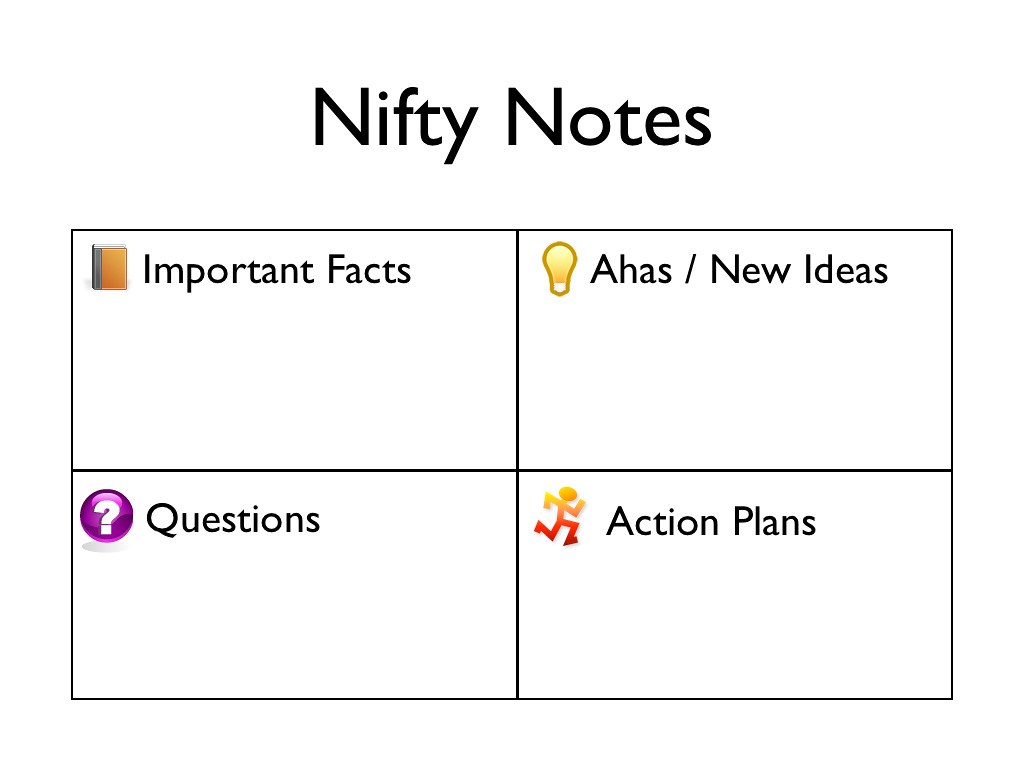
Note taking sheet
Learning to take notes requires the same focus and attention as learning to highlight text. Teachers use strategies such as the New AmericanLecture, Cornell Notes, and a host of others to help students learn how to take notes effectively. I find that I have to continually remind students to use organizers when taking notes. In middle school, I often give students organizers that have three bullets in each of four boxes. Students are instructed not to exceed three bullets.  Other times, I will use up to five bullets. The point is that students need note taking parameters. Left to their own devices, I agree with Mueller and Oppenheimer, students will mindlessly transcribe.

Part of my curriculum involves students taking notes while viewing videos. In order to reduce the temptation to transcribe the video, I send the students a link to a video transcript. They immediately understand they do not need to retype the transcript. It is available to them anytime they need it. Teaching note taking requires the same skills as teaching any other concept. Students need an introduction, opportunity to practice, and some form of feedback loop.

The question Mueller, Oppenheimer, and McGloin should have asked their college students is what note taking method they used and why they chose it. When I ask seventh graders this question, many reply they have no organized method, they just write bullets. I teach at least three methods of taking notes in my class. We begin with Cornell, outline, and mind mapping (mapping.)  I review which methods helped students and by the end of the year, I ask them to choose the method they have found the most helpful.
Students do not automatically remember these methods from year to year or class to class or even unit to unit within the same class. The temptation to revert to a new bullet for every note and mindlessly transcribe is often too great to resist. The reason note taking methods, even just longhand, work is that students have to mentally analyze and evaluate information prior to writing/typing it. Every teacher from middle school to university needs to instruct and remind students how to take useful notes.

Taking notes on a laptop is far more useful than longhand if taught and practiced correctly. Laptop notes can be annotated, tagged, re-used, shared with study groups, and, when cited correctly, become the basis for research articles, class papers, and essays. Electronic notes also encourage reorganizing, further research, etc., that both enhance and extend learning. Part of my teaching note taking methods involves students coming to class with at least three questions generated from their notes. These become the basis for a quick review/discussion. Muller’s and Oppenheimer’s study do not indicate any follow up other than a quiz.


Longhand notes might work well in the short term, either for a unit or a single class. Electronic notes will last longer and be far more useful provided students are taught/reminded that there has to be a method to their note taking. Mindless transcription is not a method, just as mindless text highlighting is not actively reading. Students should be explicitly coached how to take notes and encouraged to use the methods they have learned.  Pam Mueller agrees and, in a follow up interview, concludes, “Ultimately, the take-home message is that people should be more aware of how they are choosing to take notes, both in terms of the medium and the strategy.”  The question isn’t pixel or pen. It is which note taking method will help me learn and retain this material?


Image sources:
Keyboard & Pen
Nifty Notes
What's so Simple about Note-Taking
Keyboard toolbox


Tuesday, February 12, 2013

The Storming of the Bastille and the Estates

Everybody has, at some point in their lifetime, heard of the Battle of Waterloo, and the fight at Gettysburg during the Civil War. Have you, however, heard of the Storming of the Bastille, and of all of the brave citizens who dared defy the higher classes? Of the unfair system of social rank, or the Third Estate? To know more about these answers, we must first go back and learn what the Estates are.

The estates were sort of like social classes, with the third being the lowest, and the first the highest. The Third Estate was by far the majority, it was 95% of the population. If France were our middle school, out of the roughly 200 students, only about ten would be in the upper two classes. Servants, skilled and unskilled workers, serfs, storekeepers, and laborers were all part of the Third Estate. However, it didn't only consist of slaves and serfs, also doctors, lawyers, and teachers. These people were the very backbone of the nation. They payed the biggest share of the taxes, even though they had few privileges and almost no say in governmental decisions. It wasn't until the Estates-General was formed that the Third Estate began to have a voice in the government, but even then, they would lose by vote of two to one.


The First Estate is mainly made up of members of the Church, and religious leaders. People believed that God gave a hierarchy to them, and a luxurious life to religious men who lived under God. They represent a minuscule 1% of the people of France, or two people out of the 200 in our middle school. This small minority owns one-tenth of the land, however! These people enjoyed many privileges, including not having to pay taxes. Nevertheless, most of the people of the First Estate weren't corrupt and rich, but relatively poor and well meaning. Many also knew they had unfair privileges. 


The Second Estate consisted of nobility and royalty, other than the monarch, who stood outside of the estates system. Owning from 25-30% of all the land of France, they had no shortage of places to live. They enjoyed many of the same privileges as the First Estate, and collected rent from the peasants who lived on their land, allowing them to live a very lavish lifestyle. Often, people from this estate joined the Church and moved up to the First Estate. Women were also born into either the Second or Third Estates, but were also labeled with the 'feminine estates': either a virgin, a widow, or a wife. 
Bernard René de Launay


The people of the Third Estate felt like they were being treated unfairly, and their lives were being controlled by the government. A very iconic building of the government was the Bastille. The Bastille was a fortress, serving as a prison located in Paris. Around 30,000 pounds of gunpowder were stored in there, in order to prevent citizens from acquiring arms. A very secure place, the Bastille was very important, and seen by many every day, reminding them of the power of the government. At the time, the governor of the Bastille, proving to be a very important character in the later invasion, was named Bernard René de Launay, son of the previous governor. He was actually born inside Bastille walls, and died protecting them.

During the reign of Louis XVI, France fell upon a major economic crisis, partially because of France's intervention in the American revolution. France attempted to solve its money problems by severely taxing the citizens of the Third Estate. This caused the Third Estate to get extremely angry, only worsening conditions. The government got nervous and posted extra guards to the eighty-four guards already at the Bastille. Eventually, a small group of demonstrators from the twenty-four million strong Third Estate decided to attack the Bastille in Paris.

On July 14, 1789, hundreds and hundreds of peasants, doctors, writers, shopkeepers, and other unified near the Bastille. They had previously stormed the Hôtel des Invalides to gather 31,000 muskets, yet without powder or shot, and now were trying to acquire the 30,000 pounds of gunpowder in the Bastille. There were only seven prisoners there at the time, but the taking of this fortress would be a huge step. The 954 people gathered outside the gates, calling for the surrender of the prison, the removal of the cannons stationed on the wall, and the release of the prisoners and the gunpowder. Anticipating a response, the crowd's hopes rocketed when the governor admitted two negotiators. They stayed inside until noon, and then the people began to get restless and frustrated. Another half an hour later, the now furious mob charged the fortress. 


With whatever weapons the group could find, like a seething, unstoppable wave, they advanced, venting all their rage into this moment. Charles Dickens' A Tale of Two Cities describes this scene immaculately. "With a roar that sounded as if all the breath in France had been shaped into the detested word, the living sea, wave on wave, depth on depth, and overflowed the city to the point. Alarm-bells ringing, drums beating, the sea raging and thundering on its new beach, the attack began. Deep ditches, double drawbridge, massive stone walls, eight great towers, cannon, muskets, fire and smoke. Through the fire and through the smoke-in the fire and in the smoke, for the sea cast him up against a cannon, and on the instant he became a cannonier..." By 3:00, new reinforcements came to the brave attackers; “gardes françaises,” who came along with two cannons, making the guards not the only ones with weapons.

Meanwhile, a substantial force of Royal Army troops were camped very nearby on the Champs de Mars, yet they didn't intervene. The fighting continued, a desperate reach for freedom, 954 courageous humans attacking an enormous fortress, the Bastille. 

Finally, at 5:30, July 14, 1789, Governor de Launay surrenders and opens the gates to the very inner courtyard, and the victorious mob swept into the core of the Bastille, concluding a successful yet hard-fought battle. 98 attackers died, and only one guard during the battle, but afterwards the people of the Third Estate took their revenge upon the guards, and killed many more. 


De Launay was dragged onto the streets from the fortress, and into a nearby tailor shop, where discussions about his fate began. Finally, he exclaimed, "Enough, let me die," but not before kicking an angry pastry chef named Dulait in the groin. Governor de Launay was repeatedly stabbed, shot, and kicked by the frothing, rabid, and furious mob, not yet satisfied with their victory. Finally, Bernard René de Launay's head was sawed off viciously, and triumphally set on a pike. The mob marched throughout the streets of Paris, showing off the beheaded face of the Governor, as well as the other dead guards.

Although this ending may seem unnecessarily violent, imagine a single man controlling your entire life, living above you, living with money and privileges, living a luxurious life while you starve on the streets. Living back then, you would have done the same! After the battle, the 954 heroes who stormed the Bastille would be forever remembered with the creation of an important holiday in France. Called Le Quatorze Juillet (14th of July), formally known as the Fête de la Fédération (Federation Holiday), and called Bastille Day in English, it celebrates the storming of the Bastille and the act of the Third Estate against the higher government for a greater, overall good.


Monet's depiction of Bastille Day
My family and I traveled to France this year before our annual visit to Hungary. We first stayed in Paris for a couple of nights - I mean, if you go to France, who doesn't stop in Paris - and then traveled to Corsica (incidentally where Napoleon Bonaparte was born). We were in Paris from July 12 to July 16, so we had the luck of being there for Bastille Day. It's treated similarly to the Fourth of July here in the U.S., what with fireworks, parties, and dancing. Bastille Day is also celebrated in many countries, such as Hungary, New Zealand, Belgium, England, and even here in Portland! On Champs Élysées, thousands of seats are set up along the street, for the citizens to view the soldiers marching, and the long military parade. Also on Champs-Élysées, hundreds of flags are raised to celebrate the event, accompanied by spectacular fireworks by the Eiffel Tower. We didn't get to go see the parade, the crowds must have been overwhelming, but at home we lit some fireworks with our host family, which was also a lot of fun!


While we were in France, I learned how much France's history affects every-day life, yet how different living in Paris must have been from how it is now. No matter which estate you were or are in, no matter whether you were there for the storming of the Bastille or not, whether you live in France or in Uruguay, everyone can reflect and be amazed and affected by the French history in 1789; everybody can continue to be inspired by what drove those attackers, the same inspiration many of us draw from every single day.


Works Cited:

"Estates of the Realm." Wikipedia. Wikimedia Foundation, 31 Jan. 2013. Web. 10 Feb. 2013.

"The Estates." ThinkQuest. Oracle Foundation, n.d. Web. 10 Feb. 2013.

Dickens, Charles, Hablot Knight Browne, and Frederick Barnard. A Tale of Two Cities,. New York: Dodd, Mead &, 1942. Print.

"Google Images." Google Images. N.p., n.d. Web. 10 Feb. 2013.

"How Do You Pronounce Bastille?" Yahoo! Answers. Yahoo!, n.d. Web. 10 Feb. 2013.

Karpiel, Frank, Kathleen Krull, and Grant P. Wiggins. MyWorld History. Boston, MA: Pearson, 2012.

My mom

My camera (the pictures at the end are mine)

"Storming of the Bastille." Wikipedia. Wikimedia Foundation, 02 Nov. 2013. Web. 10 Feb. 2013.

"The Three Estates." The Three Estates. N.p., n.d. Web. 10 Feb. 2013.


Some pictures from our visit to France: 


The beach in Corsica
The view from our little house in Corsica


Paris as seen from the Eiffel Tower (The line is so long!)
The Seine River as seen from the Eiffel Tower