Showing posts with label History. Show all posts

Wednesday, February 8, 2017

Flipping the Pages Through History

Flipping The Pages Through History

Stephen King, an author of many books, once quoted,“Good books don’t give up all their secrets at once.” Each and every book written, published and read has it’s own story with a secret hidden, but what about the history of books? After reading a few books and learning about revolutions throughout history, I wondered how books evolved too. The process of books took many forms as technology and resources increased. A few forms of the first books in history were storytelling, painting, and writing. Each style had its own significance to the many cultures of which the story was created.


The first structures of books were painting and storytelling. Painting may not seem like a story, but if you look closer, the art almost seems like it’s telling a tale. An example where art takes the place of books is cave paintings, almost like a picture book on a stone wall. Besides drawing, storytelling was commonly used as well. In the olden days and even today, people have shared stories verbally. Telling stories in native languages, and passing them through generations of their people. The stories were told from the elderly to young adults and to children. One story that was told was “The Epic of Gilgamesh”. Over time, this story has changed and today, they have a few written copies.

One form of the earliest books made in history is the Bible. It was the first book to be made with parchment paper. Another one of the Bible’s earliest appearance were on paper scrolls. The Bible was full of many stories that happened throughout the beginning of history. An early use of the Bible was in Christian churches. Even the today, the Bible takes an important role not only in Christianity, but in many other religions around the world such as Catholic. Before paper was an available resource, in many places such as ancient Greece, they wrote on stone tablets. They also wrote stories and some of them being about the ancient Greek Gods such as Poseidon, Zeus, Hades and so many more.


After researching about the history of books, I feel like I have found one of the many secrets that books keep. In today's world, our skills have improved and our resources have increased. There are many books to read now in many different genres such as fiction, nonfiction, mystery, fantasy, the categories are countless. Most books nowadays are typed, printed and bound together into what we call books. In the future, I have considered becoming an author and writing many books for anyone of any age. I'm currently writing a novel called "The Shadows We Fear". It's about Victoria, a newly crowned princess, and how she must voyage across the deep blue sea to ask peace of her kingdom from their gods. Victoria also encounters many obstacles along the way. Stories have been such an important piece to human history. If you long to know a secret of books, just keep flipping the pages through history. I’m sure that the stories are hidden somewhere.

Links:


Monday, February 18, 2013

Swan Lake

The Revolution of Swan Lake
By Gracie Rosenheim


            Swan Lake is one of the most well known ballets through out the world, and yet very little people know the history about it. In the late 1800s Poytr Ilyich Tchaikovsky composed music for many famous ballets, Swan Lake being one of them. The music contained many different tempos and sounds, but the music still flowed beautifully throughout the theatre. Once the music was composed, the ballet was soon choreographed by Julius Reisingner. He choreographed a full four acts, adding up to a total of three hours. Every other act, he went from the castle, then to the lake, and then to the castle again, and finally ending the show at the lake where Odette, the white swan, dies.    
            In the first act, Prince Siegfried is celebrating his birthday with                    
his tutor, friends, and peasant people. Every one at the party is having a wonderful time until the Queen comes to the party, with four ladies in waiting. She gives him a wooden cross bow for a birthday present, and tells Prince Siegfried that he must marry one of the ladies in waiting. The prince doesn't agree with what his mother says, which makes her leave. As she is walking away, she tells him the he must choose a bride before the royal ball the following evening. Once she leaves, the party continues, and the peasants dance along with the waltz couples. Slowly the guests start leaving, until only Prince Siegfried and his friends are with him. They see a flock of swans flying over head, and decide to take the Prince's new cross bow out, and go hunting for the swans.
            When act two begins, the Prince has been separated by his                friends. He finds a clearing by a lake, and decides to stay there. As he is waiting, the flock of swans he saw earlier, lands nearby the lake. He aims his cross bow at one of the swans, but freezes up when it turns into a beautiful lady. At first, the lady is terrified that he will hurt her, but when he says that he won't, she tells him that her name is Odette, and she is the Swan Queen. She explains to him that she and the other swans have been cursed by an evil sorcerer Van Rothbart, to be swans by day, and humans at night. She tells him that the only way the curse can be broken, is if someone who has never loved anyone else before promises to love her forever. As the night passes on, Siegfried soon realizes how powerful love is, and how much he loves Odette. It soon becomes dawn, and Odette and the other ladies turn back into swans.
            In act three, the guests are arriving at the royal ball. The queen has invited six princesses for Prince Siegfried to dance with, and after the last dance, he must choose one of the princesses to be his bride. The Prince dances with each bride, but he had no interest in it, because his heart is still set on Odette. The queen insists for him to choose a bride, but they get distracted when two unknown guests appear at the party dressed in black. The guests turn out to be Von Rothbart who transformed himself into a more dignified looking person, and his daughter Odile who is disguised as Odette. Once the guests from Spain, Italy, Russia, and Hungary dance for the court, Odile tries to trick Siegfried into betraying Odette. A reflection of the real Odette is shown upon the window to warn him to not get tricked by Odile, but Siegfried is so spellbound by Odile, so he declares to the guests that he will marry Odile. Triumphantly, Van Rothbart and Odile show Siegfried his betrayal to Odette. In shock, the Prince runs out of the castle in search of Odette.
             In the last act, Siegfried returns to the lake during a terrible storm created by Van Rothbart. Siegfried searches for Odette through the storm, and finally finds her. He begs for her forgiveness, but although she forgives him, there is nothing that can be done. Odette will remain a swan forever. Odette's heart has been broken, she knows that she will be sad forever, so she decides to die.
             For almost two-hundred years Swan Lake has been performed through out the world. But why is it still so popular? It is such a popular ballet, because it's not like any other love story. Every love story ends with a Prince marrying a Princess, but Swan Lake is one of the only love stories where the love ends up to be forbidden.  Swan Lake shows that even if you can have anything in the world, you can't always have love.    


SITES: 
"Swan Lake." Wikipedia. Wikimedia Foundation, 16 Feb. 2013. Web. 18 Feb. 2013.
Swan Lake. 16 Feb. 2013. The Oregon Ballet Theatre's Swan Lake program. The Keller Auditorium, Portland, OR.
"Google." Google. N.p., n.d. Web. 18 Feb. 2013.
"Criticaldance Ballet-Dance Magazine: Oregon Ballet Theatre Swan Lake Review."Criticaldance Ballet-Dance Magazine: Oregon Ballet Theatre Swan Lake Review. N.p., n.d. Web. 18 Feb. 2013.


Thursday, February 14, 2013

Tycho Brahe


Tycho Brahe was an astronomer during the late 1500’s who created new, more accurate devices for observing planets. He created the idea of a geo-heliocentric universe, because his observations of the planets created a new pattern of how the planets move. Since he created this new idea he got shunned because this went against the Bible and what people believed at the time.  His new idea might have been the reason for his death. Tycho Brahe had some really big ideas and helped many of the astronomers after him.

Tycho's geo-heliocentric idea was one of the first steps closer to finding the true orbits of the planets. In the geo- heliocentric model the sun and the moon orbit earth and all of the other planets orbit the sun. Although this idea was incorrect, it was a step closer to finding the orbits. He created new instruments to use that were more accurate in observing the planets. Tycho’s new idea of planetary motion was incorrect but was closer than it was before.
Tycho’s idea that the planets were geo-heliocentric was a completely new idea and because it was so new people tried to ignore his ideas. The idea also went against the Bible so he got shunned by churches as well. People might have tried to cut him out because his ideas were so new and they didn’t understand them and how this would work. If they would have listened to him  then they might have understood his idea and agreed with him.
Though some people shunned him, others may wanted his ideas to the point of killing him. On October 24, 1601 Tycho died of a suddenly contracted bladder or kidney ailment after a banquet in Prague. A couple years ago scientists thought that it was not from bladder problems but from mercury poisoning which they thought might have been done by Johannes Kepler because he wanted his work. However in 2012 scientists returned and discovered that it was probably a burst bladder because there was not enough mercury for it to be lethal.

During Tycho’s time he was treated poorly and in a way bullied. What I can’t believe is that he stood up to thousands of people, and kids can’t stand up to a bully. Bullying is a really serious thing and no one should be a bully. Even if someone is just trying to be funny sometimes they can hurt feelings. The thing is, when this happens no one will stand up to them. I think that kids don’t stand up to them is that they think that they won’t make a difference or they will get bullied to. If everyone stands up to a bully then there won’t be bullies any more.
During the scientific revolution many of the scientists were “bullied” for their new ideas; though they had different reasons when compared to the average bully today, the scenario is similar. Though the scientists usually stood up for their idea and kids today usually back down. I hope that people stop being bullies, but also that people stop backing down to them. If people stopped backing down to them, and instead telling them that what they are doing is wrong, then maybe people would stop being being bullies.
In the end Tycho Brahe was a important astronomer during the scientific revolution. He made a lot of important discoveries during his time. Tycho also improved a lot of equipment and stood up for what he believed, even though so many doubted him and told him that he was wrong. He was not the only only scientist that stood up for what he believed in. He is a great example of fighting for what you believe in.


Sources:
"Tycho Brahe." Wikipedia. Wikimedia Foundation, 02 Dec. 2013. Web. 14 Feb. 2013.
"Tycho Brahe Quotes." Rugu RSS. N.p., n.d. Web. 14 Feb. 2013.

Tuesday, February 12, 2013

The Storming of the Bastille and the Estates

Everybody has, at some point in their lifetime, heard of the Battle of Waterloo, and the fight at Gettysburg during the Civil War. Have you, however, heard of the Storming of the Bastille, and of all of the brave citizens who dared defy the higher classes? Of the unfair system of social rank, or the Third Estate? To know more about these answers, we must first go back and learn what the Estates are.

The estates were sort of like social classes, with the third being the lowest, and the first the highest. The Third Estate was by far the majority, it was 95% of the population. If France were our middle school, out of the roughly 200 students, only about ten would be in the upper two classes. Servants, skilled and unskilled workers, serfs, storekeepers, and laborers were all part of the Third Estate. However, it didn't only consist of slaves and serfs, also doctors, lawyers, and teachers. These people were the very backbone of the nation. They payed the biggest share of the taxes, even though they had few privileges and almost no say in governmental decisions. It wasn't until the Estates-General was formed that the Third Estate began to have a voice in the government, but even then, they would lose by vote of two to one.


The First Estate is mainly made up of members of the Church, and religious leaders. People believed that God gave a hierarchy to them, and a luxurious life to religious men who lived under God. They represent a minuscule 1% of the people of France, or two people out of the 200 in our middle school. This small minority owns one-tenth of the land, however! These people enjoyed many privileges, including not having to pay taxes. Nevertheless, most of the people of the First Estate weren't corrupt and rich, but relatively poor and well meaning. Many also knew they had unfair privileges. 


The Second Estate consisted of nobility and royalty, other than the monarch, who stood outside of the estates system. Owning from 25-30% of all the land of France, they had no shortage of places to live. They enjoyed many of the same privileges as the First Estate, and collected rent from the peasants who lived on their land, allowing them to live a very lavish lifestyle. Often, people from this estate joined the Church and moved up to the First Estate. Women were also born into either the Second or Third Estates, but were also labeled with the 'feminine estates': either a virgin, a widow, or a wife. 
Bernard René de Launay


The people of the Third Estate felt like they were being treated unfairly, and their lives were being controlled by the government. A very iconic building of the government was the Bastille. The Bastille was a fortress, serving as a prison located in Paris. Around 30,000 pounds of gunpowder were stored in there, in order to prevent citizens from acquiring arms. A very secure place, the Bastille was very important, and seen by many every day, reminding them of the power of the government. At the time, the governor of the Bastille, proving to be a very important character in the later invasion, was named Bernard René de Launay, son of the previous governor. He was actually born inside Bastille walls, and died protecting them.

During the reign of Louis XVI, France fell upon a major economic crisis, partially because of France's intervention in the American revolution. France attempted to solve its money problems by severely taxing the citizens of the Third Estate. This caused the Third Estate to get extremely angry, only worsening conditions. The government got nervous and posted extra guards to the eighty-four guards already at the Bastille. Eventually, a small group of demonstrators from the twenty-four million strong Third Estate decided to attack the Bastille in Paris.

On July 14, 1789, hundreds and hundreds of peasants, doctors, writers, shopkeepers, and other unified near the Bastille. They had previously stormed the Hôtel des Invalides to gather 31,000 muskets, yet without powder or shot, and now were trying to acquire the 30,000 pounds of gunpowder in the Bastille. There were only seven prisoners there at the time, but the taking of this fortress would be a huge step. The 954 people gathered outside the gates, calling for the surrender of the prison, the removal of the cannons stationed on the wall, and the release of the prisoners and the gunpowder. Anticipating a response, the crowd's hopes rocketed when the governor admitted two negotiators. They stayed inside until noon, and then the people began to get restless and frustrated. Another half an hour later, the now furious mob charged the fortress. 


With whatever weapons the group could find, like a seething, unstoppable wave, they advanced, venting all their rage into this moment. Charles Dickens' A Tale of Two Cities describes this scene immaculately. "With a roar that sounded as if all the breath in France had been shaped into the detested word, the living sea, wave on wave, depth on depth, and overflowed the city to the point. Alarm-bells ringing, drums beating, the sea raging and thundering on its new beach, the attack began. Deep ditches, double drawbridge, massive stone walls, eight great towers, cannon, muskets, fire and smoke. Through the fire and through the smoke-in the fire and in the smoke, for the sea cast him up against a cannon, and on the instant he became a cannonier..." By 3:00, new reinforcements came to the brave attackers; “gardes françaises,” who came along with two cannons, making the guards not the only ones with weapons.

Meanwhile, a substantial force of Royal Army troops were camped very nearby on the Champs de Mars, yet they didn't intervene. The fighting continued, a desperate reach for freedom, 954 courageous humans attacking an enormous fortress, the Bastille. 

Finally, at 5:30, July 14, 1789, Governor de Launay surrenders and opens the gates to the very inner courtyard, and the victorious mob swept into the core of the Bastille, concluding a successful yet hard-fought battle. 98 attackers died, and only one guard during the battle, but afterwards the people of the Third Estate took their revenge upon the guards, and killed many more. 


De Launay was dragged onto the streets from the fortress, and into a nearby tailor shop, where discussions about his fate began. Finally, he exclaimed, "Enough, let me die," but not before kicking an angry pastry chef named Dulait in the groin. Governor de Launay was repeatedly stabbed, shot, and kicked by the frothing, rabid, and furious mob, not yet satisfied with their victory. Finally, Bernard René de Launay's head was sawed off viciously, and triumphally set on a pike. The mob marched throughout the streets of Paris, showing off the beheaded face of the Governor, as well as the other dead guards.

Although this ending may seem unnecessarily violent, imagine a single man controlling your entire life, living above you, living with money and privileges, living a luxurious life while you starve on the streets. Living back then, you would have done the same! After the battle, the 954 heroes who stormed the Bastille would be forever remembered with the creation of an important holiday in France. Called Le Quatorze Juillet (14th of July), formally known as the Fête de la Fédération (Federation Holiday), and called Bastille Day in English, it celebrates the storming of the Bastille and the act of the Third Estate against the higher government for a greater, overall good.


Monet's depiction of Bastille Day
My family and I traveled to France this year before our annual visit to Hungary. We first stayed in Paris for a couple of nights - I mean, if you go to France, who doesn't stop in Paris - and then traveled to Corsica (incidentally where Napoleon Bonaparte was born). We were in Paris from July 12 to July 16, so we had the luck of being there for Bastille Day. It's treated similarly to the Fourth of July here in the U.S., what with fireworks, parties, and dancing. Bastille Day is also celebrated in many countries, such as Hungary, New Zealand, Belgium, England, and even here in Portland! On Champs Élysées, thousands of seats are set up along the street, for the citizens to view the soldiers marching, and the long military parade. Also on Champs-Élysées, hundreds of flags are raised to celebrate the event, accompanied by spectacular fireworks by the Eiffel Tower. We didn't get to go see the parade, the crowds must have been overwhelming, but at home we lit some fireworks with our host family, which was also a lot of fun!


While we were in France, I learned how much France's history affects every-day life, yet how different living in Paris must have been from how it is now. No matter which estate you were or are in, no matter whether you were there for the storming of the Bastille or not, whether you live in France or in Uruguay, everyone can reflect and be amazed and affected by the French history in 1789; everybody can continue to be inspired by what drove those attackers, the same inspiration many of us draw from every single day.


Works Cited:

"Estates of the Realm." Wikipedia. Wikimedia Foundation, 31 Jan. 2013. Web. 10 Feb. 2013.

"The Estates." ThinkQuest. Oracle Foundation, n.d. Web. 10 Feb. 2013.

Dickens, Charles, Hablot Knight Browne, and Frederick Barnard. A Tale of Two Cities,. New York: Dodd, Mead &, 1942. Print.

"Google Images." Google Images. N.p., n.d. Web. 10 Feb. 2013.

"How Do You Pronounce Bastille?" Yahoo! Answers. Yahoo!, n.d. Web. 10 Feb. 2013.

Karpiel, Frank, Kathleen Krull, and Grant P. Wiggins. MyWorld History. Boston, MA: Pearson, 2012.

My mom

My camera (the pictures at the end are mine)

"Storming of the Bastille." Wikipedia. Wikimedia Foundation, 02 Nov. 2013. Web. 10 Feb. 2013.

"The Three Estates." The Three Estates. N.p., n.d. Web. 10 Feb. 2013.


Some pictures from our visit to France: 


The beach in Corsica
The view from our little house in Corsica


Paris as seen from the Eiffel Tower (The line is so long!)
The Seine River as seen from the Eiffel Tower


Monday, January 28, 2013

Kyle's James Watt Blog Post


James Watt

An influential innovator of the 18th and 19th centuries


Without the steam engine where would we be today? The steam engine is, in the minds of many people, the most important innovation of the industrial revolution. The original function of the steam engine was simply to pump water out of the mines. But as time progressed, so did the steam engine. As early as the 19th century use of the steam engine spread to mills, locomotives, and even boats. Each of these things were extremely influential to the industrial revolution. Without James Watt, the improvements to the engine may never have been made. Watt revolutionized the steam engine which caused the use of the engine to spread to other industries allowing the industrial revolution to begin.


James Watt
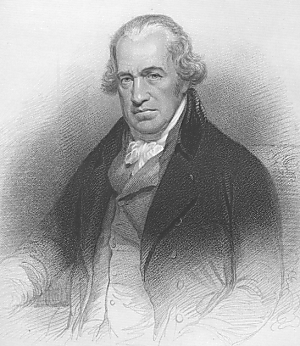
James Watt was born on January 19th, 1736, in Greenock, Renfrewshire, Scotland. Watt was a Scottish inventor and mechanical engineer who was best known for his contributions to the steam engine. As a child Watt was home-schooled and rarely attended regular school. After several years of being home-schooled, Watt decided he would enroll at Greenock Grammar School, where he showed exceptional talent in math and engineering. When Watt was 18 years old he chose to reside in Glasgow, where he was intent on setting up his own instrument making business. His application for his business was denied by the Glasgow Guild of Hammermen, which meant he could not start his business. Later, the arrival of astronomical instruments to the University of Glasgow provided James an opportunity for work. After several years of working at the University of Glasgow, Watt was given the opportunity to start a small workshop within the university. Watt took up this offer and initiated his workshop in 1757.
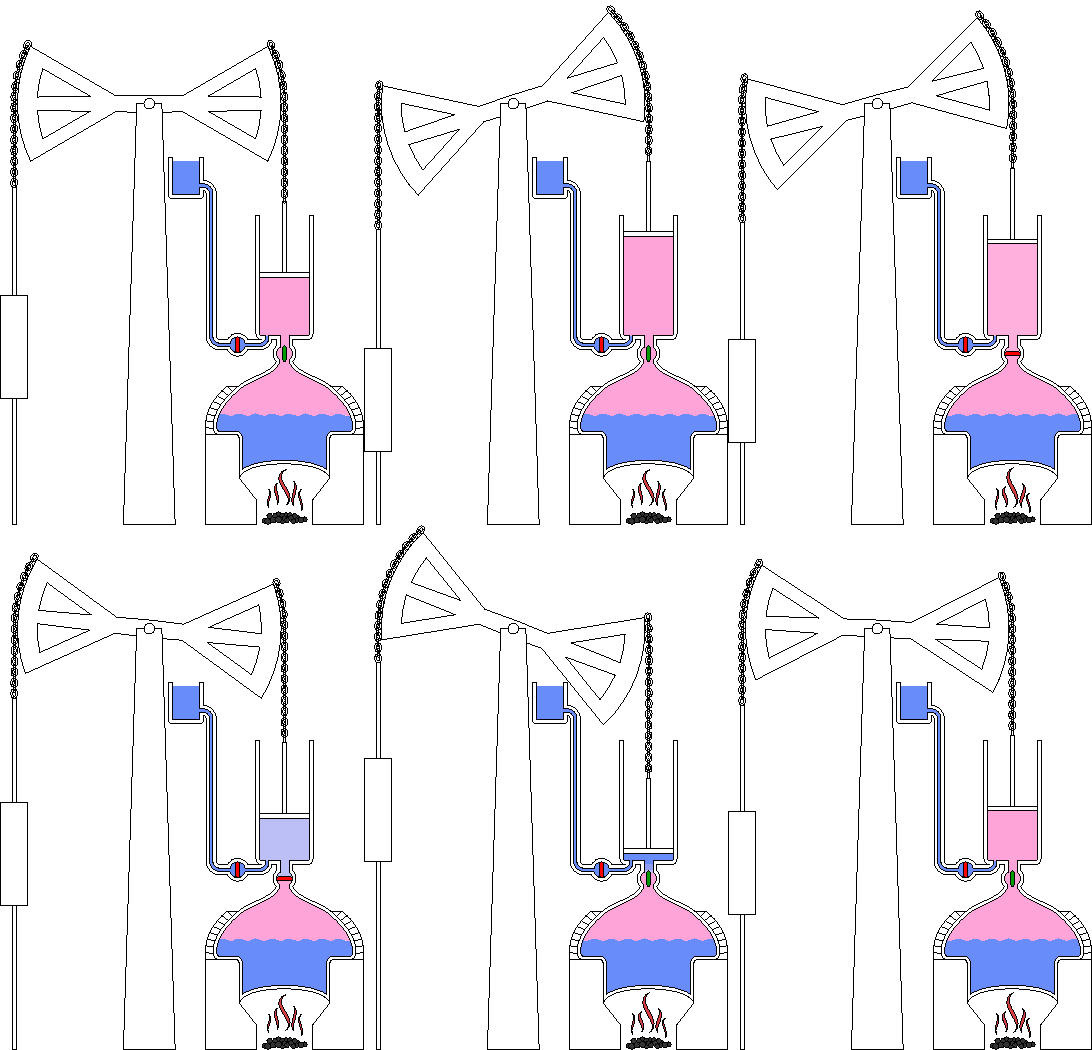
Animation of a Newcomen steam engine.

The first working steam engine was invented in 1712. This engine was called the Newcomen steam engine. In 1764, Watt was given a model Newcomen engine to repair. The problem the Newcomen engine had was that it consumed too much steam while doing its job. After examining the engine, Watt realized that the reason this engine consumed so much steam was because it cooled down to condense the steam after every stroke, and then reheated. Watt needed to find a way to condense the steam without cooling the main cylinder. He contemplated this issue for months and he finally concluded that he would design a separate, smaller cylinder connected to the main one. This second cylinder was meant for steam condensation. Having the two chambers connected allowed for less loss of heat. The steam would enter the first cylinder through an inlet valve; then the piston, propelled by atmospheric pressure, would push the steam out of the main cylinder and into the smaller, condensing chamber. This allowed the first cylinder to remain hot which prevented huge losses of steam.
Watt's separate condenser (left).

Following Watt’s successful invention of the separate condensing chamber, he decided he would attempt to build a full scale steam engine. He met a man by the name of John Roebuck, with whom Watt later formed a partnership. Roebuck agreed to back the production of a full scale steam engine. For a duration of four years Watt worked on constructing a full scale steam engine. Finally, Watt was able to get a full scale engine to work well enough for a patent. Watt and Roebuck were granted this patent in 1769. Roebuck offered to pay off all the debt in exchange for two thirds of the money that the engine made. Watt agreed to this because there was massive debt due to all the trial and error involved with the creation of the newly patented steam engine. Roebuck also helped Watt one more time before their partnership was over. He indirectly introduced Watt to Matthew Boulton, with whom Watt would later form one of the most significant duos of all time.


The Watt Steam Engine.
Boulton recognized the potential of the newly patented steam engine and attempted to acquire Roebuck’s rights to the engine. However, Boulton could not come to a deal with Roebuck and was unsuccessful in acquiring the rights. Later in March of 1773, Roebuck was in desperate need of cash. Boulton acquired Roebuck’s rights to the engine in that same year. The partnership of Boulton and Watt worked out much better than Watt’s partnership with Roebuck because Boulton hired craftsmen who were experienced and accomplished, which is something Watt had lacked in his partnership with Roebuck. In March of 1776, the Bentley Mining Company started the first Boulton-Watt steam engine. The Bentley Mining Company had taken a risk in removing a widely-used Newcomen engine and replacing it with a brand new Boulton-Watt engine. The new engine was a huge success. Emptying a pit 57 feet deep of water in less than an hour. This success caused the demand for Boulton-Watt engines to increase significantly. In 1795, Boulton and Watt opened the Soho Foundry to manufacture the engines. By 1800, 84 British cotton mills used Boulton-Watt engines.
Watt retired in 1800 and his partnership and patent also expired. The partnership was transferred to the sons of these historic figures. Even though Watt was supposedly retired, he continued to invent things to his deathbed. In 1816, Watt took a trip on a famous steamboat called the Comet, which was a product of his inventions. He died at age 83, on August 19th, 1819 at his home in Handsworth, Birmingham, England.
The steam locomotive.
James Watt was one of reasons the industrial revolution began. His improvements to the steam engine allowed use of the engine to spread to other industries. The industry that benefited from the steam engine most significantly was the locomotive industry. Steam locomotives were one of the most important innovations of the industrial revolution. The steam locomotive was the primary source of transportation for goods. Steam locomotives are considered the biggest leap in transportation technology in history. Without steam locomotives, factories were not supplied with the materials they needed to manufacture their products. And without steam power, factories were not as efficient. The steam locomotive allowed the industrial revolution to take place.  
Steam power also had a profound effect on the expansion of factories in the industrial revolution. Before Watt made the improvements to the steam engine, factories had to be located by rivers in order to power their machinery. The steam engine made it possible for factories to be located away from rivers because they provided an alternate source of power. Steam also provided a consistent source of power for factories, unlike water power which provided an inconsistent source of power due to floods, droughts, and other similar occurrences. Overall, factories were able to produce more goods at a more consistent level due to the implementation of the steam engine.
Without James Watt, would the improvements to the steam engine ever have been made? And without the steam engine, would the industrial revolution ever have happened? James Watt improved and adapted the steam engine so it could be used efficiently in multiple industries. Without those industries, the industrial revolution never would have progressed. James Watt was the reason the industrial revolution began. Without James Watt, we never would have evolved from our old ways of life. 


Important Dates:


1712 ~ Newcomen Engine Patented
1736 ~ James Watt Born
1755 ~ James Watt Trained in London
1764 ~ James Watt Discovers Problem with Newcomen Engine
1765 ~ James Watt Discovers Separate Condenser
1769 ~ John Roebuck and James Watt Patent the Engine
1774 ~ Boulton Acquires Roebuck's Patent Rights
1776 ~ The First Boulton-Watt Engine is Installed by the Bentley Mining Company
1800 ~ James Watt Retires at Age 64
1819 ~ James Watt dies, age 83


Monday, March 12, 2012

The Underground Railroad

The Underground Railroad was an organization of quakers that believed differently from the Southern states of the United States of America. It began when people of the country started to lose slaves, and were confused about that- More and more slaves started to go missing, and more and more people joined the organization of quakers. It grew so large that it needed a name, which was come to be The Underground Railroad. The "railroad" part of the word is meant to signify how they moved slaves to and from different "safe houses," which were stations that slaves took breaks at, and traveled to in the night. It was very dangerous though, because if anyone who was with the Underground Railroad was caught, they would have been tortured, prisoned, or even fined up to $1,000. The other part of the word is “underground,” and that signifies how it was secret, and the slave holders didn’t even know that their slaves were being taken until they went to check on them. The southern states of America were bigger in slavery, and disagreed with the northern states, which was also one of the leading causes of the American Civil War. Some people from the Underground Railroad fought in the American Civil War, like Harriet Tubman, who was a very successful woman. Even though she began with the freedom of her own family, she eventually saved over 700 slaves, and possibly even 1000. She was also the first woman to lead an armed military raid, and helped Colonel James Montgomery and his 2nd South Carolina black regiment up the Combahee River, routing out Confederate outposts, destroying stockpiles of cotton, food and weapons, and saving slaves along the way. Harriet Tubman also served as a spy and a nurse in the American Civil War. She was so successful at helping slaves, that she gained a nickname: “Modern Moses.”
Saving slaves was hard work, and they moved at night to avoid people catching them. They had to walk through harsh conditions, or paddle in boats and ride horses if they could find them. They even had to change their appearance, and use their limited money supply, because some people around them would get suspicious of black people with ragged clothing. After getting to a safe house, the safe house keeper would feed them, and give them all of the necessities they needed. The safe house keepers would also send a letter to the next safe house, to make sure that they were ready for the next group of slaves to come there. If you’re wondering if Harriet Tubman was a safe house keeper, you’re wrong. Harriet Tubman was a conductor, which was a person who guided and led slaves to each safe house. Harriet Tubman and other conductors had to go through the same harsh conditions that slaves did, and were risking their lives for others. Even though they only saved a small percentage of all the slaves in the south, they still believed it was important to save the slaves’ lives. They had to travel from southern states on foot or other small vehicle, and go all the way north to Canada. Why not the northern states? It is that, because if slaves and conductors were caught in the northern states, the slave owners will still have the right to take their property back. So Harriet Tubman took many trips back and forth from Canada to the South, and liberated many slaves as well. 
Even though I’ve mentioned Harriet Tubman as the real hero of the Underground Railroad, there were many others risking their lives as well. One of which was Levi Coffin, who helped more than 2,000 slaves. This does not mean he brought them all the way to Canada, but still means he helped them. He was also a conductor, who traveled in and out with all of the slaves.