Showing posts with label France. Show all posts

Thursday, February 13, 2014

Ballet in Revoltionary Times

Ballet in Revolutionary Times
by Rowan Treece
Louis XIV in an original costume
Ballet, as we know it, began in the court of Louis XIV in the 1640s. It flourished under his attention, and he opened the first organized ballet school, The Royal Academy of Dance, in France. He was a great fan of ballet, a performer and student himself, and often put on lavish performances for his court, sometimes 12 hours long with magnificent sets, costumes and music. As ballet transitioned from the court to the theatre, it became intertwined with opera, often having ballets staged between the acts. In the build up to the French Revolution, ballets and operas were used as propaganda for the “New France” that the revolution promised. When the revolution began however, in 1789, the opera and the ballet were shut down and the performers were safeguarded with the King and his court. When the theatre reopened in 1837, it marked a new age in the development of ballet throughout Europe. 

A promotional picture for an old ballet
1837- 1870 is considered the romantic period of ballet. During this time, Jean-Georges Noverre, a noted choreographer and teacher in France, created l’ballet d’action, or the ballet of action, known to us now as the story ballet. These ballets were no longer extravagant but pointless ramblings with no definitive plot, but instead took their origins from Latin pantomimes and folk tales. He professed that ballets should unfold through dramatic movement and relations between characters. He encouraged artistic development, refined costumes, capitalization upon natural talents, relevance of the set, music and lighting to the story, and the logical development of the story. He revolutionized the training of dancers by changing the entire point of the performance. He made ballet an art, instead of a display of wealth and royalty.
While this was happening in France, ballet grew all over Europe. Marius Petipa, a French dancer, choreographer, and teacher, choreographed arguably the most long lasting, well known and influential ballets to ever grace the stage, with the help of Lev Ivanov, for the St. Petersburg Imperial Theatre in Russia. His most enduring works are the first versions of  Le Corsaire, Giselle, La Esmeralda, Coppélia, La Fille Mal Gardée (with Lev Ivanov), and Swan Lake (with Lev Ivanov), all of which have been remade “after Petipa” many times. The most recent of these reproductions was by a pair of Russian figure skaters in the ice dancing competition in Sochi at the Olympics. They skated in the theme of Swan Lake, though obviously not at all like the ballet. 
Modern Swan Lake
During the 18th and 19th centuries, ballet became a central social point in both courts and theatre, and created lively cultural exchange in places such as Venice, in the famed Teatro San Benedetto, Spain, Portugal, Poland, Germany, and Hungary. Ballet schools sprang up in many different places, and the theatre became a high class locale. Ballet continued to develop but the foundation was set to place ballet as a high art in the modern world. But it’s not over yet. To this day, ballets are performed throughout the world by thousands of companies and schools, new ballets are created, ballet is fused with other dances and arts, it addresses social issues and modern problems, it continues to grow. The art that began in the revolutionary times will outlive us all.

Tuesday, February 12, 2013

The Storming of the Bastille and the Estates

Everybody has, at some point in their lifetime, heard of the Battle of Waterloo, and the fight at Gettysburg during the Civil War. Have you, however, heard of the Storming of the Bastille, and of all of the brave citizens who dared defy the higher classes? Of the unfair system of social rank, or the Third Estate? To know more about these answers, we must first go back and learn what the Estates are.

The estates were sort of like social classes, with the third being the lowest, and the first the highest. The Third Estate was by far the majority, it was 95% of the population. If France were our middle school, out of the roughly 200 students, only about ten would be in the upper two classes. Servants, skilled and unskilled workers, serfs, storekeepers, and laborers were all part of the Third Estate. However, it didn't only consist of slaves and serfs, also doctors, lawyers, and teachers. These people were the very backbone of the nation. They payed the biggest share of the taxes, even though they had few privileges and almost no say in governmental decisions. It wasn't until the Estates-General was formed that the Third Estate began to have a voice in the government, but even then, they would lose by vote of two to one.


The First Estate is mainly made up of members of the Church, and religious leaders. People believed that God gave a hierarchy to them, and a luxurious life to religious men who lived under God. They represent a minuscule 1% of the people of France, or two people out of the 200 in our middle school. This small minority owns one-tenth of the land, however! These people enjoyed many privileges, including not having to pay taxes. Nevertheless, most of the people of the First Estate weren't corrupt and rich, but relatively poor and well meaning. Many also knew they had unfair privileges. 


The Second Estate consisted of nobility and royalty, other than the monarch, who stood outside of the estates system. Owning from 25-30% of all the land of France, they had no shortage of places to live. They enjoyed many of the same privileges as the First Estate, and collected rent from the peasants who lived on their land, allowing them to live a very lavish lifestyle. Often, people from this estate joined the Church and moved up to the First Estate. Women were also born into either the Second or Third Estates, but were also labeled with the 'feminine estates': either a virgin, a widow, or a wife. 
Bernard René de Launay


The people of the Third Estate felt like they were being treated unfairly, and their lives were being controlled by the government. A very iconic building of the government was the Bastille. The Bastille was a fortress, serving as a prison located in Paris. Around 30,000 pounds of gunpowder were stored in there, in order to prevent citizens from acquiring arms. A very secure place, the Bastille was very important, and seen by many every day, reminding them of the power of the government. At the time, the governor of the Bastille, proving to be a very important character in the later invasion, was named Bernard René de Launay, son of the previous governor. He was actually born inside Bastille walls, and died protecting them.

During the reign of Louis XVI, France fell upon a major economic crisis, partially because of France's intervention in the American revolution. France attempted to solve its money problems by severely taxing the citizens of the Third Estate. This caused the Third Estate to get extremely angry, only worsening conditions. The government got nervous and posted extra guards to the eighty-four guards already at the Bastille. Eventually, a small group of demonstrators from the twenty-four million strong Third Estate decided to attack the Bastille in Paris.

On July 14, 1789, hundreds and hundreds of peasants, doctors, writers, shopkeepers, and other unified near the Bastille. They had previously stormed the Hôtel des Invalides to gather 31,000 muskets, yet without powder or shot, and now were trying to acquire the 30,000 pounds of gunpowder in the Bastille. There were only seven prisoners there at the time, but the taking of this fortress would be a huge step. The 954 people gathered outside the gates, calling for the surrender of the prison, the removal of the cannons stationed on the wall, and the release of the prisoners and the gunpowder. Anticipating a response, the crowd's hopes rocketed when the governor admitted two negotiators. They stayed inside until noon, and then the people began to get restless and frustrated. Another half an hour later, the now furious mob charged the fortress. 


With whatever weapons the group could find, like a seething, unstoppable wave, they advanced, venting all their rage into this moment. Charles Dickens' A Tale of Two Cities describes this scene immaculately. "With a roar that sounded as if all the breath in France had been shaped into the detested word, the living sea, wave on wave, depth on depth, and overflowed the city to the point. Alarm-bells ringing, drums beating, the sea raging and thundering on its new beach, the attack began. Deep ditches, double drawbridge, massive stone walls, eight great towers, cannon, muskets, fire and smoke. Through the fire and through the smoke-in the fire and in the smoke, for the sea cast him up against a cannon, and on the instant he became a cannonier..." By 3:00, new reinforcements came to the brave attackers; “gardes françaises,” who came along with two cannons, making the guards not the only ones with weapons.

Meanwhile, a substantial force of Royal Army troops were camped very nearby on the Champs de Mars, yet they didn't intervene. The fighting continued, a desperate reach for freedom, 954 courageous humans attacking an enormous fortress, the Bastille. 

Finally, at 5:30, July 14, 1789, Governor de Launay surrenders and opens the gates to the very inner courtyard, and the victorious mob swept into the core of the Bastille, concluding a successful yet hard-fought battle. 98 attackers died, and only one guard during the battle, but afterwards the people of the Third Estate took their revenge upon the guards, and killed many more. 


De Launay was dragged onto the streets from the fortress, and into a nearby tailor shop, where discussions about his fate began. Finally, he exclaimed, "Enough, let me die," but not before kicking an angry pastry chef named Dulait in the groin. Governor de Launay was repeatedly stabbed, shot, and kicked by the frothing, rabid, and furious mob, not yet satisfied with their victory. Finally, Bernard René de Launay's head was sawed off viciously, and triumphally set on a pike. The mob marched throughout the streets of Paris, showing off the beheaded face of the Governor, as well as the other dead guards.

Although this ending may seem unnecessarily violent, imagine a single man controlling your entire life, living above you, living with money and privileges, living a luxurious life while you starve on the streets. Living back then, you would have done the same! After the battle, the 954 heroes who stormed the Bastille would be forever remembered with the creation of an important holiday in France. Called Le Quatorze Juillet (14th of July), formally known as the Fête de la Fédération (Federation Holiday), and called Bastille Day in English, it celebrates the storming of the Bastille and the act of the Third Estate against the higher government for a greater, overall good.


Monet's depiction of Bastille Day
My family and I traveled to France this year before our annual visit to Hungary. We first stayed in Paris for a couple of nights - I mean, if you go to France, who doesn't stop in Paris - and then traveled to Corsica (incidentally where Napoleon Bonaparte was born). We were in Paris from July 12 to July 16, so we had the luck of being there for Bastille Day. It's treated similarly to the Fourth of July here in the U.S., what with fireworks, parties, and dancing. Bastille Day is also celebrated in many countries, such as Hungary, New Zealand, Belgium, England, and even here in Portland! On Champs Élysées, thousands of seats are set up along the street, for the citizens to view the soldiers marching, and the long military parade. Also on Champs-Élysées, hundreds of flags are raised to celebrate the event, accompanied by spectacular fireworks by the Eiffel Tower. We didn't get to go see the parade, the crowds must have been overwhelming, but at home we lit some fireworks with our host family, which was also a lot of fun!


While we were in France, I learned how much France's history affects every-day life, yet how different living in Paris must have been from how it is now. No matter which estate you were or are in, no matter whether you were there for the storming of the Bastille or not, whether you live in France or in Uruguay, everyone can reflect and be amazed and affected by the French history in 1789; everybody can continue to be inspired by what drove those attackers, the same inspiration many of us draw from every single day.


Works Cited:

"Estates of the Realm." Wikipedia. Wikimedia Foundation, 31 Jan. 2013. Web. 10 Feb. 2013.

"The Estates." ThinkQuest. Oracle Foundation, n.d. Web. 10 Feb. 2013.

Dickens, Charles, Hablot Knight Browne, and Frederick Barnard. A Tale of Two Cities,. New York: Dodd, Mead &, 1942. Print.

"Google Images." Google Images. N.p., n.d. Web. 10 Feb. 2013.

"How Do You Pronounce Bastille?" Yahoo! Answers. Yahoo!, n.d. Web. 10 Feb. 2013.

Karpiel, Frank, Kathleen Krull, and Grant P. Wiggins. MyWorld History. Boston, MA: Pearson, 2012.

My mom

My camera (the pictures at the end are mine)

"Storming of the Bastille." Wikipedia. Wikimedia Foundation, 02 Nov. 2013. Web. 10 Feb. 2013.

"The Three Estates." The Three Estates. N.p., n.d. Web. 10 Feb. 2013.


Some pictures from our visit to France: 


The beach in Corsica
The view from our little house in Corsica


Paris as seen from the Eiffel Tower (The line is so long!)
The Seine River as seen from the Eiffel Tower


Thursday, March 1, 2012

History of Photography


Nowadays we are always taking pictures. We like to capture the moments so that we never forget them. We now can post them on social sites like Facebook, Twitter, Instagram and many more. Being a teen especially, I love to take photos. No one thinks anything about snapping a picture on your iPhone or iPod. Sometimes you have to step back and think, “Where did photography first come from?” because it used to be a long, boring process to take just one photo.
The first photo was taken in 1826 by Joseph Niepce. His photographs were taken by on a polished pewter plate covered with a petroleum derivative which he then dissolved in white petroleum.  Bitumen hardens with exposure to light. The unhardened material was then be washed away and the metal plate polished, making a positive image.
This is the first picture ever taken. It’s the view outside the window at Le Gras in France 1825

.
The first portrait picture ever taken

During the Industrial Revolution time, the want for portraits grew in the middle class. More and more people wanted to say that they had their very own picture.In 1847 Count Sergei Lvovich Levitsky designed a camera that improved the ability to focus a camera. Some of the same focusing techniques are still in use today. He also brought up the popular idea to put decorative things in the background of the photo. He worked on the quality of the photo, and putting people into different poses for their photo.
During the mid nineteenth century, photographers started to capture stories and landscape. More and more people wanted to get their picture taken. The prices of the photos were from 50 cents to 10 dollars.Artists started to make art shows of entirely photography. In the first twenty years of photography being around, is when the most development happened. In 1884 George Eastman invented dry gel on paper so the photographer no longer had to carry around plates and toxic chemicals. In July of 1888 Kodak released a camera that people could buy. Now anyone could take a picture.

The advancement of photography began to boom and cameras became easier and easier to use.  They still continue to get better quality. Some cameras are touch screen and on some you can even upload pictures and videos straight to YouTube or Facebook. The invention of photography is a great addition to our modern life.
Sources:
http://www.neatorama.com/2006/08/29/the-wonderful-world-of-early-photography/
http://en.wikipedia.org/wiki/History_of_photography

Tuesday, February 28, 2012

Intertwined


"Do not wait to strike 'til the iron is hot; but make it hot by striking."
--William Butler Yeats 
Iron is embodiment of the oppressed, and heat is fire of revolution. Revolution is a constant in the universe. Revolution is the driving force in human development. Revolution also forms connections between peoples and nations. One of my favorite revolutionary connections
 is between the U.S. and France at the turn of the 19th century.  The fates of the French and American civilizations inexorably intertwine in the 50 year span of 1765-1815. The British colonies on the eastern side of the Appalachians both directly, and indirectly caused the abdication and restoration of the Bourbon monarchy.
Louis XVI
    It all began in the Seven Years War and Louis XV. Though this war took place in many theaters, one of its consequences was the loss of its holdings on mainland North America. In this theater, France was not only fighting with the British and the Iroquois Confederacy, but also the colonial citizens, who in this war, created new identity of nationalism that would arise as a new nation fifteen years later.This war also was first step for the future French Revolution. The loss of both the war and many overseas territories bankrupted France, causing the peasantry to pay much higher taxes. This not only caused a discontented populace, but also a starving one, the higher taxes on the populace meant less money for bread.
In 1775, the North American colonists, many of which had fought against the French in the Seven Years War, were taking up arms against their British overlords. Rebelling colonists only wish to have one thing, freedom from the political bands that bind them to their oppressors. This wish would soon take root in France, and set the world aflame.
The American Revolution had a rocky start, and quite nearly was ended at the battle of Saratoga. If They had lost this battle, the revolution would have ended, and the new king of France, Louis XVI, would not have committed the vast resources the Americans needed to win the war.
He committed a grand total of 2,000,000,000 Livres, enough money to feed and house 7 million french citizens for a year. This use of the money would later  come back to haunt the monarchy.
Though the war of American independence proved to be a improvement for the U.S., it created horrible financial debts for France. And, due to the way the French social pyramid was set up, the debt was payed off by, guess who, the starving peasants! This was step two in the sequence. The French peasants were broke, starving, and oppressed; the perfect ingredients for a revolt. Inspired and embolden by the successful revolution across the sea, in 1789, the people rebelled, and created their own revolution.
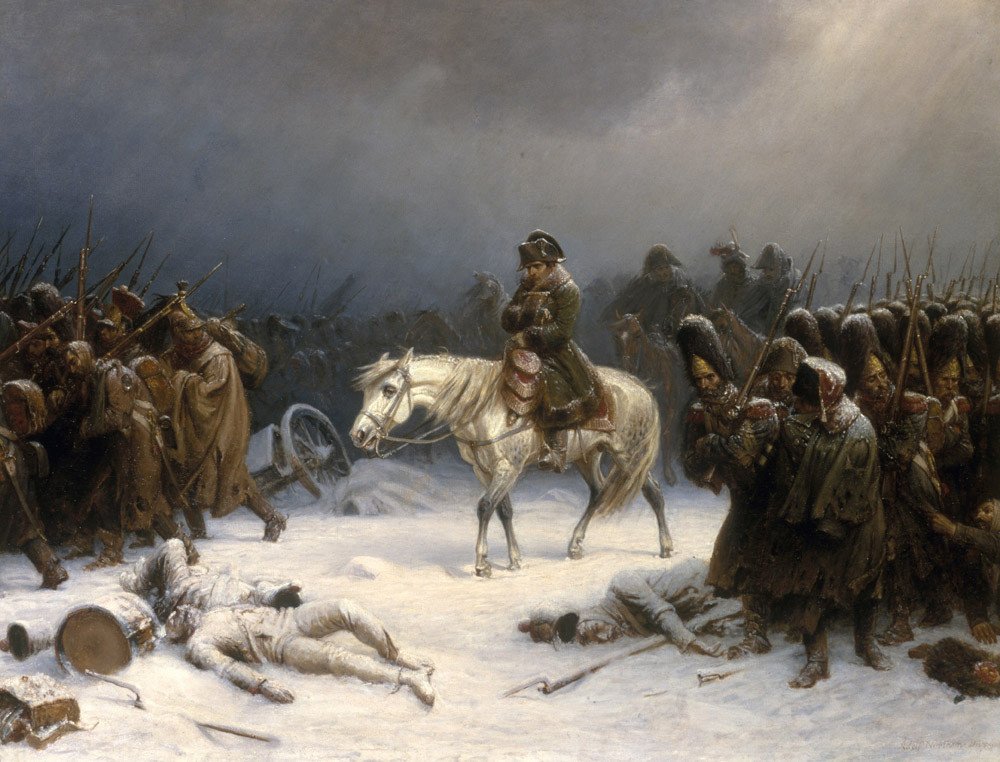
Although I would much enjoy giving a complete summary of the French Revolution, I don’t have time for that in a single blog post. I will instead jump ahead  23 years to 1812. Right now, Napoleon’s regular troops are fighting British and Spanish forces in the Iberian peninsula, Tsar Alexander I has broken the treaty of Tilsit and has begun trading with the British Isles, and American merchant vessels are being raided by English warships in the Atlantic.These infractions quite possibly led to the restoration of the French monarchy.
Due to the loss of trade revenue, loss of American life, and because the newly formed United States didn’t like being walked on, they declared war on Britain. Britain, anxious to settle the score with its former colony, committed soldiers, ships, and money, that was needed in Europe to combat the forces of Napoleon. Bonaparte, seeing the diplomatic tensions rising between the two nations saw it as an opportune moment to use the quarter of a million men he had been stockpiling in Poland to teach the Russians a lesson about breaking embargo treaties.     Though Napoleon invaded the country before he knew of the public declaration of war between the U.S. and Britain, he saw it as a diversion for the British the would lessen their threat in Iberia long enough for his six week war in the western plains of Russia. These were the two greatest mistakes of the French emperor; thinking the war with Russia would be a decisive victory in one massive engagement on the open plains of eastern Europe, and thinking that Napoleon’s veteran troops could hold off the “weaker” British forces until his return shortly after.
After Napoleon’s doomed march on, and retreat from Moscow, his invisibility was shattered, his grande armee was dead, and his security gone, within 2 months, Coalition forces had surrounded Paris, and Napoleon abdicated, giving rule of France back to Louis XVII, the surviving heir of the monarchy.  
Revolution is a self oxidizing flamed that cannot be extinguished and humanity is the iron that only through the heat of revolution can be shaped. As seen above revolutions can shape the world by accident through chain reaction. From Saratoga to Waterloo, Quebec to the Bastille, the revolutions in America and France created each other and resolved each other. They are linked in the eternal bond of history, never to be ripped apart.  If even one of these twin revolutions never took place, Britain would still rule the Americas, and Napoleon Bonaparte would be a worthless artillery captain with unused potential--not the Emperor who would set a spark to the kindling of the world.

Monday, February 27, 2012

The French Invasion of Russia


Napoleon, the emperor of France, was a power hunger leader and wanted to conqueror all of Europe. The Austrians, who were in an alliance with France at the time, were annexing the Grand Duchy of Warsaw. The Russians thought they were going to try and invade Russia. The Russian’s were also trading with England, which angered Napoleon. Russia invades Poland, so Napoleon tries to take Russia. This is the beginning of the end in the Napoleonic Wars.


The French overextended themselves. Napoleon thought that he was going to engage Russia in a couple battles, but the Russian’s fought skirmishes and move back. Napoleon had to leave men behind, so that they could guard the supply routes and protect their land.


Napoleon started invading in the fall, then he could avoid the winter. When the fall came it was the harvest season. That meant they didn’t have to guard there supply routes as carefully, because they could just take the food from the farmers. The Russians burned their field’s as they retreated, so then the French couldn’t eat from the local fields, and would keep having to bring their supplies through a supply line.

Their army was weakening very badly, but they made to Moscow after a very bloody battle called Battle of Borodino. Napoleon was able to win that battle, but had thirty-five thousand casualties, and Russia had forty-four thousand death’s. France did end up with the victory. The French made it to Moscow expecting to eat there food, and restock on there supplies. When they arrived the city was deserted, all the food and supplies had been taken. The city was on fire too.
The French army had to retreat, because they were deprived of resource. They weakened even more as Russia attacked them with different forces. The forces were from peasants to organized units of soldiers. They final attack on the French was when the Russia attacked them while they were trying to cross the Berezina River. When the army returned back to France, four hundred-forty thousand French soldiers had died.
That wasn’t the end of Napoleon. The United Kingom, and Austria had joined the Coalition. France lost the battle in the War of the Sixth Coalition. Napoleon was captured and exiled to the island of Elba. This was one of the most important wars of the Napoleonic Wars. This was the turning point of the war, the undefeated French army was defeated, and started the War of the Six Coalition.             

(Charles Minard's graph. This show's how many people Napoleon had and lost. The yellow is the size of Napoleons army when he started and the black is when he ended)


Khan, Salman. "French Invasion of Russia." YouTube. YouTube, 23 Apr. 2010. Web. 26 Feb. 2012. <http://www.youtube.com/watch?v=F_ySQvjtAxQ>.

"French Invasion of Russia." Wikipedia. Wikimedia Foundation, 26 Feb. 2012. Web. 26 Feb. 2012. <http://en.wikipedia.org/wiki/French_invasion_of_Russia>.

Lost Stories of The French and Indian War

                           There are many things that are forgotten about the French and Indian war. Not because they're unimportant, but because focusing on them would take a whole other blog to talk about, this is that blog. This is also the blog which does not include the things that you can find on any random website, such as causes, battles, etc.

                            It is interesting why the French and Indian war was named so.In those times, wars in the new world were named after the monarch. So why wasn't this war not named King George's war after the monarch King George II, because there already was a King George's war ten years prior. The King George's war began after the War of Austrian Succession, a diplomatic war during which Britain's hostility with France grew, and these hostilities would soon lead to war. This was the first step to the French and Indian war, Britain besieged and captured Louisbourg, a big city in New France, and France replied by destroying the British city of Saratoga, New York and Capturing the British colony of Madras, India. The War would end when a treaty was signed to trade Louisbourg for Madras, and there was peace between the countries, until the French and Indian war started.


                Now we understand why they called it the French and Indian war. it was named after their enemies because there already was a war name after the monarch, but were the Indians their enemies. In fact, The Iroquois Indians were allies to the British, and the Colonists. While the french were aided by the Huron and the Algonquin Tribes. In the Queen Anne war, which was also a predecessor of the French and Indians war. During that time the Iroquois signed a peace treaty with France, but would take sides with the British and help them lead attacks at the French. After Queen Anne's war, the Iroquois hoped to keep peace with Britain. Soon, though, colonists would expand beyond the agreed land between the Iroquois and the British. Since the British did not have the military to forbid expansion, the Iroquois would be forced to keep selling their land until they were pushed back to the Tennessee river. The Iroquois joined the British when the Iroquois' enemy of The Algonquins joined the French, but it was also because they hoped to keep the British as an ally going forward. Later, during the American Revolution, the Iroquois would split up and join sides between the Colonists and the British, both of whom they fought with in the French and Indian war.

             After the French and Indian War, the main thing people focus on is Britain's expansion without having to worry about the French, but something might be even more important in history is the state of poverty France was left in after the war. France was bankrupt, it had no resources, and their population growing. Combine no money, no resources, and more people... not good. Above all that, the royal family was misusing their money which they didn't have. This started the French Revolution, which began an era of math, science, and blood. Unfortunately this is not the blog that talks about the french revolution. This is the blog about the lost stories of The French and Indian war, which I hope are not lost anymore.