The
Peace Treaties of Westphalia
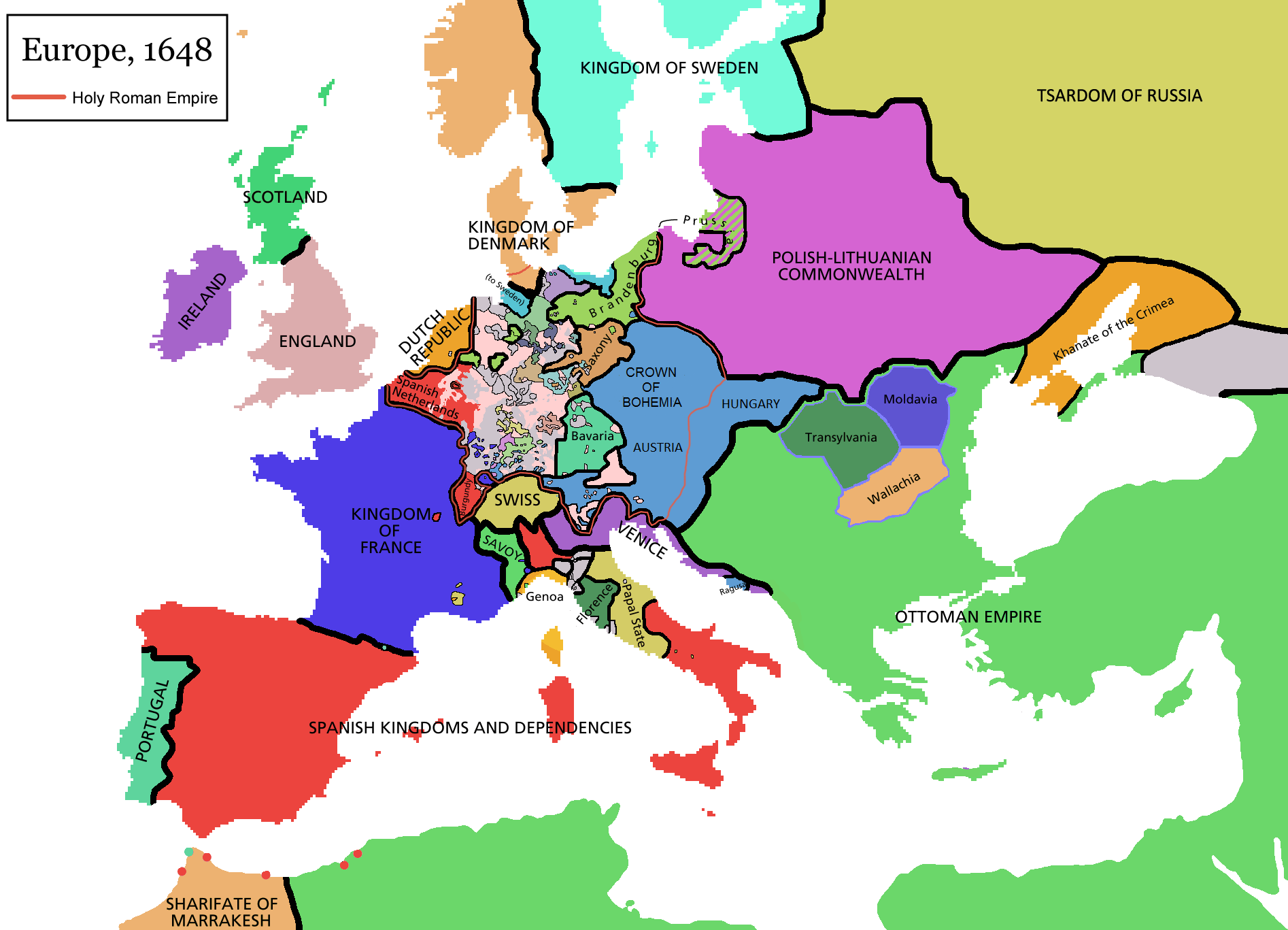
You
may be wondering what or who or where Westphalia is. Today, Westphalia is a province of Germany,
called North Rhine-Westphalia. Why does
this tiny, insignificant European place matter? In the year 1648, during May through
October, a series of Peace Treaties were signed between the Kingdom of Spain,
the Kingdom of France, the Kingdom of Sweden, and the Holy Roman Empire, and
many other smaller free governing cities and states. This stopped many wars, such as the Thirty
Years’ War and the Eighty Years’ War.
Ending these wars saved many deaths, improved living conditions, and
brought peace to Europe.
Ending
the Thirty Year’s and Eighty Years’ Wars could finally bring all the tired
soldiers back to their wives and family.
This kept them off the battlefield and away from guns. They could help the other wounded soldiers by
lending the families food and medicine.
They could also bring goods that had disappeared with the soldiers back
to markets, some of the essential such as medicines.
Signing
the Peace Treaties improved living conditions greatly. No more fear of being invaded by the Spanish,
or Swedish, or any other opposing groups.
The wives would have money from their husbands again to keep the food
hot on the table. There could be a
peaceful atmosphere where everyone could living comfortable lives.
If
a large chunk of men had died in these wars, it could have brought reproduction
to a halt in Europe. Women could’ve been
fighting for a single man, and killing each other at it. Later on, if Europe would have more elderly
than working folk, Europe could be in a major financial crisis. Europe might’ve had weak armies and been
invaded by Asians or Africans. Bottom
line, a lot of bad things could’ve happened.
 Ending
these wars finally brought prosperity to Europe. The Thirty Years’ War was one of the most
destructive and horrific wars Europe had every faced. This was one of the first wars where both
sides had canons and guns. This meant
that more soldiers died. So generals
brought more and more soldiers onto the field.
This meant that more food was needed, which was already scarce. When the soldiers marched into hostile
territories, the villagers would burn their mills and food. Soldiers were now dying from two causes, war
and starvation. Finally signing the
Peace of Westphalia Treaties was a major break for everyone in Central Europe,
where these wars were fought. Europe
could finally progress safely.
Ending
these wars finally brought prosperity to Europe. The Thirty Years’ War was one of the most
destructive and horrific wars Europe had every faced. This was one of the first wars where both
sides had canons and guns. This meant
that more soldiers died. So generals
brought more and more soldiers onto the field.
This meant that more food was needed, which was already scarce. When the soldiers marched into hostile
territories, the villagers would burn their mills and food. Soldiers were now dying from two causes, war
and starvation. Finally signing the
Peace of Westphalia Treaties was a major break for everyone in Central Europe,
where these wars were fought. Europe
could finally progress safely.
Thank you for reading this article and I sincerely hope
you have a wonderful rest of your day.
Sources:
My brain and logic
Images:
http://upload.wikimedia.org/wikipedia/commons/d/d0/Europe_map_1648.PNG
http://www.hereandtherewithpatandbob.com/wp-content/uploads/2010/08/Peace-of-Westphalia.jpg

Hi Andrei,
ReplyDeleteI love your topic! I had no idea about any of this before! During this time, who were the political leaders of these kingdoms? Who came up with the Peace Treaties of Westphalia? How did other non-involved countries react to the treaties? Thank you for writing about such a cool topic! I really like the tone you took with it.
I hope you have a wonderful day too :-)
Rowan
Hello Andrei,
ReplyDeleteI didn't know anything about this topic, and it's really interesting! I have a few questions for you. How many provinces are in Germany? Was this the largest? If not, which province was the largest? Thank you for sharing this topic with the class! I really enjoyed reading this!
Thanks!
~Sydney
Hi Andrei,
ReplyDeleteLike Sydney I had know idea what this was about. I liked it a lot it had a lot of information stuffed into it. Why these wars were happening? And who was winning? And why did it take so long to sign the treaties? Well that's about it. Thanks this was a lot of new info you gave me!
-Matteo
Thank you for you comment Rowan! The political system of the Holy Roman Empire was confusing. Some scholars think Charlemagne started it, while some think Otto I started it. The ruler, though, acted somewhat as an emperor. The Office of the Holy Roman Empire was traditionally elected, although frequently controlled by dynasties. Then there were German prince-electors, the highest ranking noblemen of the Empire. They usually elected one of their peers as "King of the Romans," who would eventually be crowned as emperor by the Pope. The Empire never really reached a complete and full unification, and was instead a decentralized monarchy with a lot of sub-units, principalities, duchies, counties, Free Imperial Cities, and other derivatives. The rulers of these places had their own rights in their own lands, but must obey the laws set by the Holy Roman Empire. The treaty was at first a treaty that allowed for two concurrent conferences. The kingdoms and city-states welcomed this, as they could all go off on their own ways. Other countries and monarchies were eager for this too, because it could end many wars, and maybe settle things down. Some didn't like it though, as these treaties recognized the Netherlands as an independent state, not part of Spain. Again, thanks for commenting! :)
ReplyDeleteSydney,
ReplyDeleteThanks for commenting!I do not know how many independent cities, kingdoms, and that sort there were at the time, but in modern day Germany there are sixteen. The largest territory of at the time in the Holy Roman Empire was the Kingdom of Germany, which acted as its rock too. Today, the largest province of Germany would be Bavaria (southwest chunk.) The Holy Roman Empire fought a battle with Napoleon, which they lost.
Thanks for commenting Matteo!
ReplyDeleteThese wars were happening because some countries wanted their independence from other countries. At first though, religion was a motivation for these wars. These wars grew and grew and started involving other greater powers in Europe. This brought an official end to the Holy Roman Empire. It only continued on as a name. The enclaves that wanted out because of their religion started winning, and other people/countries started winning against the Holy Roman Empire, like Napoleon. Hope this helps!
Hi Andrei
ReplyDeletewow! that is an intriguing subject. Before reading your post I knew nothing about this topic. Why? did it take so long to get the treaty signed? What else (if anything) was going on at the time? I like the fact that you have a lot of information in your post.
Cool topic,
-KAT
I do not know why many people do not know a lot about this topic. People overlook it I guess! It did take a long time to get the treaties signed, and there are reasons. The reasons are that they were making new constitutions for these new nation-states, so everybody had to agree. This could take a long time. Also, these wars had been going on a long time, so every acre you lost or gained was important. Nothing major was going on at the time, as this is still the 1646-1648.
DeleteHey Andrei,
ReplyDeleteGreat Job! I loved reading this! How did other countries that were around Germany feel about this?
Much Love
Alex
Thank you for your comment Alex!
DeleteThe countries around the Holy Roman Empire were happy, because their neighboring kingdom could finally progress. The neighbors wouldn't have to worry about being invaded, and could now trade and grow with their neighbors, instead of bicker with them.
Hi Andrei,
ReplyDeleteI really liked this post. It was informative and well-researched. I have a few questions:
Why did you choose this topic?
Why were the treaties signed in that particular location?
Where did you get your information?
Thanks,
ACP
ACP,
Deletethank you for your comment.
I chose this topic, because I felt it is a very important event that happened in the Revolutions Time Period, that nobody knew of. So I decided to share it with the world.
It was a generally central point of all these armies. They were all tired and wanted to stop, so they agreed when one threw out this idea.
My sources:
http://www.newworldencyclopedia.org/entry/Peace_of_Westphalia
http://www.britannica.com/EBchecked/topic/641170/Peace-of-Westphalia
Hi Andrei interesting post. I knew nothing about this before I read it. Did everyone like the Peace Treaties? Over all nice job.
ReplyDeleteEliot
Hi Andrei,
ReplyDeleteWhen I first saw this I had absolutely no idea what it was, but as I read I understood more. Good job explaining something that I didn't know anything about before.
Awesome Job,
~Grace
Andrei!
ReplyDeleteWhy did you choose to write about the peace treaties in Westphalia? It was very interesting, but I wouldn't have thought about it. I actually had no idea what they were before this post. Also, when you said that "The wives would have money from their husbands again to keep the food hot on the table.", was that a metaphor or was that a fact. I did not exactly get that part.
Thanks,
Mahala
Hi Andrei, I really like your post, and how you explained all the things that could happen if this peace treaty wasn't signed. How come it was signed in Westphalia? How did the countries talk to agree where to sign it, if they were at war? Again, really cool post. ~Hannah
ReplyDeleteYo Andrei,
ReplyDeleteI thought it was really cool how you kept the reader engaged with questions, and put some comedy into the piece. Before I read this, I had no idea that this place even existed. I think that reading this has really gotten me to think about how bad wars are, and it informed me of some very important information that should be known widely.
Nice post!
~Tali
Hey Deltas Echo (cough andrei cough),
ReplyDeleteI really enjoyed reading this. You make this whole things sound like a process. I also noticed that the whole thing seemed to revolve around the men. Do you think that if the women went to war, would there be as significant of a change? Nice piece!
~Alexander Yu
Hi Andrei
ReplyDeleteI really liked how you said what it didn't happen and would happen instead. How do you think would've effected us now if these treaties were not signed?
This is one of the best blog posts!
-Arman
Hi Andrei,
ReplyDeleteI liked how for your blog you started off by putting questions in our heads for you to later answer. The treaty being signed was a very big part of your post. I also like how you rote about a place in Germany and knowing you I think you really liked that. :-)
-Jake
Hello Andrei,
ReplyDeleteI like how your post was written, it really seemed like you knew what you were talking about. How much research did you have to do, and how much did you already know? What inspired you to write about Westphalia? I liked your post, thanks for posting.
~Emma
Hey Dre,
ReplyDeleteYour post was very informative, and you seem very educated on your topic. Did you already know this from past knowledge or were you googling this information? What do you enjoy about Westphalia that made you want to write about it?
Harry
Hey Echo!
ReplyDeleteThis blog is very cool and interesting! I had no Idea of what the peace treaties of Westphalia. Thank you for teaching me this! I have a feeling that this will be useful in the future.
-Luke
Hey there,
ReplyDeleteI really liked learning about this. It's nice to get a preview of this .
-Greta
Hello Harry,
ReplyDeleteThank you for your comment. I was just browsing topics and found an article on this, and I became interested because I'd never heard of this topic, but seemed like a big thing. I enjoyed learning about all of it, especially details about the Holy Roman Empire.
Thank you Arman for you comment,
ReplyDeleteI would think that Europe would look similar as it is today. I think that maybe some of the smaller Slavic countries might be merged. I honestly don't know exactly what would've happened exactly.
Emma,
ReplyDeleteThanks for your comment. I knew nothing about this topic, and I just found myself reading more and more about it, so I decided to write my blog about it. I just found it interesting that no one knew about such an important event, and felt motivated to write about it.
Alexander,
ReplyDeleteThank you for your comment. I do think there would've been a change. The amount of women could have shifted the power into the hands of the army with the greater forces, regardless of gender. Then all of Central Europe could have been Spanish. They might have been nurses instead of direct front lines warriors, healing the ranks again. A lot of things could have gone different.
Hannah,
ReplyDeleteThank you for your comment. Westphalia was a kind of central point among these wars, so it was a logical location. For all these armies to agree, I have no idea what it took. But they were all probably tired and had low morale. They didn't have enough food, didn't have enough ammunition, so they decided to find common ground.
Mahala,
ReplyDeletethank you first off for your comment.
I chose this topic because I couldn't believe such an important milestone is so undervalued. So I decided to share it with y'all.
It was a fact, because women generally didn't have as many job opportunities as they do now back then. So the men came back, went to work, and brought the money home. So it is a fact.
Oats,
ReplyDeletethank you for your comment.
As with all choices, people agree and people disagree. But for the most part, this was extremely welcomed by the people. They could finally live in peace, not worrying all day about their houses being raided or bombed. There were still some trigger happy war-heads who wanted to conquer the world, but were quickly shoved aside.