Steam Power
Peter Singer once said, “The Internet, like the steam engine, is a technological breakthrough that changed the world.” Steam power was much like the internet nowadays. It greatly impacted our world. Factories powered by steam could be located everywhere and not just near water sources but they worried about freezing, dry spells, and the season itself because those were factors that could’ve caused a shortage in water supply. Steam power was then later adapted to many types of transportation. Three people were responsible for the major development of the steam engine. They were Thomas Savery and his steam pump, Thomas Newcomen and and the steam engine, and James Watt and his major improvements to the steam engine.
Thomas Savery started it all off with is basic steam pump. He invented it in 1698 and got a patent in London. The pump was used for pumping water out of mines. It worked by letting in 120 to 150 psi of steam into a cylinder. On the outside, a blast of cold water would condense the steam inside, creating a vacuum. Then the valve would shut off as the water came up. The valve was then opened again to force the water into a higher level pipe.
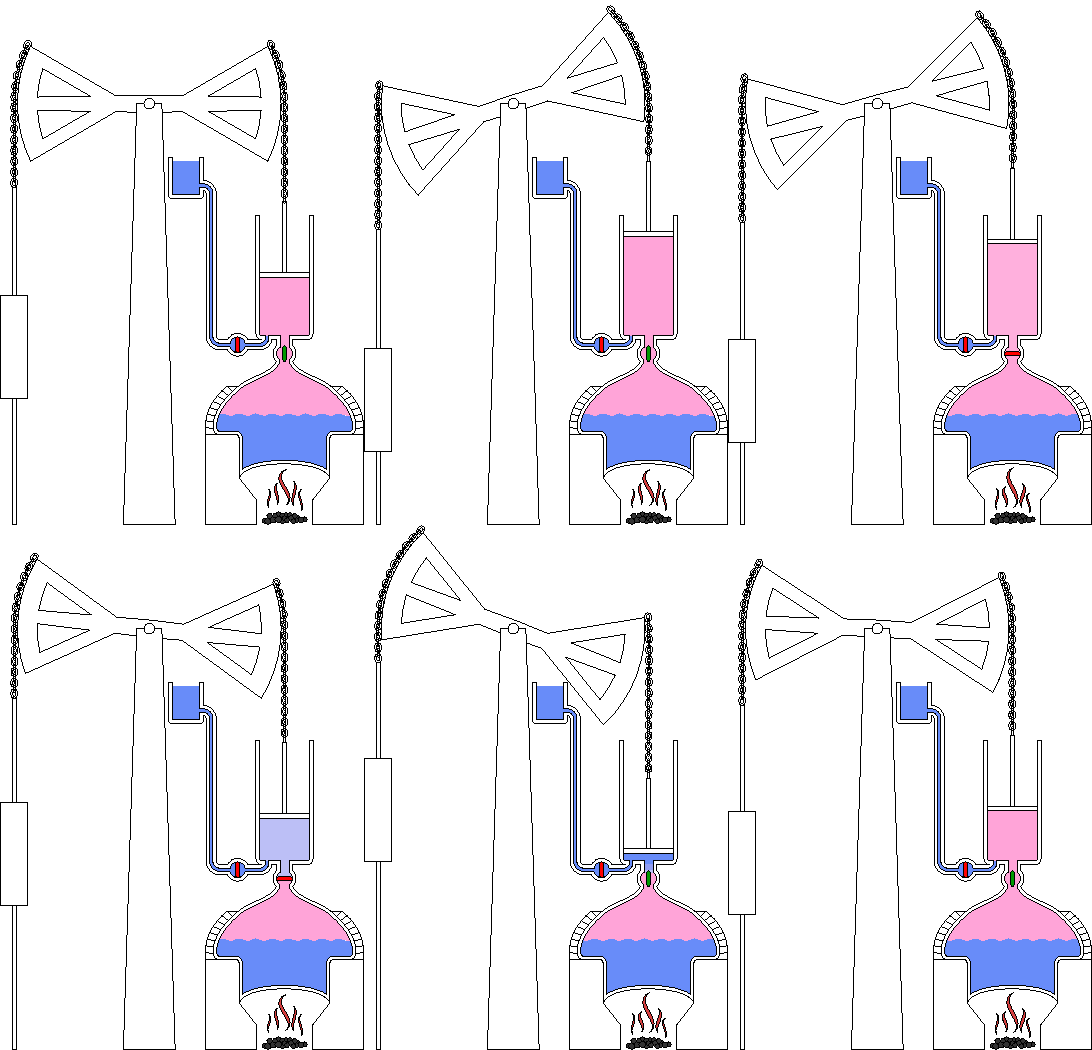
 After, Thomas Newcomen then developed the first steam powered machine. In 1712, Thomas newcomen invented another pump-like machine that was powered by steam. He wasn’t influenced by Thomas Savery but their ideas were similar. There would be a cylinder and a boiler under it with a valve in between them. The boiler would boil water and the valve would open to let the steam come through, pushing a piston in the cylinder that was connected to an arc head. this turns the other side pushing a piston down a cylinder that goes into the mine. A jet of cold water would then go directly into the steam cylinder causing the steam to condense creating a vacuum pulling the piston back down causing the other piston on the other side to come up drawing water with it. The valve of the boiler and the cylinder then opens letting the water in and then the whole process repeats again.
  After Newcomen, James Watt became very successful for the developments he made on the steam engine. James Watt worked very close with Matthew Boulton. In 1778, he officially completed perfecting his steam engine design. He had made very many improvements. He added a steam jacket around the steam cylinder to keep the temperature of the steam inside. More importantly, he put the condenser chamber a separate place. This made the machine improve by a factor of five saving 75 percent on coal costs because coal was what they used to boil the water. At the time, Newcomen’s engine could not be easily adapted to a wheel. This is not shown in the pictures but Watt developed his engine to have a centrifugal governor so he could control the amount of steam used, parallel motion so that a rod can move in a rotational direction without putting sideways strain on the horizontal rod, and a flywheel which stored energy through the torque given off by the rotating wheel.
They called the time period from 1760 to around 1840 the industrial revolution for a reason. Steam power became greatly developed during that time. It also became a much more efficient and a much more reliable source of energy thanks to Thomas Savery, Thomas Newcomen, and James Watt. Although it wasn’t the main source of energy, you have to remember, they were using coal, horses, and manpower to power things. Steam power opened up another possibility for newer and more efficient machines during the revolution.
Sources:

Alexander I really liked how you showed the moving steam pump! How did Pete Singer relate to the steam industry? Or are you just quoting him?
ReplyDelete- Gus
Hey Gus,
ReplyDeleteThanks for your comment. Pete Singer referred to the steam engine because right now, the steam engine is a mark in history that symbolizes a major development and revolution in technology. This is much like how the internet was a major change and milestone.
~Alexander Yu
Hi Alexander! I really like how you added the pictures to let us fully understand the function! I also really liked how you talked about the history and the significance of the steam engine!
ReplyDeleteHi Alexander, This was a very interesting post.Maybe you should have gave a brief description of the three men at the beginning of their story.You know like,where they were born,their early life.I really liked the pictures, they really went along with the story.
ReplyDeleteAlexander, I thought that this post did a wonderful job of capturing how the steam engine was created and perfected. I thought that maybe you could have added more about the inventions before the steam engines and how they led to the creation of the steam engine. I thought that not only the picture, but especially the GIF made the piece come to life. I thought the GIF really captured how the machine works and brought a very cool visual aspect to the piece. Great Job!
ReplyDelete-Nate
Hi Alexander,
ReplyDeleteyour post was very good it told us how it worked, and who invented it. I wish you gave more examples on what things use the steam engine. I really liked the GIF of the steam engine it made your piece really pop up, it was the reason why I started reading your post. It also helped me understand how the steam engine worked.
Great job!
-Matteo
Hi Alexander,
ReplyDeleteI thought your post was great. I loved the GIF of how it works, it was really informative. I thought the flow of the writing was great too!
~Josephine
Hey Alexander,
ReplyDeleteI love you post! I liked how you did the moving picture thingy. I also enjoyed how you explained the history of the development of the steam engine. If the steam engine hadn't been invented, what other energy would have propelled us?
Much love
Alex
Hi Alexander,
ReplyDeleteYou're post was very interesting and well researched. I enjoyed it because you really managed to show your love for science while sharing the facts and history of the steam engine. I have some questions:
Why did you choose this topic?
How was the water cooled?
What other technology did this lead to?
Thanks,
ACP
Hi Alexander,
ReplyDeleteVery interesting post, I learned a lot. The moving picture is really cool! I had no idea how it worked, but now I do! What got you interested in the steam engine?
Good job,
~Grace
Hello Alexander,
ReplyDeleteI could tell you did a great deal of research on this topic because it was very well explained. I think my favorite part about this post was that you could express your love of science while staying on topic. Thanks for sharing!
Thanks!
~Sydney
Hey guys,
ReplyDeleteThank you so much for all these comments. When I checked my post, I was like WOAH. First and foremost, I chose this topic because this is also what I did my puppet pals on. I felt like if I did my post on the same topic, I would have more time to research. Just to make it clear, Thomas Savery didn't actually invent a steam machine, he just made a pump. Newcomen and Watt were the people involved in the machine part. Thanks again everyone!
~Alexander Yu
Hi Alexander
ReplyDeleteFirst off I love the moving photos, awesome, and look at all the sources nice research I loved the post.
Eliot
Hi Alexander,
ReplyDeleteThe gifs you did are really cool! It's very smart of you to do this on the same as your puppet pals, so you could have more information and give me a more informative post. Great post!
Harry
Hi Alexander,
ReplyDeleteThank you for explaining the steam engine! You explained this very well. I feel like I have learned a lot from this. The gifs that you displayed were very helpful.
-Luke
Hi alexander,
ReplyDeleteI liked how you explained the engine. and I learned a lot from this.
-Greta
Hey Alexander!
ReplyDeleteI enjoyed reading your post, but what made you want to write about the steam engine?
Thanks!
-Quinn