Wednesday, February 29, 2012

Josephine and Napoleon

In the late eighteen-hundreds, A beautiful woman by the name of Josephé Rose Tascher la Pagerie who had two children and was not very young was required to be married to Napoleon Bonaparte a very young, not so tall, or handsome man. Josephine refused to marry Napoleon but when Barras threatened to stop providing for her if she didn’t marry him, she agreed immediately. When they got married Napoleon decided not to called her by a name that everyone called her such as, “Rose” and definitely didn’t want to call her, “Josephé Rose Tascher la Pagerie”! Napoleon wanted to be original so he decided on Josephine.
Their love for one another was very complicated. Napoleon Bonaparte her assigned partner, loved her deeply, but she despised of him strongly, thought he was very strange and was weird in the way he showed love. When Napoleon went to Italy, Josephine found her chance and immediately looked for someone new to have a relationship with. At the time Napoleon was sending her many love letters and even tried to get her to come visit him, she just pretended she was pregnant and couldn’t travel. When Napoleon heard about her on a trip away from Paris to get away from him, he was destroyed. His heart was torn to two and said that he would never love another woman the way he had loved Josephine. Soon after Napoleon’s true love betrayed him he was sent on a long trip for other rather important stuff.
 When Napoleon returned, His Wife Josephine had all of sudden finally fallen in love with him. Although he still loved her deeply he new that he could never trust her again. Napoleon had a series of affairs to try and move on from her although he new it would never work. Napoleon later divorced Josephine after finding that Josephine had played him and that they weren’t actually married by bible and married another woman whom he never loved, Marie Louise. He married to become Emperor of France. After 1-2 years of the marriage Napoleon realized his true love was Josephine. He divorced Marie and became a faithful friend to Josephine and her kids, Hortense and Eugene. 
Josephine continued to love Napoleon and when she was dying from a horrible disease called diphtheria, Napoleon’s name was one of the last words she was able to speak. After the tragic death of Josephine, Hortense and Eugene still remained faithful and Napoleon helped take care of Josephine’s beautiful children.

The Eiffel Tower

  Construction for the Eiffel Tower, nicknammed la dame de fer the iron lady in french, began in 1887. The tower was constructed for the World's Fair that was happening in Paris, the capital of France. The building was completed in 1889 only two years after construction began.
It took three hundred workers to build and is almost entirely made puddle iron. Émile Nouguier and Maurice Koechlin were the engineers and Stephen Sauvestre was the architect. Unlike most modern sky skrapers the Eiffel Tower has an open frame and doesn't have floor after floor it instead has two levels and a top where you can actually get off the elevator.
Although the open frame and few floors make it more dangerous to construct on only one worker died while working on the construction due to the safety precautions like guard rails. When the tower was first opened to the public many people complained about it and said that it looked like a dark blob had eaten up a block of the city. One man hated the Eiffel tower but ate lunch inside it everyday when asked why he did it he replies that it was the only place in town where you couldn't actually see the tower. Now a days it is considered one of the places to see in Paris and is a major tourist attraction
.
If you do go to Paris I would highly suggest going to the Eiffel Tower however my favorite time to visit is during the night if you go to the top you can see the hole city in bright lights. I would also recommend visiting L'arc de Triomphe and le Musée D'orsay.

The Eiffel Tower

     We all know or have heard about the Eiffel Tower.  We know that it's one of the attractions that Paris is most famous for.  But you probably haven't heard about who built it, why it was built, when it was built.  The Eiffel Tower is one of France's most famous monuments. 
     The Eiffel tower first was thought up by Alexandre Gustave Eiffel.  That's where the "Eiffel" part came in.  The plan was to build the Eiffel tower for the International Exhibition of France in 1889, a commemoration to the 100 year anniversary of the French Revolution.  Now, this was going to take a lot of effort and hard work in order to build a tower that would be known as the tallest building until 1930.  There would need to be roughly 300 workers to build the Eiffel Tower.  Once everything was in order and ready for go, the task could finally begin.  

tumblr_l99mb3fmX11qzy0ygo1_500.jpg

     It took lots of commitment to be a builder of the Eiffel tower.  First off, a builder needs to be willing to work for two years on this tower.  Second, they had to be aware of the fact that they, in the smallest of possibilities, could die.  Nobody wanted to be like this one man who was trying to impress his girlfriend by showing her what he was working on and lost his grip,  fell to the ground, and died.  All of the workers worked so hard and made LOTS of progress within those two years of building the Eiffel Tower.  When building the Eiffel Tower some of the materials used were:
  • rivets
  • paint
  • big iron pieces                                                                                                                                                                                             
Eiffel Tower construction video:

     The Eiffel Tower was very wonderous as a monument representing something, but also was very modern at the time.  The Eiffel tower was the first building/tower to have a radio communicator.  This was ground breaking because there had never been anything like this before and would be a milestone in technology history.
     Now, the next time that you are studying, learning, or talking about the Eiffel Tower, you can not only say, "I've heard of that!", but explain and describe about it!

Some interesting facts:
  1. 2.5 million rivets
  2. 300 steel workers, and 2 years (1887-1889) to construct it.
  3. Sway of at most 12 cm in high winds.
  4. Height varies up to 15 cm depending on temperature.
  5. 15,000 iron pieces (excluding rivets). 
  6. 40 tons of paint. 
  7. 1652 steps to the top


Sources:
  • http://www.corrosion-doctors.org/Landmarks/eiffel-history.htm 
  • http://www.google.com/imgres?q=eiffel+tower&um=1&hl=en&safe=active&sa=N&biw=1024&bih=619&tbm=isch&tbnid=-5sWtWKtunY09M:&imgrefurl=http://www.visitingdc.com/paris/eiffel-tower-picture.asp&docid=EhpqoqIxLoL1CM&imgurl=http://www.visitingdc.com/images/eiffel-tower-picture.jpg&w=385&h=540&ei=h9JOT4PDAobNmQX7xt2rCg&zoom=1&iact=hc&vpx=660&vpy=112&dur=3816&hovh=266&hovw=189&tx=70&ty=97&sig=116451267379753103044&page=1&tbnh=132&tbnw=94&start=0&ndsp=20&ved=1t:429,r:4,s:0
  • http://www.eiffel-tower.us/Eiffel-Tower-History.html

    The revolution of mining


    Mining has been important throughout the the centuries, and coal mining has been the most important type of mining. The coal was used for machines in factories and steam engines. Without coal the industrial revolution wouldn't have happened. Also there would not be the same products today without coal or the industrial revolution. Coal mining is very dangerous and many people have died throughout the centuries. There has been a lot of changes in coal mining. For example, below is a table showing the amount of coal mined in one mine over different segments of 50 years:

    1700: 2.7 million tons
    1750: 4.7 million tons
    1800: 10  million tons
    1850: 50  million tons
    1900: 250 million tons

    In this mine an average of 58 out of 349 people died in a year.
    In most mining towns the people are very poor. They cannot support their kids unless they send them to work at a very young age. The few jobs kids could do included bringing fresh air into the mines, and carrying coal and tools back and forth. There was a report published saying that kids under 5 years old worked underground as trappers for 12 hours a day, making only 2 pennies a day. One girl, at the age of 11, had to do 20 trips per shift pushing a tub which weighed over 300 pounds. Pregnant women had to work until their baby was born, and they had to go back to work sometimes as soon as a day after. If they showed signs of weakness the owners of the mines would  whip them, and they would lose their jobs if they complained or reported it.

    Trappers were used to let methane gases out, and they helped to cause cross-draft so that the workers could have fresher air. The kids would sit at the small doors, opening the doors as trains went through the mine. They also believed that the doors when closed, would prevent explosions from spreading from one section of the mine to another.

    The miners, after a couple of years of operation, had to dig deeper into the ground in order to find coal. The mines had reached as deep as 1500 feet under ground during the time of the industrial revolution. There is a lot of methane gas down that deep in the earth, and it can easily catch on fire and explode. Other deaths occurred from falling down mine shafts, drowning in dirty water used to move dirt and rocks quickly, and being run over by mine trains carrying coal.

    Gettysburg


                The battle of Gettysburg was one of the most substantial accidental battles. Both the confederate and union armies weren’t planning on fighting in Gettysburg. All the roads around Gettysburg go through Gettysburg. On a map it looks like a bicycle with the roads as the spokes. When the North ran into the South, the only option was to fight.
                Coming into the battle, the South was dominating their way up the south, and into the north. With the North on the run they were in hot pursuit. Following the roads, they ran into the North a little west of Gettysburg. After pushing the North into town, and then out into the mountain range, the South was unstoppable. Although they had a great chance of beating Meade and the North, they lost their chance and were crimpled. They were fighting for slavery and states rights, for the South. They were a group of states built on nothing but farming. To the South, The North was a bunch of snooty rich people afraid to get their hands dirty, but did they get that one wrong.

    Day 3 of the Battle of Gettysburg
                After suffering many defeats in the south, the North was on the run. They were trying to make it back home, but ran into the South. They were outgunned and outmanned, which resulted in a hasty retreat. After they made their hook formation on the ridges, the North, under command of George Meade, knew that they couldn’t let the South into their homes. After some poor decisions from the North sergeants, the North almost lost, but just barely got by. They held off Picket’s charge, and kicked the South
    right out of the North. After this slim victory, the North, who hadn’t been too engaged in the war, woke up. With help from president Lincoln, they came together and started to really turn the war.
                Gettysburg was a real turning point in the civil war. As one of the two battles fought in the North, the Union fought hard and strong and eventually claimed victory over their former brothers. With an end to the war, came changes. Three new amendments were instated: the outlaw of slavery, the establishment of citizenship and due process, and the right to vote for all male citizens. Only a short while after the war, president Abraham Lincoln was assassinated. Also post war the North was hardly touched, but after the charge to the sea, the South was a disaster. All the land and farms were destroyed. The South still has never forgiven the North for that.
                The Civil war really changed America into its current form. If it weren’t for president Lincoln, there would never had been the emancipation declaration, and without that there might still be slavery today. The Civil war was made up of many battles, but out of them the entire one that turned the tide the most, was the battle of Gettysburg.
               
                http://www.history.com/videos/the-battle-of-gettysburg#the-battle-of-gettysburg
    Short Summery video of Gettysburg

    Tuesday, February 28, 2012

    Le Petit Colón

    The little colonel, Napoleon, was regardless one of the great leaders of early nineteenth century France; he cast a massive shadow over Europe despite being vertically challenged. He was a great general who was viewed as a comrade as apposed to a general existing in a luxurious tent. Napoleon Bonaparte was one of the most popular commanders in nineteenth century times; he had a unique mind for battlefield tactics, and a great sense of timing in warfare. Undeniably Napoleon was an incredible general, but when examined in depth was flawed in judgment.
    As Napoleon grew threw the ranks of the French military he grew immensely in popularity and wealth. General Bonaparte began with small victories where he was granted the opportunity to lead; he thrived immensely and was soaring through the French military system. France was not in a healthy economic state as Napoleon was rising. France was suffering from major food shortages, loathed monarchs, and many unsuccessful battles. France was primed for a revolution, which came in 1789. The citizens of Paris attacked the monarchs and King Louis XVI and Marie Antoinette were eventually guillotined. Maximillian Robes-Pierre sparked the revolution and was now leading France. He quickly became drunk with power and was bringing France into even deeper troubles. Robes-Pierre led France into the Reign of Terror a horrible time for citizens, with mass executions being held daily. As the people of France were unhappy without the government that they had been promised prior to the revolution this set the stage for a new leader to emerge.
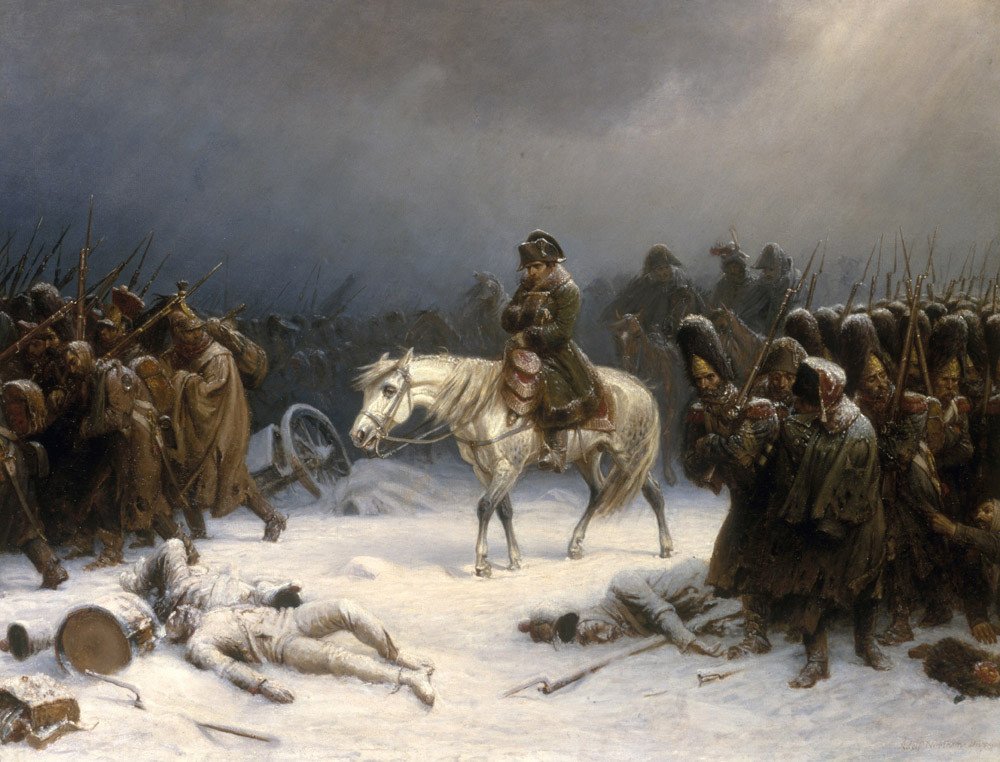
    Napoleon Bonaparte’s preferred method of action was understandably conflict based on his military background since the age of nine. As the age of monarchy in France was passed the unsteady state of government and society left France vulnerable to outside attack. France was clearly wrong at this time, using the strength of a crumbling military to kill it’s own people rather than defending from the inclosing nations. Napoleon swiftly rose as the leader of France’s military in dire straights. The invasion of France from Prussia was quickly led away. Napoleon headed a successful invasion of Italy shortly after being appointed leader. This invasion truly gave Napoleon a taste of victory in combat, something that he had not experienced because of him constantly being on the defensive. The military’s success continued in 1797 as Austria, Belgium, and Holland became part of France. However Napoleon was not content with these victories and invaded Venice, robbing the city of many of their most valuable art treasures. Later Napoleon invaded Egypt, the great success of France on land did not continue in the sea and the British navy dominated the French ships in the battle of the Nile. After this defeat Napoleon returned to France, which was again under attack in the north and south he saved France and appointed himself First Council the most powerful man in France. Few years later in 1804 he crowned himself emperor of France, and Britain, Austria, Russia and Sweden joined forces in an attempt to defeat him. In 1805 he smashed both Russia and Austria in one of his most brilliant battles ever and was now virtually the leader of Western and Central Europe. In 1808 the one European country still threatening France was Britain, Napoleon promptly shut off all trade with Britain and continued his conquest over Europe invading Spain. Placing his brother on the throne Napoleon returned to France ordering generals to invade Portugal. In 1811 the Duke of Wellington managed to end the war in Spain and Portugal defeating the French troops. In 1812 Napoleon made his largest, gravest mistake invading Russia. Napoleon had grown power hungry and his judgment had clouded, although France managed to take Moscow, similar to the German Nazis one hundred fifty years later were unprepared for the harsh Russian winter. The casualties in Russia were immense, there were 300,000 men lost in Russia. In 1813 Prussia, Austria, and Britain closed in on Napoleon forcing him back to France, months later Napoleon refused peace offers and the allies invaded, Paris fell in March, 1814 and in April he was exiled to the Mediterranean island of Melba. In only a year Napoleon escaped and returned to power with an army, again the neighboring countries planned to invade. Napoleon attacked his enemy the Duke of Wellington in the battle of Waterloo but was unable to repeat his success, and France again fell. Napoleon was again exiled to the remote Atlantic island of St. Helena where he died in 1821.  Napoleon Bonaparte was immensely respected even by his foes. When his nemesis the Duke of Wellington was asked whom the greatest general was he replied, “In this age, in past ages, in any age, Napoleon.”

    Napoleon by, Jacques-Louis David

    Napoleon leading on horse back

    Napoleon was a beloved leader who brought immense success for France, his troops enjoyed serving under him, and who had an unrelenting thirst for power. Although he became clouded with his talent and the power he had gained he remained and still remains one of the most respected military generals, and leaders of all time. 

    Happiness :)


             Most people say that money is the key to a better life, but really it's not. A better life can't be based off of what brands you wear, or house you live in. It is actually based off of happiness. Researchers show that to live a happier life, you should...


    • Create rituals around the things we love to do.
    • Express gratitude for the good things in our lives.
    • Set meaningful goals that reflect our values and interests.
    • Play to our strengths instead of dwelling on weaknesses.
    • Simplify our lives — not just the Stuff, but the time.

              Of course, money can buy happiness, but it also can lead to extreme unhappiness. Paying your mortgage can feel great, but not paying your mortgage. Well, not so much. My point is; money is a roller coaster, while happiness is a smooth ride along the beach. Many people often work harder to get the bills paid, and this obviously doesn't make life any easier.

              Having good friends is one of the biggest reasons to be happy. Friends that you can trust, rely, laugh with, cry with, hang out with, talk to, and love is all another reason you should be happy. Creating memorable times together is a great thing to do to boost yourself up one notch on the happiness scale. 

              Time management! Another one of the most important things to have in a happy life. Creating time for your friends, family, and yourself. Researchers show that the more hobbies you have, the happier you will be. This is both true, and not true. Having many hobbies is a good thing, but not too many. You don't want to jam your life with things you love that your whole calender is full. Create some space for your family and friends, or just a little calm time to yourself.


              Living in the present. This is a great thing to do because if you live in the future, most times you expect something marvelous, or extraordinary is going to happen, but when whatever you were wishing doesn't happen, you get sad, and all of the happiness that you expect just goes away.


             Happiness is important, but don't work too hard to grab it. It will eventually come to you if you pass it on to others.


    Sources for both facts and images:

    • http://www.getrichslowly.org/blog/2009/12/28/its-more-important-to-be-happy-than-to-be-rich/
    • www.google.com/search?tbm=isch&hl=en&source=hp&biw=1275&bih=620&q=happiness&gbv=2&oq=happiness&aq=f&aqi=g10&aql=&gs_sm=3&gs_upl=1049l3727l0l3983l9l9l0l4l4l0l112l372l4.1l5l0#hl=en&gbv=2&tbm=isch&sa=1&q=happy+faces&pbx=1&oq=happy+faces&aq=f&aqi=g10&aql=&gs_sm=3&gs_upl=8588l11745l0l12145l16l16l1l1l1l0l143l955l13.1l14l0&bav=on.2,or.r_gc.r_pw.,cf.osb&fp=f0cef3f10d934053&biw=1275&bih=620
    • www.google.com/search?tbm=isch&hl=en&source=hp&biw=1275&bih=620&q=happiness&gbv=2&oq=happiness&aq=f&aqi=g10&aql=&gs_sm=3&gs_upl=1049l3727l0l3983l9l9l0l4l4l0l112l372l4.1l5l0#hl=en&gbv=2&tbm=isch&sa=1&q=happy+friends&pbx=1&oq=happy+friends&aq=f&aqi=g10&aql=&gs_sm=3&gs_upl=63319l64148l0l64405l6l6l0l3l3l0l78l228l3l3l0&bav=on.2,or.r_gc.r_pw.,cf.osb&fp=f0cef3f10d934053&biw=1275&bih=620
    • www.google.com/search?tbm=isch&hl=en&source=hp&biw=1275&bih=620&q=happiness&gbv=2&oq=happiness&aq=f&aqi=g10&aql=&gs_sm=3&gs_upl=1049l3727l0l3983l9l9l0l4l4l0l112l372l4.1l5l0#hl=en&gbv=2&tbm=isch&sa=1&q=happiness+quotes&pbx=1&oq=happiness+&aq=0&aqi=g10&aql=&gs_sm=3&gs_upl=20668l22354l2l23825l10l10l0l4l4l0l154l492l5.1l6l0&bav=on.2,or.r_gc.r_pw.,cf.osb&fp=f0cef3f10d934053&biw=1275&bih=620
    • www.google.com/search?tbm=isch&hl=en&source=hp&biw=1275&bih=620&q=happiness&gbv=2&oq=happiness&aq=f&aqi=g10&aql=&gs_sm=3&gs_upl=1049l3727l0l3983l9l9l0l4l4l0l112l372l4.1l5l0#hl=en&gbv=2&tbm=isch&sa=1&q=happiness&pbx=1&oq=happiness&aq=f&aqi=g10&aql=&gs_sm=3&gs_upl=22489l23561l4l24065l7l7l2l0l1l0l63l299l5l5l0&bav=on.2,or.r_gc.r_pw.,cf.osb&fp=f0cef3f10d934053&biw=1275&bih=620
    • http://en.wikipedia.org/wiki/Happiness
    • http://www.happiness-project.com/


    Intertwined


    "Do not wait to strike 'til the iron is hot; but make it hot by striking."
    --William Butler Yeats 
    Iron is embodiment of the oppressed, and heat is fire of revolution. Revolution is a constant in the universe. Revolution is the driving force in human development. Revolution also forms connections between peoples and nations. One of my favorite revolutionary connections
     is between the U.S. and France at the turn of the 19th century.  The fates of the French and American civilizations inexorably intertwine in the 50 year span of 1765-1815. The British colonies on the eastern side of the Appalachians both directly, and indirectly caused the abdication and restoration of the Bourbon monarchy.
    Louis XVI
        It all began in the Seven Years War and Louis XV. Though this war took place in many theaters, one of its consequences was the loss of its holdings on mainland North America. In this theater, France was not only fighting with the British and the Iroquois Confederacy, but also the colonial citizens, who in this war, created new identity of nationalism that would arise as a new nation fifteen years later.This war also was first step for the future French Revolution. The loss of both the war and many overseas territories bankrupted France, causing the peasantry to pay much higher taxes. This not only caused a discontented populace, but also a starving one, the higher taxes on the populace meant less money for bread.
    In 1775, the North American colonists, many of which had fought against the French in the Seven Years War, were taking up arms against their British overlords. Rebelling colonists only wish to have one thing, freedom from the political bands that bind them to their oppressors. This wish would soon take root in France, and set the world aflame.
    The American Revolution had a rocky start, and quite nearly was ended at the battle of Saratoga. If They had lost this battle, the revolution would have ended, and the new king of France, Louis XVI, would not have committed the vast resources the Americans needed to win the war.
    He committed a grand total of 2,000,000,000 Livres, enough money to feed and house 7 million french citizens for a year. This use of the money would later  come back to haunt the monarchy.
    Though the war of American independence proved to be a improvement for the U.S., it created horrible financial debts for France. And, due to the way the French social pyramid was set up, the debt was payed off by, guess who, the starving peasants! This was step two in the sequence. The French peasants were broke, starving, and oppressed; the perfect ingredients for a revolt. Inspired and embolden by the successful revolution across the sea, in 1789, the people rebelled, and created their own revolution.
    Although I would much enjoy giving a complete summary of the French Revolution, I don’t have time for that in a single blog post. I will instead jump ahead  23 years to 1812. Right now, Napoleon’s regular troops are fighting British and Spanish forces in the Iberian peninsula, Tsar Alexander I has broken the treaty of Tilsit and has begun trading with the British Isles, and American merchant vessels are being raided by English warships in the Atlantic.These infractions quite possibly led to the restoration of the French monarchy.
    Due to the loss of trade revenue, loss of American life, and because the newly formed United States didn’t like being walked on, they declared war on Britain. Britain, anxious to settle the score with its former colony, committed soldiers, ships, and money, that was needed in Europe to combat the forces of Napoleon. Bonaparte, seeing the diplomatic tensions rising between the two nations saw it as an opportune moment to use the quarter of a million men he had been stockpiling in Poland to teach the Russians a lesson about breaking embargo treaties.     Though Napoleon invaded the country before he knew of the public declaration of war between the U.S. and Britain, he saw it as a diversion for the British the would lessen their threat in Iberia long enough for his six week war in the western plains of Russia. These were the two greatest mistakes of the French emperor; thinking the war with Russia would be a decisive victory in one massive engagement on the open plains of eastern Europe, and thinking that Napoleon’s veteran troops could hold off the “weaker” British forces until his return shortly after.
    After Napoleon’s doomed march on, and retreat from Moscow, his invisibility was shattered, his grande armee was dead, and his security gone, within 2 months, Coalition forces had surrounded Paris, and Napoleon abdicated, giving rule of France back to Louis XVII, the surviving heir of the monarchy.  
    Revolution is a self oxidizing flamed that cannot be extinguished and humanity is the iron that only through the heat of revolution can be shaped. As seen above revolutions can shape the world by accident through chain reaction. From Saratoga to Waterloo, Quebec to the Bastille, the revolutions in America and France created each other and resolved each other. They are linked in the eternal bond of history, never to be ripped apart.  If even one of these twin revolutions never took place, Britain would still rule the Americas, and Napoleon Bonaparte would be a worthless artillery captain with unused potential--not the Emperor who would set a spark to the kindling of the world.

    Monday, February 27, 2012

    Making a model guillotine


    I decided early on in the fame project that I wanted my do-make to tie into by teach a class about the storming of Bastille and the rest of the French revolution. So I decided to make a Guillotine. Once my Proposal was accepted I immediately went to the hardware store and bought five different pieces of balsa wood. I got three 2cm x 2cm by 90cm pieces of wood and one 1cm x 1cm by 90cm piece of wood. I also got two other thin sheets of balsa. I cut two of the 2 by 2s and the one 1 by 1 in half with a hand saw and made the tall beams with them. The way I glued them together was: half a 2 by 2 then in the middle a 1 by 1 and on the other side was another 2 by 2 Like this:
    It created a groove for the blade.

     I then used my last piece of 2 by 2 and cut out the supports with a handsaw. I attached the supports with glue and screws and then screwed the two beams on.

    Then I used some metal I had and cut it in half with a 45 degree cut using a hack saw and used screws to attach the metal from the side supports to the two beams.

    Then I made the Blade by cutting some metal into a 45 degree edge and attached it to a piece of thin balsa with three screws and then drilled a hole in the top of the wood for the string to go through.

    Next thing to do was the table where the person would lie. I used 1 of my sheets of thin balsa wood and cut two pieces from it I glued the first one vertically onto the front support. Then I glued the other sheet square to the first sheet and glued it the space between the two beams and where it met the other sheet.

    Now it was time for the Lunette or the thing that the executed put their head in I cut a square piece out of the leftover balsa wood and drilled a hole in the center. I then cut it in half and glued the bottom piece to the two beams I then created a rail for the top lunette to slide on using a similar technique as when making the groove in the two beams

    I then made the top and cut out a design and glued the top on and gave the hole guillotine a coat of brown spray paint

    I screwed an “I hook” into the top upside-down. Then I drilled a hole in the side of one of the beams and threaded a string though it.

    I then tied the string to the wood connecting it to the blade and I was done!


    The French Invasion of Russia


    Napoleon, the emperor of France, was a power hunger leader and wanted to conqueror all of Europe. The Austrians, who were in an alliance with France at the time, were annexing the Grand Duchy of Warsaw. The Russians thought they were going to try and invade Russia. The Russian’s were also trading with England, which angered Napoleon. Russia invades Poland, so Napoleon tries to take Russia. This is the beginning of the end in the Napoleonic Wars.


    The French overextended themselves. Napoleon thought that he was going to engage Russia in a couple battles, but the Russian’s fought skirmishes and move back. Napoleon had to leave men behind, so that they could guard the supply routes and protect their land.


    Napoleon started invading in the fall, then he could avoid the winter. When the fall came it was the harvest season. That meant they didn’t have to guard there supply routes as carefully, because they could just take the food from the farmers. The Russians burned their field’s as they retreated, so then the French couldn’t eat from the local fields, and would keep having to bring their supplies through a supply line.

    Their army was weakening very badly, but they made to Moscow after a very bloody battle called Battle of Borodino. Napoleon was able to win that battle, but had thirty-five thousand casualties, and Russia had forty-four thousand death’s. France did end up with the victory. The French made it to Moscow expecting to eat there food, and restock on there supplies. When they arrived the city was deserted, all the food and supplies had been taken. The city was on fire too.
    The French army had to retreat, because they were deprived of resource. They weakened even more as Russia attacked them with different forces. The forces were from peasants to organized units of soldiers. They final attack on the French was when the Russia attacked them while they were trying to cross the Berezina River. When the army returned back to France, four hundred-forty thousand French soldiers had died.
    That wasn’t the end of Napoleon. The United Kingom, and Austria had joined the Coalition. France lost the battle in the War of the Sixth Coalition. Napoleon was captured and exiled to the island of Elba. This was one of the most important wars of the Napoleonic Wars. This was the turning point of the war, the undefeated French army was defeated, and started the War of the Six Coalition.             

    (Charles Minard's graph. This show's how many people Napoleon had and lost. The yellow is the size of Napoleons army when he started and the black is when he ended)


    Khan, Salman. "French Invasion of Russia." YouTube. YouTube, 23 Apr. 2010. Web. 26 Feb. 2012. <http://www.youtube.com/watch?v=F_ySQvjtAxQ>.

    "French Invasion of Russia." Wikipedia. Wikimedia Foundation, 26 Feb. 2012. Web. 26 Feb. 2012. <http://en.wikipedia.org/wiki/French_invasion_of_Russia>.

    The Great Railroad Strike of 1877

          The Great Railroad Strike of 1877, or the Great Upheaval, began on July 14th in Martinsburg, West Virginia. It ended about 45 days later.
    The engines being blocked in Marinsburg, July 16th 1877.
          After the Civil War ended, railroads started become begin very popular. 35,000 miles of new track was laid coast-to-cast between 1866 and 1873. After agriculture, the railroad construction was the highest employer. The industry needed lots of investment, but investing in the construction was very risky. Jay Cooke's firm, a banking firm was investing in railroads, but at a disproportionate amounts, almost creating disaster.  Jay Cooke's firm was used as a gateway to get land grants and loans, that only the government could give out. This made Cooke's effect on the nation's economy mush worse.
         Railroad workers began to have disagreements with the leaders of the industry. By 1877, poor working conditions, 10% pay cuts and more led to a large number of strikes all around the country. These strikes later led to the labor unions of the U.S.
    Many of the railroads mentioned
    are the same as the ones in monopoly.
         On July 14th, 1877, in West Virginia, the strikes began. After Baltimore and Ohio Railroad (B&O) cut wages for the second time, a number of workers started a strike, until the second cut was revoked. State militia units were sent to restore the train service, but the militiamen refused to use force against the strikers. The governor called in federal troops, who he knew would do the job.
         In Cumberland, Maryland, while this was happening, workers stopped all freight and passenger traffic. In Illinois the rails were blocked up by angry mobs of unemployed citizens, shutting down both the B&O and the Illinois Central Railroad.
         But, the most brutal and violent strike, was in Pennsylvania. Thomas Alexander Scott, who worked for the Pennsylvania Railroad, suggested that the strikers should be given "a rifle diet for a few days and see how they like that bread." Local law refused to do as requested until, it became clear on July 21st, that it was the only thing to do. Militiamen bayoneted the strikers, killing 20 people and wounding 29 others. The strikers became very angry and the militiamen had to take refuge in a railroad roundhouse. The strikers set fire to 39 buildings, destroyed 104 locomotives, and also destroyed 1,245 freight and passenger cars. In Reading, the third largest industrial city in Pennsylvania, 16 citizens were killed by state militia during the Reading Railroad Massacre.
         That is only the beginning of what happened during the rough 45 days of the Great Upheaval.
    it ended when the President, President Hayes, sent federal troops city to city. They suppressed the strikes until finally, all the strikes were over.


    Photo Credits:
    http://en.wikipedia.org/wiki/File:Harpers_8_11_1877_Blockade_of_Engines_at_Martinsburg_W_VA.jpg

     http://www.google.com/imgres?hl=en&biw=806&bih=723&tbm=isch&tbnid=ZtLflletUD-_1M:&imgrefurl=http://boards.theforce.net/census_and_games/b10264/28554956/r29422899/&docid=DqKPCulmi_3iMM&imgurl=http://www.snapdrive.net/files/522046/Monopoly/B%252520%252526%252520O%252520Railroad.Gif&w=208&h=236&ei=fp5KT6mSDIabiAK9oKnaDQ&zoom=1&iact=hc&vpx=294&vpy=89&dur=271&hovh=188&hovw=166&tx=128&ty=122&sig=104832587460217101678&page=1&tbnh=140&tbnw=123&start=0&ndsp=12&ved=1t:429,r:1,s:0

    http://www.google.com/imgres?hl=en&biw=806&bih=723&tbm=isch&tbnid=cdd5f_pu_pkNXM:&imgrefurl=http://www.stonecoldmagicmagazine.com/free-monthly-magic-trick/mental-monopoly/&docid=nTITxRMJOPOkDM&imgurl=http://www.stonecoldmagicmagazine.com/images/free-tricks/monopoly-reading-railroad.png&w=201&h=220&ei=fp5KT6mSDIabiAK9oKnaDQ&zoom=1&iact=hc&vpx=318&vpy=20&dur=63&hovh=176&hovw=160&tx=122&ty=97&sig=104832587460217101678&page=6&tbnh=170&tbnw=155&start=62&ndsp=13&ved=1t:429,r:1,s:62