Monday, February 27, 2012

Lost Stories of The French and Indian War

                           There are many things that are forgotten about the French and Indian war. Not because they're unimportant, but because focusing on them would take a whole other blog to talk about, this is that blog. This is also the blog which does not include the things that you can find on any random website, such as causes, battles, etc.

                            It is interesting why the French and Indian war was named so.In those times, wars in the new world were named after the monarch. So why wasn't this war not named King George's war after the monarch King George II, because there already was a King George's war ten years prior. The King George's war began after the War of Austrian Succession, a diplomatic war during which Britain's hostility with France grew, and these hostilities would soon lead to war. This was the first step to the French and Indian war, Britain besieged and captured Louisbourg, a big city in New France, and France replied by destroying the British city of Saratoga, New York and Capturing the British colony of Madras, India. The War would end when a treaty was signed to trade Louisbourg for Madras, and there was peace between the countries, until the French and Indian war started.


                Now we understand why they called it the French and Indian war. it was named after their enemies because there already was a war name after the monarch, but were the Indians their enemies. In fact, The Iroquois Indians were allies to the British, and the Colonists. While the french were aided by the Huron and the Algonquin Tribes. In the Queen Anne war, which was also a predecessor of the French and Indians war. During that time the Iroquois signed a peace treaty with France, but would take sides with the British and help them lead attacks at the French. After Queen Anne's war, the Iroquois hoped to keep peace with Britain. Soon, though, colonists would expand beyond the agreed land between the Iroquois and the British. Since the British did not have the military to forbid expansion, the Iroquois would be forced to keep selling their land until they were pushed back to the Tennessee river. The Iroquois joined the British when the Iroquois' enemy of The Algonquins joined the French, but it was also because they hoped to keep the British as an ally going forward. Later, during the American Revolution, the Iroquois would split up and join sides between the Colonists and the British, both of whom they fought with in the French and Indian war.

             After the French and Indian War, the main thing people focus on is Britain's expansion without having to worry about the French, but something might be even more important in history is the state of poverty France was left in after the war. France was bankrupt, it had no resources, and their population growing. Combine no money, no resources, and more people... not good. Above all that, the royal family was misusing their money which they didn't have. This started the French Revolution, which began an era of math, science, and blood. Unfortunately this is not the blog that talks about the french revolution. This is the blog about the lost stories of The French and Indian war, which I hope are not lost anymore.

Sunday, February 26, 2012

The History of Cannons

Cannons were some of the most important weapons on the battle field. Normally if an army didn’t have cannons they wouldn’t win the war.
    Cannons were invented in China and were some of the first forms of artillery. They replace siege engines and other out dated military equipment. The first cannons used in Europe were used in the war between the Spanish and the Islams. The English first used cannons during the Hundred Year War. During the middle ages, when the cannon was first made, it was very bulky and non-maneuverable. The cannons of the middle ages were replaced with lighter, more maneuverable cannons. Now they had wheels and could be moved by man or by horse.
    Cannons were put on ships for naval battle during the early revolutionary period. England had cannons that could fire farther away then any other military force. One of their tactics was to put their ships outside of the range of the enemy cannons and just pelt them with cannon ball after cannon ball. The Carronade, a kind of cannon, was developed by the Royal Navy. It had a smaller barrel length and had slower velocity. It was used to create more wooden splinters in the enemy ship.
     During the 19th century cannons got longer and more accurate. The Americans made the Griffin Gun. It had a range of over a mile. Cannons were very important to Napoleon’s rise to power. At the battle of Waterloo, Napoleon had more cannons the n the English or the Prussian, but it was very muddy out so Napoleon could not move his cannons as fast. When the cannons fired, the recoil would bury them in the mud and the troops would have to get the cannons out of the mud, causing a slower rate of fire. Also the round cannon balls did not ricochet with as much velocity off of the soft ground.
    In 1855 rifling became very popular with cannons. rifling is when spiraling lines are put on the inside of the cannon barrel to increase accuracy and range. One of the earliest rifled guns was the Armstrong Gun. The maker, William George Armstrong, said that it had better accuracy, range, and power then a cannon without rifles. He also said it could go through a ships side and explode in the center, causing more damage. The British were impressed and adopted it into their navy.
    Cannons started to be less and less used as technology got better. Soon everyone stopped using cannons all together. In the mid 1900s most of the armies stopped using cannons.

Matt

http://www.nzhistory.net.nz/files/images/armstrong-gun.jpg

http://revolutionarywarantiques.com/images/molly-pitcher.jpg

Friday, February 24, 2012

Feeling stressed?

So as most of you know my life has been getting pretty hectic. I have three new sisters, my mom is a state senator now, I play volleyball for a competitive club team and I have a tournament every other weekend if not every weekend. My life is pretty stressful because of all of this. On top of everything, I have all of my homework, including the Revolutions project. I have a lot of good tips about ways to reduce stress or get rid of it completely.
One of my first tips is to make sure that you don’t work on one thing for a long time. I know that teachers are always telling you that you should space out work, and for a while, I ignored those tips like most of you probably do. I started pacing my work better. If I had a lot of math homework, for example, I made sure that I did half of the problems then worked on something completely different for at least 20-30 minutes. I then go back to my math and finish it up. When I do this, I end up actually finishing my work quicker than I would have, and I usually do it better than I would if I had done it all at once.
A tip for your home life, is that when you are having trouble with someone in your family or even if they are just stressing you out, then make sure that you find a way to separate yourself from them in a polite way. When I am really tired or just not in a great mood, if one of my sisters, new or old, starts to get on my nerves, I make sure that I let them know that I am really tired and I tell them I need a little bit of alone time. I usually go up to my room, just find a special space in my house, and read or play on my phone, listen to music, or maybe even just choose my clothes for the next day. I always make sure that what I am doing is not stressful at all. When I do get so stressed that I have to go up to my room for alone time I never do homework. If I try to do homework, it just gets me more and more stressed.
When your other commitments, besides school (or work for the adults who read this), get you stressed make sure that you plan your time well. Try to finish your homework before your activity if it is in the evening. If you can’t finish you homework before hand, try to make sure that you don’t spend a lot of extra time after your activity is over and try to get straight home. Also make sure that you use your advisory or study period well.
Also for me, at home since my mom has become a state senator she has been driving to Salem almost everyday. Seeing that Salem is about a hour away, she doesn’t get home until really late sometimes. Also since I have three new sisters, my dad has to spend a lot of time helping them get comfortable around the house and bring them to their activities and to school and all of that type of stuff. I definitely don’t get nearly as much attention as I used to and that makes me a little bit sad at times. I also don’t get as much help with my homework. This definitely stresses me. I always try to remember that I have had 13 years to spend time with my two parents and that I shouldn’t worry about it.
Well I have a lot more tips but if I typed up all of my tips, I would be here forever! I hope that my tips help a lot and that your stress level goes way down!

~Emma~

references:
http://www.cukierski.net/Stress-Zebra.gif
http://www.buzzle.com/img/articleImages/23717-40.jpg

Marquis de Lafayette

Marquis de Lafayette

I decided to write my blog about Marquis de Lafayette. He was incredibly important to the American Revolution, and yet he is hardly ever mentioned when talking about the revolution. Marquis de Lafayette was born in France in 1757. He was left alone as an orphan at the age of twelve. When he was fourteen, he joined the Royal Army of France.
Two years later, on August 8, 1775, Lafayette spoke to the Duke of Gloucester at a dinner. During this meal Lafayette told the Duke about the troubles the new colonies in America were facing, and he decided to travel there. The reason that Lafayette wanted to come to America was to aid the Americans as a volunteer. Lafayette ended up being very helpful and Congress like the fact that he came to serve without pay, so they made Lafayette a Major general. That summer, Lafayette met General George Washington, and they became close friends.
The first battle that Lafayette participated in was the battle of Brandywine, but he got injured during the closing of this fight. He returned to the American forces that autumn, and was a big asset in other battles, such as Valley Forge. When he returned France, he was honored as a hero and used his fame to persuade the French to send troops to help the American soldiers. These French soldiers who came to help, came during the battle of Yorktown. This was the final battle of the Revolutionary War, and Lafayette asking the French soldiers to fight might just have won America the war.  By the end of Marquis de Lafayette’s life, he had accomplished many things, but May 20, 1834 marked the death of the legendary hero Marie- Joseph-Paul-Yves-Roch- Gilbert du Motier, the Marquis de Lafayette. A time of national mourning was called on behalf of his death.

Slavery in The Civil War Era

The Thirteenth Amendment spoke, "Neither slavery nor involuntary servitude, except as a punishment for crime whereof the party shall have been duly convicted, shall exist within the United States, or any place subject to their jurisdiction." There is a long past of history of slaves in the United States. In the beginning it was introduced in the Colonial times, from 1619 - 1790. It was in the independence and Civil War era, lasting from 1790 - 1865. Slavery was a part of pretty much all the colonies, due to the independence. Although, The Northern colonies didn't really have a need for the slaves. By 1820, there were around 3,000 slaves in the Northern colonies. Most of the 3,000 were working on farms in New Jersey. Slavery was not vital part of the Northern economies, so therefore there were less slaves. Slavery could be abolished way easier in the North, then in the South. Another reason why the people in the south needed slaves more, was because they grew cotton. They needed people to grow and look after the cotton. 
Workers in a cotton field


Being a slave was no fun of course. You were over worked and rarely paid. You really had no choice though. There was multiple punishments including, whippings, threatening to sell there families, and short rations. Although, many of the slaves didn't have families, since they had been sold, or torn about due to lack of work. Slaves were not allowed to testify in court, to earn their freedom. If you were lucky enough you would sleep in a hut, with about 10 - 12 other slaves. You would have been treated like a object. Slaves would be bought, sold, or even given away as a gift


Slaves being sold

Slaves first arrived to America in Jamestown, New jersey 1619. There was about 20 of them. People realized that it was nice having a helping hand around decided they wanted more. Between the 16th and 19th century fifteen million more slaves were imported.  In the 1820’s there were 1,538,022 slaves in America. Starting just from the few 20. It's almost sick to think about, all of those innocent people, being worked for other peoples use. After the gin cotton was invented, the demand for slaves was even higher. A well built could be sold for $500.00 a pop. Eventually that man would be worth $1,800.00. 


We have all heard about the underground railroad. If you haven't, it's time you learn. This place was a environment where you could be free.  It was a place where slaves would run to and travel at night. They would move in to slave free states or Canada. Sometimes, your salve owner would catch you, or somebody else. 50,000 to 100,000 were believed to have used the underground railroad on their road to freedom. A person called Harriet Tubman was known for helping about 300 salves into their freedom. *The rail road was used mainly in Ohio, Indiana, and Pennsylvania.*
Slaves using the underground railroad


I chose the video below because it has no words. It really lets you think. Don't worry there is captions telling you what is going on. Enjoy!


Thursday, February 23, 2012

The Ornithopter

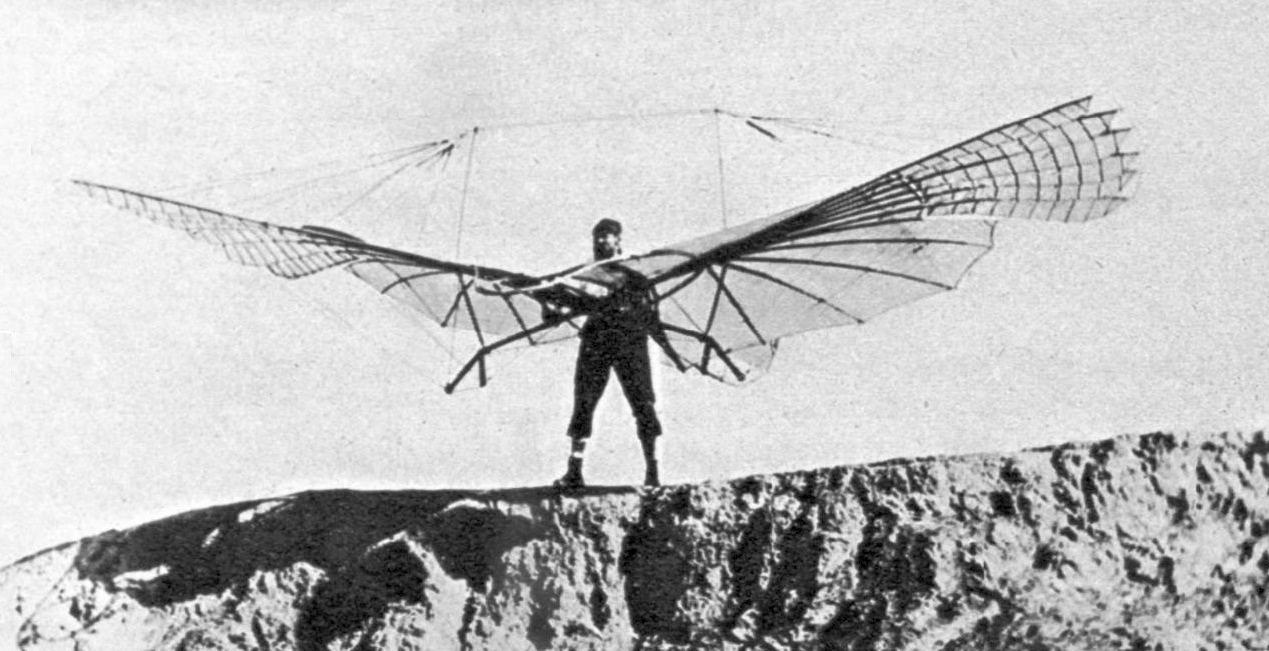
File:Otto is going to fly.jpg
Otto Lilienthal on August 16, 1894 with his kleiner Schlagflügelapparat
An ornithopter is a type of vehicle that flies. Unlike airplanes we use today, ornithopters fly by flapping their wings, just like a bird. Early aircraft designers have observed birds, insects, bats, and others similar to these and seen how they flap their wings and tried to imitate that. They even usually built on the same scale as these flying creatures. There are two types of ornithopters, manned and unmanned. A lot of people have tried to make manned ornithopters but only a hand full have succeeded even to glide without towing. Small bird sized ornithopters you can make even at home.
An RC ornithopter
The human brain: 100 billion cells
by Rubin


Ever think about your brain? Well, the human brain is a very complicated organ. The brain consists of many different parts, but we dont care about that, we only care about one part, the thinking part. The brain is one of the most curious mysteries to most, but once you know a little bit about it the brain make alot of sense. 
How the brain works

The brain is not a simple thing, 100 billion cells is pretty difficult to grasp. To help you remember how the brain works I broke it up into 5 main parts to make it more understandable.


1. The frontal lobe:
          In the red area of the brain, you can see the frontal lobe. The frontal lobe is responsible for controlling impulses, controlling judgment, language production, working memory, motor function, problem solving, socialization, spontaneities, planning, coordination, and executing behavior. This may seem like a lot functions for just one part of the brain, However after careful reading I realized a lot of the functions relate and overlap each other.

2. The parietal lobe:
          In the brown area of the brain you see the parietal lobe. the parietal Lobe is responsible for reading touch and body position. The parietal lobe receives the brain waves for for the nervous system. the parietal lobe combines nerv information from different modalities, mostly determining spatial sense and navigation. It is associated with movement, orientation, recognition, perception of stimuli.

3.The occipital lobe:
          In the dark green area of the brain you can see the occipital lobe. the occipital lobe controls our visual perception. The Prostrate region of the occipital lobe discriminates between colors and processes movement.
Visual perception is important because it stops us from running into trees and things infront of us, by triangulating with our eyes we can fing the distance of things by processing it with our occipital lobe.

4. The temporal lobe:
          In the light green area of the brain you can see the temporal lobe. The temporal lobe is responsible for processing sound. When a temporal lobe is not functioning It is impossible to understand someone with out reading there lips. The temporal lobe is very important in everyday life and it is used to decipher answers to almost 9,000 thousand words we say every day.

5. The cerebellum: 
          In the blue you can see the cerebellum. The cerebellum is responsible for controlling you coordination  balance, voluntary motor movements, sense of position of the different parts of your body, equilibrium, muscle tone, and your fine motor skills. These skills control your Ability to write and type as well as much more physical actions like shooting a basketball or catching a football. Next time you think you have a "bigger brain" than a "dumb jock" think again.   

Here is a video of the microscope embedded neurosurgical training system


John Locke vs. Thomas Hobbes


Picture of John Locke from the Internet encyclopedic of philosophy


John Locke is a big part of the constitution. John Locke was a British philosopher, Oxford academic and medical researcher. Anthony Ashley Cooper led him to become a government official charged with collecting information about trade and colonies, economic writer, opposition political activist, and finally a revolutionary whose cause ultimately triumphed in the Glorious Revolution of 1688.


Picture of Thomas Hobbes from Famous people.com


Thomas Hobbes was also an English philosopher that did not believe what Lock said, Actually he thought that the people shouldn't have a say in what goes on in the government.  He thought that there should be one ruler and that person should be King. As Hobbes says “we are needy and vulnerable”.

John Locke and Thomas Hobbes are the exact opposite Hobbes thought that there should be a king that ruled all. Locke thought that the people should have a say in who is in charge of them. As Locke says “lest men fall into the dangerous belief that all government in the world is merely the product of force and violence.“ Locke's account involves several devices which were common in seventeenth and eighteenth century political philosophy. Now while Locke says government is merely the product of violence Hobbes says “when we act, we may do so selfishly or impulsively or in ignorance, on the basis of faulty reasoning or bad theology or others’ emotive speech.”

Here is a video that talks about a simple version of there differences...enjoy  


Information from internet encyclopedia of philosophy and the Stanford encyclopedia of philosophy

The Battle of Bunker Hill

Bunker Hill was a very big event in the revolutionary war, the odds were against the Americans. The British had 2,400 men while the Americans had only 1,500. The battle took place on Breed's hill north of the Boston Harbor. The first attack was repelled and so was the second attack. But on the third attack the British broke through the American lines and the Americans retreated. The Battle of Bunker Hill was considered the turning point in the war and it was in the American's favor. The British suffered heavy losses each attack that is why it was a turning point. It demoralized the British and they lost a lot of men, 1,054 men were lost all together. The Americans only had 145 fatalities. From then the British began to lose more and more battles until the end of the war. Here is a video of what it might of looked like: 

By Nick Kindley

Researching Barbara Strozzi

         I chose to remake Venice, Italy from the 1700's for my do-make on Barbara Strozzi.  I first had to download Google SketchUp on my computer, so that took a few minuets.  After I did that, I had to familiarize myself with the commands and options on SketchUp.  I received a great link from Paul that takes me to a bridge from Venice Italy in the SketchUp Warehouse.  I am using that as a base foundation for my recreation of Venice, Italy.  I have been adding textures and colors to the bridge and I have started to make some building that are as accurate as I can make them from the pictures available of what Venice would look like in the 1700's.  I am also adding the canals, which is proving to be slightly harder than simple buildings.  I am hoping to add some Gondolas which are used in the canals.


     I have finally gotten the model to let me edit it on SketchUp, I have been able to add things around the model, but I still have lots of work to do.


I am going to be updating this blog with the progress I am making.

The Effects of The Cotton Gin

            Change is inevitable in our world. People continue to invent great things that cause our world to change. Some of these inventions cause change for the better, and others cause change for the worse. Some inventors do both, without meaning to. When someone invents something revolutionary, they are usually trying to make life easier or better in some way. They have no idea that their invention could negatively affect peoples lives at all. 
One of those inventions is the cotton gin. When Eli Whitney invented it in 1794, all of the cotton owners agreed that it was a magnificent, revolutionary invention. It caused major changes in the cotton industry. People no longer had to pick the cotton seeds out of the cotton by hand, which was a very slow and tedious task. People could simply put the freshly picked cotton with the seeds in it in one end, turn the handle, and the cotton would come out the other end with no seeds in it! Although this may not sound very amazing to us, because of all of the incredible inventions from our time, this invention shaped more than just the cotton industry. Cotton could be separated 50 times faster with the cotton gin than by hand, which caused the industry to explode. 
For many families in the South during the 1790s, cotton was their livelihood. Children grew up on cotton plantations, and many would eventually become the owners. Families depended on cotton for their income. If I were growing up in a family like that, the cotton gin would have been an important, exciting invention for me. My family would be able to process cotton 50 times faster, and expand our plantation. But more cotton means more work. We would have to hire people to help us, and the only solution to that would be hiring slaves. 
    I and many other southern cotton owners were against slavery, but it was a tough decision to make. People had to support their families, and their only means of doing that was with cotton. Eli Whitney’s cotton gin caused such a massive explosion in the industry, that cotton owners had to keep up with everything by growing more and more cotton. They needed slaves to work in order to support their families. What would they do?


    Many people, even though they were against slavery, chose to give in and hire slaves in order to expand their plantation and support their families. More and more slaves were hired everywhere in the south. This affected all of their lives, and many people who were against slavery were forced to hire slaves.
     Although Eli Whitney’s cotton gin really was a revolutionary invention, there were some negative affects from all of this change. When Whitney invented the cotton gin, he most likely wanted to make it easier to process cotton. He did not expect that his invention could change so many people’s lives in good and bad ways. It is amazing that one invention could change so much. 

Historical Visitor

Today, George Washington came to class.  He recited his First Inaugural Address.  Conditions were damp and gray, historically accurate.  We were honored to have this opportunity.  Enjoy the movie.