Saturday, February 25, 2017

How video games influence our social life and culture.


Video games, we all know what they are, you probably have played them once before.  Right now I will discuss my options on how they affect us in good ways, and in bad in our social life and culture.
Many people regard video games as a new impressive technology, but 26% of adults think that most video games are a waste of time (according to pewresearch.org).  Many adults dislike video games and gamers because most of them when they were born they were not exposed to such a high amount of screen usage.  My parents and many other parents who have kids at my school, did not grow up with video games in their lives.  Video games are now getting increasingly more violent and I think a lot of parents are opposed to having their kids play shoot ‘em up games. Even if video games get less violent parents would still prefer that their kids spend more time away from the screen.
155 million americans play video games regularly (this statistic was found on bigfish.com, and includes mobile games) this means 3 to 4 hours each week.  This shows that video games are becoming more and more popular in the world, with the Call Of Duty franchise’s net worth at over 3 billion dollars in 2009.  Many people love video games and even enjoy watching others play them in “let's play” videos, these are videos where you watch someone else play a video game.
Many people have heard of mass shootings or issues of violence in our country, and many try to link those to violent video games.  Also people say that video games glamorize guns, weapons, and killing.  I believe that a mere simulation could not drive someone to take someone else's life.  All though video games can be linked to aggression and being anti-social.  For example when you go play a video game like CS:go or call of duty, a game with a voice chat.  You will notice that people usually yell rude words and curse at you.  I think this is linked to using screens a lot.  Also there are some gamers who are very polite and don’t get mad at people.  Even though many parents and adults dislike video games, the industry is continuing to grow.


Friday, February 24, 2017

The positive effects of video games


Note: Before I get started, it’s important to say that too much of anything is bad, even oxygen

When people think of video games they think of someone sitting with a controler in front of a screen. People think of video games as an anti social hobby that only introverts do. In a research study over half of people said that none or only a few of video games were helpful with half of those people saying that they were entirely a waste of time. The easy retort to this is educational games. Students that play “Pre-social” games are more likely to help others in real life situations. Games can help students learn not to do drugs, or let students explore a simulated environment, and games to teach geography. 70% of teachers reported an increase in student engagement while using educational games
However not all games are educational, in fact most aren't. However that’s not to say that everything other than educational games are bad. They notably improve hand-eye coordination, and multitasking. Doctors who regularly play video games are better at laparoscopic surgery than those who don’t play video games. Video games can help improve confidence, in the form of achievements or other in game activities. Video games also promote group and team play. For example the game Overwatch gives users 20% more in game experience points for playing in a group, and game consoles have features that allow people to chat with their friends while they play.
Aside from all of this video games can offer a great bonding activity for parents and their kids, especially as parents are approaching their kids on their own turf. Seeing as the average age of video game players is 37 a whole new generation of parents is having kids while knowing the world of gaming. And hey guess what, those positive effects I was talking about. They work for adults too! Research done by ONR show that adults that play video games can process information faster and improve in their abilities to solve problems and reason.
There are other activities that can provide the same skills, but video games are fun. Many people will say that games are addictive, and I am not here to argue against that. All I will say of the matter is that video games don’t use chemicals or hormones to trigger releases in the brain.
I know personally for me video games can be an escape. Have you noticed the world we are inheriting. A video game is a work of art whether you view it as “high art” or “low art” is your choice. I don’t use video games to improve my reaction times or things like that. I use video games to have fun. My personal purpose of this was not to prove that videogames are good. I wanted to prove that they aren’t bad. Video Gamers still face stereotypes as fat boys living in their parents basement. This is extremely far from true.  Video games are for all, and to be played by all.

How PCs are the Ultimate Gaming Machine, and Consoles are Misleading


Video Games. One of the most profitable, and most popular forms of entertainment. A form of media where the most different of people can sit down and have a good time. However, nothing can be without controversy, and the catch of gaming is that before you play, you have to choose a console. Most people just blindly buy a PlayStation or Xbox just because they've the names in advertisements, and while I do admit that once described me, I have discovered that PCs are ultimately superior in every way. But why have so many people fallen into the trap of console gaming? How can so many people be oblivious to all the wasted dollars they're throwing down the drain?
                                                                                                                                                        This all boils down to anti-consumerist companies such as Sony, Microsoft, and Apple spreading false information. I won't go too in-depth into Apple, because that has already been covered by Kamran's blog, Is Apple Scamming You?. "How are those companies anti-consumerist?" you might be asking, "They bring powerful gaming at lower prices." This is exactly what these companies want you to think. You see, this is what Microsoft and Sony do,they pander to the majority of gamers. Casual players who don't want to be spending too much. They lure you in with shiny plastic buttons, and trick you into thinking this is "powerful gaming", when a GTX 760, a $150 graphics card card from 3 years ago, can out preform the Xbox one S, and the PlayStation 4 Pro, both new consoles that have only been released a few months ago


Image result for gaming pc
Source: CyberPowerPC.com
One of the ugliest truths of console gaming is the joke that is premium memberships. Sadly, I first learned about this just after I forked over my last twenty dollars. Basically, as multiplayer games such as Call of Duty, and Battlefield became increasingly more popular, consoles saw this, and starting charging players $10 a month ($120 a year) to play their favorite games online. While this service is completely free on PC, console gamers see no problem with this, even going as far as to defend this obvious scam, saying that money is being used properly maintaining the servers. News flash, servers don't cost anything for the companies making the consoles anymore. Companies such as Blizzard or Activision handle the servers for their games.


It is believed that consoles have more exclusives, and PCs just get the salty backwash of games that are already on Xboxes and PlayStations. This is quite the opposite, actually, as PCs have hundreds, maybe even thousands more than consoles could even dream of, and most of the time they're of a higher quality than your average Halo clone. Games on PC are also much cheaper, with services such as Steam having huge sales very frequently. Just last month I bought Just Cause 3 for $10 (normally $40). Not to mention, games on PCs drop in price much quicker, whereas console games usually linger above $40 for about a year. This doesn't even include bundles. A new way of purchasing games on PC, bundles allow you to pay a single dollar to get upwards of ten different games. I can't even count the amount of money I've saved using sites like Bundle Stars, or Humble Bundle.


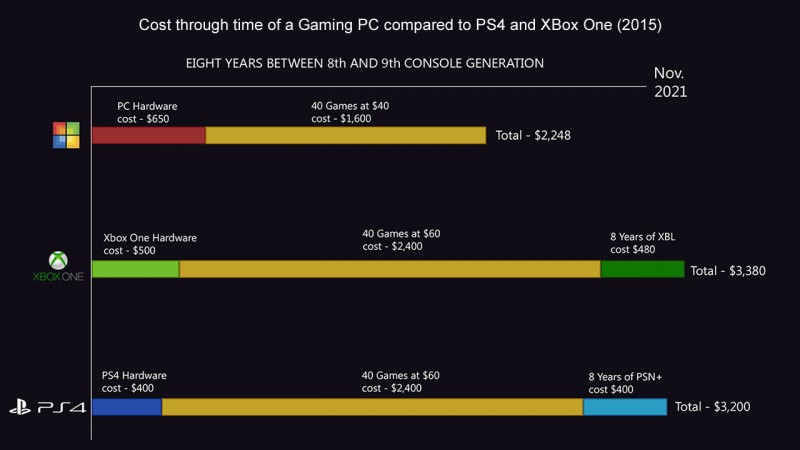
Image result for pc vs consoleThe most common factor I hear spoken about when defending consoles, is the initial price tag of a PC. Most starting builds, gaming-wise, are usually going to range in price from $450-$700. Now while this is slightly more expensive than the $400-$500 of a console, PCs are much cheaper in the long run. The graph to the right (created by Andrea Brandi on stari.co), shows the total price a PC, a PlayStation 4, and an Xbox One over the span of eight years, if you buy 40 games, and eight years of an online subscription. Eight years, is also about how long it takes until a new generation console is released, so theoretically it could cost you even more to play on consoles than the graph shows, if you buy a new one each time one comes out. The same could be said for PCs if you upgrade your hardware during that time, but upgrading one small component for a PC would cost way less than buying an entirely new console.


That isn't even close to the entire story, I haven't discussed controllers, and how it's nearly impossible to use them, fauly hardware, the fact that PCs can be used for more than just gaming (work, music, and internet, just to name a few), the insanely huge modding communtiy on PC. I could go on and on about why consoles are plain bad, but in the end, what's really at fault is the anti-consumerist, all for profit ideology that's ruining companies, and the commercial market as a whole. In theory, consoles could be great for the consumer, and for the company, but after years of milking gamers for everything that they can get, consoles and their respective companies have sunk to the spot they're at now. A laughing stock for the PC community, and just flat out not worth the money

How Memes are Taking Over the Internet


Writing the Emancipation Proclamation political cartoon

        Memes: You've probably heard of them, seen them, or even made them, but where did they come from? Why are they called memes? How do you make them? In this blog I will dive into the history of memes, and share the information with you.


  Memes go much further back than you might expect them to. The term meme wasn't invented until 1976, but far before then there were cartoons, comics, and drawings that were the memes of there time. For example, during Abraham Lincoln's presidency, a lot of Americans made fun of him through political cartoons. One political cartoon that got very famous was a photo of Lincoln writing the emancipation proclamation. This photo went viral because of how it showed that being the president wasn't a smooth or easy job, and a lot of people found it relatable to their lives.

      Most memes these days are nothing like they were back then. Back then a lot of them were drawings about political events, usually without "funny" or "relatable" captions. There wasn't such thing as the internet back then, so most of them weren't as widespread as they are now. Memes have changed a lot. The definition of an internet meme is "a concept or idea that spreads "virally" from one person to another via the Internet." -webopedia.com. They are usually a photo or video with a funny,
sarcastic, or relatable caption. 
The popular Blurry Krusty Krab meme
 Some notable examples of modern 
day memes are Pepe the frog, 
the Catch Me Outside girl,
and the blurry krusty krab. 
Some people have made livings out of running  
meme accounts, with millions of followers, 
and lots of ad revenue. 


          The word meme came from the biologist Richard Dawkins 1976 book where he says:
"We need a name for the new replicator, a noun that conveys the idea of a unit of cultural transmission, 
or a unit of imitation. ‘Mimeme’ comes from a suitable Greek root, but I want a monosyllable that sounds  
a bit like ‘gene’. I hope my classicist friends will forgive me if I abbreviate mimeme to meme. 
If it is any consolation, it could alternatively be thought of as being related to ‘memory’, or to the
French word même. It should be pronounced to rhyme with ‘cream’."
I don't know about you, but I wasn't expecting this to be where the word 'meme' came from.

      In my opinion, memes are a great thing. If I'm ever sad, I'll look at some memes, and if I ever want to cheer other people up, I'll make one. There are lots of ways to make memes, and I'll share two of them with you. The first one is simple: Use twitter. Most memes that you see these days are just a picture with a twitter caption above it. Just screenshot the twitter post and crop your username out of it. Here is an example:

Cropped version of Twitter post
Screenshot of Twitter post


      The second way to make them is download and app to make them. Some good apps are PicMeme, Mematic, and Meme Design. Once you have an app you can easily follow the instructions, find a good photo, and come up with a good caption. If you want to know some more about making memes,
feel free to check this awesome website that I found out: http://bit.ly/2lDg8cW


        In my opinion, there is nothing bad about memes: they are funny, witty, and relatable all at once. They make me laugh, and I feel like they are a good little distraction from all of the hate and negativity in the world right now. 


Sources:

Writing the Emancipation Proclamation. Digital image. Abrahamlincolnsclassroom.org. N.p., n.d. Web.

Blurry Krusty Krab. Digital image. Smosh. N.p., n.d. Web. 24 Feb. 2017.

"Where the Word Meme Comes From." Today I Found Out. Today I Found Out, 03 Dec. 2012. Web. 24 Feb. 2017.

Beal, Vangie. "Internet Meme." What Is Meme? Webopedia Definition. Webopedia, n.d. Web. 24 Feb. 2017.


 Memes, Dank. "Dank Memes (@DankMemes)." Twitter. Twitter, 24 Feb. 2017. Web. 24 Feb. 2017.


The Fake News of the French Revolution ¯\_(O.O)_/¯


Marie Antoinette - EXPOSED


"Qu'ils mangent de la brioche" means let them eat cake in French. This was the famous quote spoken by the last queen of France, Marie Antoinette, who helped provoke a revolution upon learning peasants were suffering from widespread bread shortages. Because brioche was a luxury bread, enriched with with butter and eggs, the quote was said to reflect the princess's disregard for the peasants. With that callous remark, the peasants banded together to form an army, invaded the palace, and beheaded the monarchs and palace officials using guillotines.


Who knew cake could contribute to the start of a revolution? Nobody, and that is because it didn't. Marie Antoinette was actually very sensitive to the poor population of France, and she never said “let them eat cake.” The quote would have been highly uncharacteristic of her, as she was an intelligent woman who donated to many charities, despite her lavish lifestyle.

So, if she never said "let them eat cake," where did this rumor originate? It was first told by a spanish princess named Marie Therese. She allegedly suggested to the French, "La croûte de pâté,” let them eat cake. Later on, about eighteen others were blamed for the irritable remark, most famously, the philosopher Jean Jacques Rousseau. Whoever uttered those unforgettable words, it was certainly not Marie Antoinette
Now that we know Marie Antoinette was not responsible for the distasteful quote, why did the revolution even start? Marie Antoinette was only a small part of the revolution, as the actual revolution started because her husband, King Louis XVI, as he was found conspiring with foreign powers, later being charged with treason, and beheaded as well. Even if she hadn't said “let them eat cake,” the people wanted to contribute to the uprising around them, and they needed a reason to do so. An easy target like Marie Antoinette would destroy the monarchy. All in all, the entire let them eat cake shenanigan was merely the fake news of the French Revolution!

Thursday, February 23, 2017

Social Media in the 18th Century

Most people in our era think if social media as an app on a device that uses data, and allows you to communicate with friends, family and new people. But in the 18th century, that is not what social media was like. First of all, touch-screen phones had not been invented. In fact, people during that time period didn't have anything close to a smartphone. The only way they could communicating with people far away was through telegrams… Second of all, no one had come up with the idea of apps for  phones (Snapchat, Instagram, Tumblr, Facebook, etc…) because obviously, they didn’t have them.
Image result for social media in the 18th centuryImage result for social media
             Social media in the 18th century       V.S.      Social media in the 21st century


In the 18th century, there was a different widespread meaning for social media. They didn’t have any version of a device. So instead, they used coffeehouses and art salons to spread news, share ideas, and meet new ppl. The historian Brian Cowan describes English coffeehouses as "places where people gathered to drink coffee, learn the news of the day, and perhaps to meet with other local residents and discuss matters of mutual concern." This was a way for people to catch up on the current matters of the world, and be in a social environments!
Image result for coffee house in the age of enlightenment
In theory, English coffeehouses and Persian salons were almost as effective as social media. They allowed people to do similar things: communicate with multiple people, and hear about the hottest new gossip/ important world news.


In my opinion, social media then and now are both very similar, even though they were, and are not executed in the same ways. Social media is important to me because it allows me to meet new people, share things I find interesting, and build knowledge about many things. I use many apps, such as Instagram, Snapchat, Tumblr, Pinterest, and YouTube. They are all entertaining, and I learn new things!


The video linked below describes how coffeehouses and salons were used in the 18th century

Longboarding

Image result for surfingSurfing was first described in 1769 by Joseph Banks. It was an important part of Polynesian culture. It started as bodysurfing and then slowing evolved into standing up on a board and riding down the waves. You might wonder why people chose to get on a board and ride down a wave and the answer to this is adrenalin. Surfing slowly evolved from water to land and that how we got the skateboard.

Skateboarding evolved from a plank of wood with the bottom of roller skates on them to a full-blown culture. I longboard and skateboard because I think that they are both fun in their own ways. However, I recently started to like longboarding more because of the adrenaline.
Now I'm going to tell you how longboarding works. For longboarding, you need a helmet gloves and knee pads if you want to protect your knees. First I'm going to talk about freeride, freeride is where you do a ton of slides, you slide by turning the board sideways and sliding the wheels. Next I'm going to tell you about my personal favorite wich is downhill. Downhill longboarding is going as fast as you can down a hill and sliding as little as possible. This sport has evolved into a culture and a lifestyle. Related image

How Might The Universe End?


            Before I begin, I'd like to give you a bit of a content warning. I want to let you know that this is a very heavy topic. The matters I'll be discussing here may be a tad distressing to some people. Okay, moving on. One day in the far, far future, the Universe will die. Now, you may be wondering; how? and why? how do we know this? first off, the Universe is expanding, and has been expanding since the Big Bang. Also, the rate of expansion is increasing. The reason of this accelerated expansion? Dark energy. Dark energy is a weird phenomenon that scientists think permeates the entire Universe. Up until the year 1998, scientists thought the Universe worked a bit like a yo-yo, if you will. No matter how far down it goes, it always comes back up. They though the expansion must slow at some point. However, the expansion, like I said before, is actually speeding up. Now, where is this speeding up of the expansion coming from? We don't really know, but this is what we call dark energy. Albert Einstein first thought of this idea, and then decided it was silly. Now, however, astronomers think this idea is very plausible. The problem is, this is all extremely theoretical, and, we aren't really sure what the properties of dark energy are. However, there are a few theories, and they lead us to a few conclusions of how to Universe will end. 

Theory One: The Big Rip.            

            Since the birth of the Universe, it has been expanding. Not only that, new space is created everywhere in the Universe equally. (Weird, right?) This means the space between Galaxies moves apart, making them move farther and farther away from each other. The space inside stellar objects like nebulae and galaxies is also expanding, the gravity in such objects is strong enough to hold them together. However, the Big Rip theory states that one day, the expansion will be so fast and so powerful that the gravity of these objects will not be strong enough to hold them together. First, big objects like galaxies will be torn apart. Over time, stars, planets and black holes would too be torn apart, leaving behind atoms. When the Universe begins expanding faster than the speed of light, atoms too would dissolve. The Universe would then be a strange place, full of particles that would never be able to touch, whizzing around for, well, who knows how long?

Theory Two: Heat Death.           

            The Heat Death Theory states that over an extremely long yet finite amount of time, matter stays intact but degenerates into radiation, while the Universe expands forever. How does this work? One word: entropy. All systems tend to fall into the highest level of entropy. Think of it like a Latte Macchiato. When served, it generally has three regions, but over time, these regions will cool down, dissolve, and become one region. This also applies to the Universe. While the Universe gets larger and larger, and, along with it, matter slowly decays. After some time, the gas in the gas clouds needed to form stars will run out, and the Universe will turn dark. The remaining long lived stars will die, and black holes will degenerate and evaporate. (I know!) This is caused by a theory called "Hawking Radiation." Black holes are thought to take (drumroll, please), 10 to the 92nd power years. That's an almost incomprehensible number. I mean, the Universe is only 14 billion years old. Think about that for a moment. I could go deeper with this, but that's a whole 'nother blog post. All activity in the Universe ceases at this point. Entropy is at it's fullest capacity. The Universe is hereby dead forever. Unless, theoretically, after a mind-bogglingly long time, part of this dead Universe would be spontaneously jostled, leading to what's known as "quantum tunneling, which would result in a new Big Bang. Weird!

Theory Three: The Big Crunch + The Big Bounce.            

            If there is actually less dark energy than we think there is today, or if it slowly runs out over time, gravity will be the most pervasive and dominating force in the Universe. If this happens, the Universe will shrink, and the galaxies will get closer and closer together. Since a smaller Universe means a hotter Universe, the temperature will rise dramatically. It would get so hot that background radiation (the microwave radiation remaining from the Big Bang), will become so hot that stars would be cooked, if you will, from the outside. It will then get so hot atoms will tear apart. And it'll keep shrinking. Soon, all that we would be able to see would be the galaxy. Then it would shrink down to the size of the solar system. Then to the size of the earth, and, although this may sound strange, it will keep shrinking. It will shrink so small, the universe will be the size of a subatomic particle. There is one idea that gives me some hope, however. This is where the Big Bounce Theory comes into play. The Big Bounce Theory states that this expansion and contraction has happened an infinite amount of times, and will keep happening. The Universe will just keep expanding and contracting. Wouldn't that be nice?


            I haven't thought about this subject deeply enough to decide upon which theory I support. At the moment, though, the Heat Death theory seems the most likely. 


            When I think about all of this, though, I can't help but remember those first people who looked up to the sky and wondered what was beyond our vision. From the great minds of the Scientific Revolution like Galileo, Copernicus and Kepler, to Greeks like Hipparchus and Aristarchus. It is because of them that we know as much about the heavens as we do today.

Wednesday, February 22, 2017

How the Greeks have helped the way we see astronomy

                             Astronomy

  
     Have you ever wondered what the heck "Jupiter" means? Is it just me who gets Saturn and Neptune mixed up? Once you learn about who and what these planets are named after, you will never confuse and ponder what these names are supposed to mean.
  Let's take the hydrogen planet Neptune for example. Neptune is a rather strange and unique name, don't you think? Neptune is actually a Roman name for the Greek sea god Poseidon, who controlled the seas and oceans. Poseidon is the brother of the king of the gods, Zeus, whose Roman name is Jupiter. Most of the planets' names, except for Earth, are named after Roman gods, which are adapted from Greek mythology. 
  The constellations, too, are derived from Greek lore. The dipper-shaped constellation, Ursa Major, is a big momma bear named Callisto, and her son Arcas, her smaller counterpart, is Ursa Minor. In an attempt to save his beloved Callisto from the wrath of his wife and daughter, Zeus cast her up into the sky as a constellation of a bear, along with their son, Arcas. These constellations, which can be seen glittering brightly in the night sky, are just some of a whole plethora of constellations created and believed in by the Greeks. 
  In magazines such as Seventeen and J-14, horoscopes are all over the place; practically every issue of these magazines have a page that determines your future that month by your horoscope sign. These, too, are created by the Greeks, and every sign has its own special Greek myth. For example, if you are a Leo, you were born in the months of the Nemean Lion, who was killed, skinned, and worn as a cape by the infamous hero Hercules, and if you are a Scorpio, you were born in the months of the giant scorpion that stung Orion's heel. Quite delightful. 
  The ancient Greeks have greatly influenced how we see astronomy, and without their earlier discoveries and beliefs, we wouldn't have been able to understand space quite like we do now. To do your part to acknowledge their powerful influence on astronomy, remember that each and every single planet except Earth is called what it is today with the help of the Greeks, and that the stars that shine above you hold great symbolism and character that have built the foundation for our current understanding of space.  
   

Stained Glass

Choir hall
Have you ever gazed up in a church and stared at the stained glass that adorned the ceiling? Have you wondered how it was made or invented? Stained glass is an artwork that has dazzled us all throughout the ages.
Colored glass has been produced since the ancient times. The Romans and Egyptians manufactured many small glass objects such as vases, trinkets, or beads. Phoenicia was the main glass producer and spread the idea of glass making throughout the world. The origin of stained glass started in Syria during the Islamic period. They developed gilded glass that led to the production of stained glass.
Alabaster window
Indication of the first stained glass windows come from the 7th century when Saint Benedict Biscop hired a Frenchman to glaze the windows of his monastery. In the 4th and 5th century, early Christian churches had windows of thinly sliced alabaster, so the windows looked like stained glass but in shades of brown. Stained glass windows did not appear in churches until the introduction of gothic cathedrals.
Rose Window
Stained glass gained popularity in the Middle Ages, when it was used in Christian cathedrals and churches. This unique art form was used as an illustration to show scenes in the Bible, like the Garden of Eden or the Saint Mary. Stained glass quickly spread throughout Europe, as windows became larger and more elaborate. In France, a circular window, called the rose window, was developed. It was built of linked windows for a mandala effect.
Classical Style
There were two main styles that were used in the Middle Ages: Gothic and Classical stained glass. Classical glass was influenced by the Gothic style. Gothic was a form that used vibrant colors and usually depicted figures of Christ, framed in  floral patterns and designs. Classical stained glass used a more mellow color scheme, and the pictures were more refined.
Stained glass lost its demand during the Reformation and the French Revolution. Many windows were smashed by protestants and being replaced with plain glass ones. The French Revolution caused the destruction and neglect of many stained glass pieces. The Dissolution of Monasteries was especially damaging to the tradition of making stained glass. Because they were  “abused images”, Henry VIII destroyed thousands of windows. Only a handful of windows stayed intact. The traditional practice of stained glass was lost and would not be rediscovered until the 19th century.

light shining through the Nasir Mosque
Stained glass is an extraordinary type of art. It is both beautiful and practical, providing pictures of the Bible for context. I love seeing the brilliant colors of the mosaic-like artwork and looking at the colorful light that it sheds. Stained glass is a tradition of artwork that I hope never disappears.

Sources:
https://en.wikipedia.org/wiki/Stained_glass
http://www.houzz.com/ideabooks/9456207/list/flying-colors-stained-glass-through-the-ages-to-today

Who Invented the Telescope?

This has been a question many people have asked. There are four men who are involved in the answer to this question that we are still puzzling about today. Hans Lippershey, Zacharias Janssen, Jacob Metius and Galileo Galilei.


Hans Lippershey was an eyeglass maker and the first person to apply for a patent on the idea of a device that could magnify what you are looking at three times. People argued against him trying to patent this idea, saying that he stole the idea from another eyeglass maker, Zacharias Janssen. Jansen and Lippershey lived in the same town, and were both eyeglass makers, but there is no proof that  Lippershey made his telescope alone. In the end, Lippershey got credit for creating the telescope and Jansen got credit for creating the compound microscope. The topic of who created the microscope is debated as well, but as the article, “Who Invented The Telescope?” By Lauren Cox reads, “while Jansen is credited with inventing the compound microscope. Both appear to have contributed to the development of both instruments.”  meaning that both men appeared to have both worked on creating the microscope and telescope.


Soon another man, Jacob Metius was thrown into the mix. Jacob Metius applied for a patent on the telescope a few weeks after Lippershey did. The government soon turned down both offers for a patent because of counterclaims. In the end, Jacob Metius got a small reward but Lippershey was paid a lot of money to have his telescopes remade and sold or used.


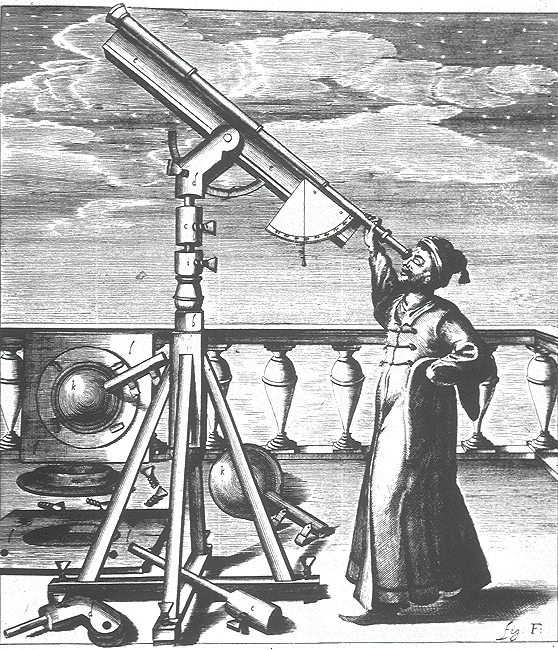
Lastly, Galileo Galilei was involved in this mess when he had heard about the first telescopes and created his own with a few tweaks and then presented it to the Venetian Senate, and in return they set him up for life as a lecturer at the University of Padua. Galileo was also the first to look at the sky and the stars with a telescope, resulting in the discovery of  the Sun’s sunspots and Jupiter’s set of moons as well was many other things, that you can check out here.


Lastly, where is my thought in all of this. Personally, I feel that there is so much more out in the universe that has not yet been seen and just like Galileo, I want to use something we already have and see the world and the universe in a new way as he used the telescope to look at the stars.


Four men who are all considered to be the creator of the telescope, but who actually made the first one? Many people have been wondering this, and many more to come are going to ask this question as well.


Sources:
Images: