Friday, February 19, 2016

To Float Like a Swan


Ballet is amazing.  You can let go of all your worries and soar like a swan across the stage.  I have been dancing since I was 4 and currently dance at Portland Dance  School (Portland Festival Ballet).  Before class, I watch the trainees (they are very serious about ballet and do online school so they can do ballet all day) and I am entranced as they glide across the room leaping and twirling in their pointe shoes.  Ballerinas go through excruciating pain and hard work to get where they are, but some people just think ballerinas are fragile and that ballet is not brutal enough to be a sport.  A person at my ballet studio once performed 10 shows with 4 broken toes on one foot.  This shows endurance, dedication and determination.  Sometimes when I watch ballerinas flutter and float across the stage, I think about all of the other people who danced that role.  Who were they? Where did they come from?  Was ballet what did they did for a living?  I wonder about the first time a ballet was ever premiered and how someone even choreographed everything in it.   One ballet that initially failed and is now is one of the most popular ballets is Swan Lake.  
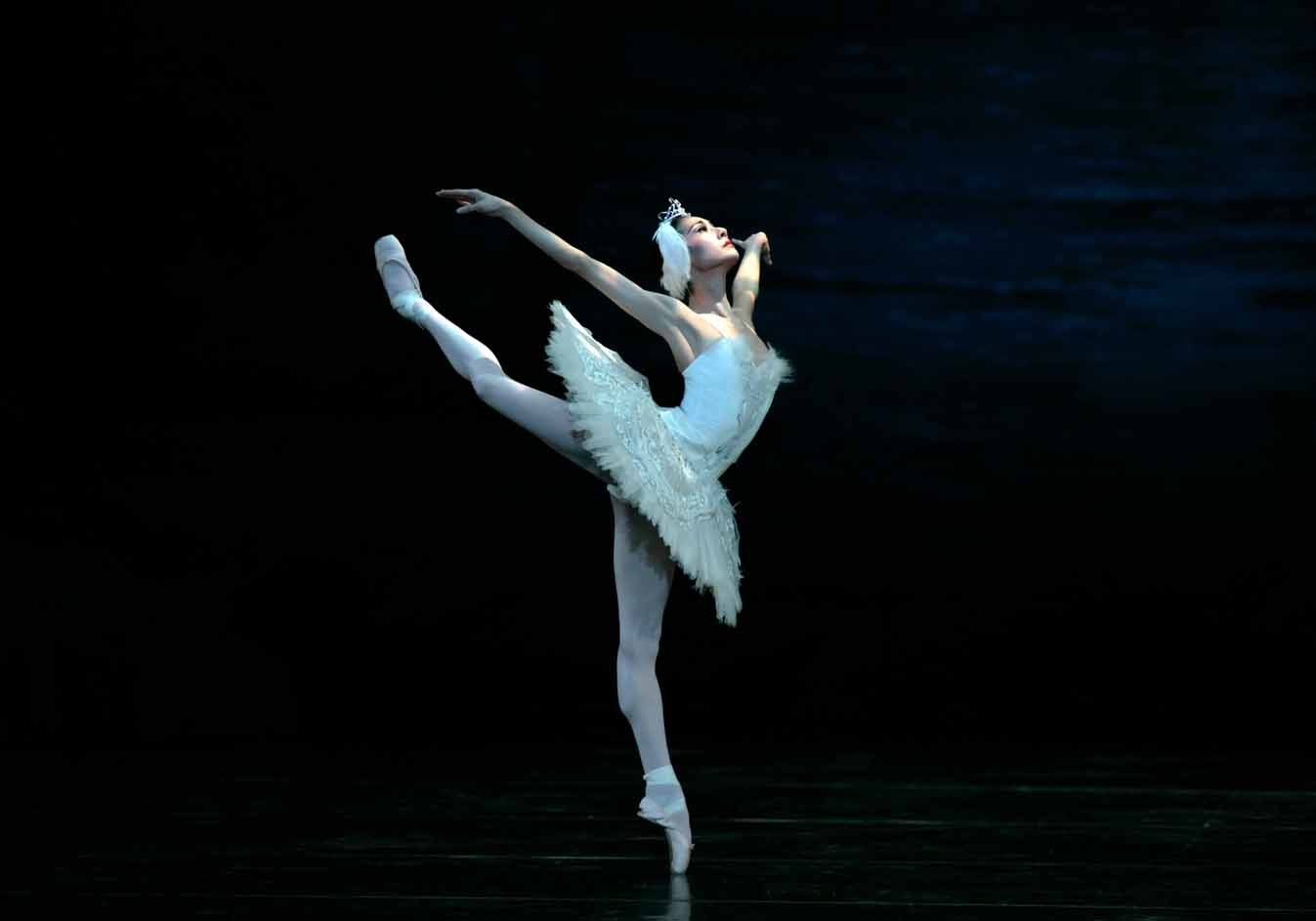
The music of Swan Lake was composed in 1875 - 1876 by Pyotr Ilyich Tchaikovsky.  Swan Lake tells the tragic story of a young princess named Odette, who was transformed into a swan by a curse casted by an evil sorceress.  On Friday, March 4, 1877, Swan lake was premiered.  The role of Odette was performed by Pelageya Karpakova (Polina Karpakova).  It was originally intended to be performed by Anna Sobeshchanskaya,  however she was removed from the performance after a governing official accused her of  receiving a few items of expensive jewelry from him, only to sell the items of jewelry for cash and marry a fellow danseur.  The premiere was not well-accepted, and there was almost unanimous criticism concerning the orchestra, the stage sets, and the dancers.  The “failure” of the production was said to be due to a few other reasons.  One issue was regarding German origins of  the Swan Lake story.   Another reason was that the ballerina that danced the role of Odette (and possibly Odile) was “not particularly convincing” and was a secondary soloist.
 During the early 1890s and late 1880s, Vsevolozhsky and Pepita were conversing with Tchaikovsky about reviving  Swan Lake.  Unfortunately, on November 6, 1893, Tchaikovsky died just when the plans for the revival of Swan Lake were about to be fulfilled.   As a result of the tragic death, Drigo had to revise the score by himself.  Two memorial concerts that were planned by Vsevolozhsky were given and yielded in honor of Tchaikovsky on February 1894.  In the production, the ballerina who danced as Odile and Odette was Pierina Legnani, the Italian virtuoso.  The revival prospect of  Swan Lake had been planned for Pierina’s 1894-1895 season benefit performance because of her amazing talent.  
Her performance during her début in Cinderella with the Imperial Ballet demonstrated her phenomenal technique.  During the grand pas, in her variation, she executed thirty-two or more fouettés en tournant (turns on one foot) which at that time that was the most ever performed.  At the beginning of  1895, on Friday January 27, the revised Swan Lake was premiered.  The premiére of  the revival was a huge success.  Today it is the revised Tchaikovsky’s score  that is used when many ballet companies perform Swan Lake.
There are so many talented ballet dancers who have come before us and future rising stars that will come after.  Many of them may have endured similar hardships and criticisms in the harsh world of ballet.  Now when I am on stage, I look out into the ocean of people in the audience and through the blinding stage lights, and wonder...


Sources:


  • http://24.media.tumblr.com/tumblr_mbl7rkbPTK1qmy8oho1_500.jpg
  • http://warmjello.com/wp-content/uploads/2015/06/misty-copeland-swan-lake-103.jpg
  • http://24.media.tumblr.com/tumblr_mbl7rkbPTK1qmy8oho1_500.jpg

Thursday, February 18, 2016

Food Now Vs Food in the American Revolution

Food in American Revolution vs Food Now


Everyday, we might take going to the grocery store for granted. It’s only a 15 minute drive, and it has everything you would need. A seemingly endless supply of basic necessities. You can pretty much buy anything you would want. Fruits, veggies, bread, and much more. The people of the American Revolution were rationed to very little per day and per week. Imagine if you had to share molasses and other food with 99 other men, well that’s what people in the American Revolution had to endure. Many other basic needs were cut down to very little for soldiers, and for other people who weren’t on the war. It was very far from gourmet.


There certainly weren’t an McDonald's or any restaurants for that matter. Most people ate things they hunted or grew. Milk, fruits, veggies, eggs, and grains were common to trade and eat. Most people at a lot of stews of meat and vegetables. Woman spent a lot of their day cooking because they had to milk the cow, build a fire for cooking, bring water from the well, and get the meat ready to eat. There was a big meal each day that was served around 2pm.


Nowadays, there are restaurants, grocery stores, and farmers markets that you can get food without working very hard. Many women now have jobs, and don’t spend half their day cooking. You can go to grocery store and get all the things you need to cook a meal, or to make it easier you can go to a restaurant and order a dish, without doing any work; it’s prepared for you. We normally eat three meals a day with snacks in between. For most families, dinner is probably the biggest meal. Most families don't have huge gardens, I know for sure that my family doesn't really know how to garden. We have a couple strawberry plants, but that's about it.


The reason it’s easier to get food now, is because it’s more accessible. We don't have to slaughter our own food. When I was three, I certainly didn't help kill the chickens for dinner. Technology has also played a role in making it more accessible. We now have cars, planes, and boats that help food get transported from around the world into one place. In the American Revolution they didn’t have those privileges of having foods get transported from around the world, right to them.

Even in the last 100 years, things have changed dramatically. In 1900, a small child would know how to kill a chicken, and older kids would know how to grow their own food. Today, in kindergarten, I'm pretty sure most kids grew their own little pea plant or a small vegetable. Most people would agree that eating your food that you grew, was awesome; however, you probably don't want to know how your chicken, that you're eating for dinner, was killed.

In conclusion, food now has gotten much more complicated. We can go to a grocery store and get food from right here, Japan, or Morocco. Food has become more accessible and because of that, the food and dishes that you can make have changed.

Wednesday, February 17, 2016

Why We Text: It All Started with the Telegraph

In 1844 the telegraph was invented by a man named Samuel Morse. The telegraph was the first machine that allowed people to communicate over long distances faster than a letter. The telegraph was the machine that revolutionized modern day communication. The telegraph was an invention that allowed people to communicate quickly where messages were sent over a long wire. By 1860, telegraph wires stretch from the east coast of the United States west of the Mississippi River. It wasn’t until 1866 that a telegraph line stretched across the Atlantic Ocean, allowing people to communicate outside of the U.S. To use the telgraph, you had to understand Morse Code because all you could type into the telegraph were dashes and dots. In Morse Code, each letter was assigned a specific sequence of dashes and dots.


In 1844, almost everyone who could afford the telegraph got one and used one. Why? Because the telegraph was the “next best thing” and it was what everyone else was speding their money on. Much like the telegraph, the smart phone is “the next best thing” for 2016 so, many people have one.


Morse code is somewhat similar to texting because you have to understand the different codes (abbreviations). For example, WTF doesn’t usually mean “why the face” and lol usually means “laugh out loud” not “lots of love”. If you were to use these in a wrong way, it could completely offend someone and make them mad at you. For example, if you were to hear that someone just lost their job and you said “I’m so sorry to hear about your job. lol” or if your friends grandma had recently become sick and you said “I’m so sorry to hear about your grandma. lol” I don’t think they would necessarily be to pleased with you.


What do you think would’ve happened if a texting device was invented before the telephone?


If Alexander Graham Bell had invented texting and Steve Jobs had invented the telephone, I think that the current generation would be talking instead texting. This also relates to my “next best thing” theory which is that society follows the current trends. Also, most teenagers and adults are using social media networks like Instagram, Facebook, Snapchat, etc. more than talking on the phone. Lately, everyone is so wrapped up in their cyber life that they don’t spend the time to talk to people face to face anymore. Talking through the phone was invented before texting, so now when teenagers come from school and their parents ask “How was your day? or, “what did you learn?” or “what did you eat for lunch?” they usually get a one word answer like “good” or “nothing” or “food”. I feel that if texting was invented before talking on the phone, our generation would be much more talkative because our version of technology would involve way more conversation and social skills.

Sources:

"Morse Code and the Telegraph." History. N.p., n.d. Web. 8 Feb. 2016.
    <http://www.history.com/topics/inventions/telegraph>.


"Invention of the Telegraph." Library Of Congress. N.p., n.d. Web. 8 Feb. 2016.
    <https://www.loc.gov/collections/samuel-morse-papers/articles-and-essays/
    invention-of-the-telegraph/>.


"Alexander Graham Bell." Wikipedia, the Free Encyclopedia. N.p., n.d. Web. 14
    Feb. 2016. <https://en.wikipedia.org/wiki/
    Alexander_Graham_Bell#First_invention>.  


Images:


"Blizzard of 1888." Business Insider. N.p., n.d. Web. 14 Feb. 2016.
    <https://static-ssl.businessinsider.com/image/
    542049756da8115a21ba15df-960-720/
telegraph-wires-many-of-which-would-have-connected-tickers-created-a-tech-y-canopy-above-downtown-manhattan.jpg>.


"Trains and Telegraphs." The Telecommunications History Group, Inc. N.p., n.d.
    Web. 14 Feb. 2016. <http://www.telcomhistory.org/vm/Images/main/science/

    telegraph1.jpg>.

I'll Pass You Shoot

A lot has changed over the years - technology, sports, music - the list goes on. A sport that has seen a lot of changes is basketball. When I step onto the court, the game I play today and the rules that I must follow look very different than in 1891 when basketball was first invented by James Naismith. I enjoy getting to play basketball and if things hadn’t changed I might not have had the chance to play considering the fact that Mr. Naismith originally invented the game for men.

Basketball had 13 original rules, some of which have stayed the same and many that have changed. When playing basketball people would shoot at fruit baskets, trying to get the ball to stay in that basket. As you know, basketball is no longer played that way, which I’m glad for. If changes hadn’t been made, every time someone made a basket the whole game would have to stop so that someone could get a ladder to get the ball out of the basket. With 8 minute quarters and all of that ladder moving, our games would take forever.

Speaking of scoring, when you get points in a game today they are all from making baskets. However, the original rules said that if a team got three fouls in a row the other team would get a point. Kareem Abdul-Jabbar had 4,657 personal fouls in his careers - that would have been 1,552 points awarded to his opponents. I imagine this would have upset his teammates and made teamwork more challenging. In a game like basketball, a lack of teamwork could spell disaster.

Teamwork is an essential element in any team sport. You must work together to accomplish your goal. No one person can score every basket, defend every shot. When I am out on the court I know that my teammates are there to help me and I trust that we will all work together to win the game. Teamwork requires that you trust your teammates and that they trust you - trust you to make smart decisions. Trust you to know when to shoot or when to pass, when to avoid fouls at all costs and when a well timed foul can help you get the win. Teamwork makes the (basketball) dream work, but failure to work as a team could very well end up costing you and your team the game.

Sources:

Music: Revolutions

Baroque music
Ever wonder how music has changed over the years and how its effected our society. Baroque music is a style of music composed from approximately 1600 to 1750. This era followed the Renaissance, and was followed in turn by the Classical era. The word "baroque" comes from the Portuguese word barroco, meaning deformed pearl. In the Baroque Era the most famous composers were Vivaldi, Beethoven, Bach, Handel. Their music is still quite famous. Their pieces were mostly classical. Music evolved and in the American Revolution the National Anthem was invented and composed by a man named Francis Scott Key in 1814.
Image result for violin
Music has always been a passion of mine, I've been playing the violin since I was 5 and I took up piano during for a little bit then quit, and recently I started the viola. But what I love the most is music (what plays on the radio). I still remember my first favorite song, Taylor Swift you belong with me. Music would surround me in the car 107.5, 100.3, 95.5, and hits 1 and at home, my sister used to play the piano and would play it a lot and I would practice my violin a lot. My favorite songs used to be the most popular songs now its songs that I find while searching my favorite artists (The Weekend, J. Cole, Chris Brown, Kalin & Myles and Jeremih).

Music has brought people together for centuries and hopefully centuries more.

http://www.essential-humanities.net/western-art/music/baroque/
https://en.wikipedia.org/wiki/Baroque_music
http://historyomtssg.blogspot.com/2011/01/1600-1610-opera-opens.html
    http://realbraveaudio.com/rentals/

Tuesday, February 16, 2016

Slave Trade

The triangular trade is a term showing trade between three regions. The best known type of triangular trade was the transatlantic slave trade, which started in about the 15th century and slowed down in the 1800’s, however, since it had been going on for over 1000 years, it was difficult to end it. Slavery still continued through the 1930’s.


The transatlantic slave trade usually followed a route forming the shape of a triangle. First, European traders left ports and headed towards Africa’s West Coast. When they were there, they traded their goods for people. The European traders loaded the people they bought onto very crowded ships. Below is a diagram of a ship that the people were loaded onto. The ships only had enough room for each person to lay down and were only fed one or two times a day. The European traders took the African people to the Americas. The trip from Asia to the Americas took 6-8 weeks. Once they were in the Americas, the African people who had survived the trip were loaded off the ship and the Europeans traded the Africans as slaves for goods such as sugar, coffee, tobacco, rice. Later, they started trading for cotton, which was produced by the slaves from before.

Children during slavery

Children were commonly enslaved as prisoners of warfare. In some places of West Africa, kidnapping was a popular way to enslave children. They were usually taken while working in fields, walking around a town, or playing outside of their parents view. Families sometimes sold their children into slavery so their food scarcity would end. Children were also sold into slavery because they were poor in health, required special needs, or to repay debts or crimes their parents or relatives had committed.

Child labor today

You may not think about it, but there is still child labor going on today. Most child labor is in agriculture.


I will use child labor in the Ivory Coast and Ghana as an example. Ghana and the Ivory Coast are low-wage countries, and their average income per day is below half a dollar.


Many workers are cocoa farmers. Ghana and the Ivory coast produce half the world’s supply of cocoa. To realize how little children make for how much they work, let’s use the value of a chocolate bar. Only 5% of the money we pay for a chocolate bar goes to the workers.


Children also face some dangers while working on a cocoa farm. 

Chemicals: children don’t usually wear protection while spraying pesticides. 

Sharp tools: When the cocoa pods grow, the worker cut them from the trees with sharp tools such as machetes. 

Heavy loads: after the beans are taken out of the pods, they are carried in large, heavy loads to drying racks. 

Long hours in the sun: workers spend a lot of time out in the sun while packing beans into sacks and loading them on trucks.

Child labor also goes on in many other countries, I just decided to use Ghana and the Ivory Coast as an example. Now when you buy a chocolate bar, or something with chocolate, think about how much kids in Ghana and the Ivory Coast have worked for you to be able to eat that chocolate bar, and how little money they made from it.


Images from:
"The Numbers Behind Child Labor." National Geographic. N.p., n.d. Web. 31 Jan. 2016. <http://news.nationalgeographic.com/2015/09/2015-09-26-data-points-children-behind-child-labor/>.

Monday, February 15, 2016

Can You Hear Me Now?


Many things were invented during the industrial revolution, and several of those things are still in major use today. One example of this is the telephone. From the time period of around 1860-1876, the telephone was a big topic, and one that seemed impossible to create. However, in 1870, a man named Alexander Graham Bell fully turned his attention to developing a device where a needle vibrated in water to transmit sound. The sound was transmitted because the electrical current would change. Eventually, on March 7, 1876, Alexander got a patent on the telephone. There were also other inventors such as Elisha Gray, and Antonio Meucci, who also developed their own technology that transmitted sound, but they have never gotten credited like Alexander Graham Bell.


With all of this being said, the telephone is still in great use today. Over the past 140 years, the phone has changed immensely, and now it's one of the most popular electronic devices in the world. The phone has definitely changed my life, and it's changed it a lot. From playing games, to texting, to going on social media, and of course making phone calls, I use my phone almost every single day. Now, even though phones are a lot more than just calling in the modern day, that was what was invented in the industrial revolution, so let's focus on that. Personally, if I need help, I'm in danger, or just need to communicate with anybody, my phone is the number one thing I would go to to connect with somebody. I make calls at least once a day or two days, depending on the events that happen. An astonishing fact about phone calls, is that in the present, about 3 billion phone calls are made each day, and that's just in the U.S.! Overall, the telephone is still in major use in the present, and it has revolutionized the way I communicate with people from any distance, and in any place in the world.


Click here to go back to my Table of Contents


http://www.texasinsider.org/3-billion-phone-calls-made-in-us-every-day/


https://www.shoretel.com/content/alexander-graham-bell-and-history-telephone


http://www.t-mobile.com/


https://thescienceclassroom.wikispaces.com/Alexander+Graham+Bell?responseToken=629f26234e0362edcea84f990c5d9a9b


https://en.wikipedia.org/wiki/Alexander_Graham_Bell


What Does Gender Equality Have to Do with Eventing in the Olympic Games?

       There is no sport in the world quite like horseback riding. First off, you won't find a bond in any stadium as unique as that between horse and rider- the sports are just trust exercises, with a few dangerous obstacles in the mix. Secondly, it might be the only sport in the world where people of all ages, races, genders, and body types can compete in the same arena as respected equals.
         It wasn't always that way, however. Eventing became popular in the late 1800s, and competition resembling the current first took place in 1902 at the Champonniat du Cheval d-Armes, in France. Equestrian sports were first introduced into the Olympic Games in 1900, and, ironically, none of those sports (polo, for example) are in today's Olympics. Eventing came around in 1912, and then, it was very exclusive.
         "Exclusive" meaning that only young commissioned officers in uniform, along with their military horses could compete- women were considered too delicate and weak. In fact, until 2004, the Classic format was used, a form originally developed to test cavalry troops. The first woman to compete was Lana DuPont Wright, in 1964. It should be noted that not only did she compete, she won a silver medal for the United States. Non-commissioned Army officers couldn't compete until 1956; male civilians were allowed to participate in 1924. Those weren't the only limitations- in addition, all Olympic athletes had to be amateurs.
           Classic format became the standard by 1924, at which point the five cross country phases totaled more than twenty miles. I can't imagine that, as that one person who has trouble getting the stubborn horse over a single fence I could step over.
          This, of course, isn't considering the ancient Olympic Games, where women couldn't even watch. The ancient Games included mounted and chariot races, but, instead of the jockeys, horse owners stood on the podium. Today, horse owners still get the bulk of the purse, but riders get to stand on the podium as well- regardless of their gender, thank goodness.
          As I've said before, riding is one of the few sports where everyone can compete as equals. This raises the question, why don't all sports have the same expectations for men and women? At our all-school track meet, we (as in, the girls) use the boy's shot in shot put, and we run, jump and throw the same distance. Using that different equipment, going that extra stride, jumping that extra foot, helps me develop my physical abilities better. If I could do this in more sports, and other girls could as well, we would be, as a whole, more physically fit and, in addition, more sports would probably be co-ed. Negative stereotypes, like the suffix "like a girl" might fall out of use, as they should have way earlier.
         Eventing is a truly special sport. You get a workout and you make a friend- surviving many near-death experiences with your horse and all the time you spend grooming them will pay off. As an equestrian today, I'm ridiculously thankful that eventing has come as far as it has. I might not be able to ride at all, or ride in breeches, if it hadn't. And, for those skeptics- if you think riding isn't a sport, you're invited to my barn any time.
Screen-Shot-2013-03-20-at-3.00.48-PM.png (377×349)
Before 1924, only male commissioned officers could compete in eventing competitions. 

The first link is a history of eventing, the second is about Lana DuPont Wright (remember her?)
http://practicalhorsemanmag.com/article/jim-wofford-history-of-eventing-29598
http://theequestrianista.com/?p=2363

Fear the Beard


Abraham Lincoln


Now, I know what you’re thinking. That I’m just here talk about another old, white, male president from the 1800s. Well, yes, he is an old, white, male president from the 1800s, but he’s also an old, white, male president from the 1800s that cared about racial equality throughout America during a time where that wasn’t normal. Now, I’m not going to sit here and lie to you and say that all of his morals about race were in the right place because he probably wasn’t looking to make things completely equal, but he was on the side of the people who wanted to get rid of slavery in the South which was definitely a new concept. Now, who is Abraham Lincoln? I’m going to be honest here and tell you that before doing a little research I thought that he was the guy who cut down some tree. Well guess what that happens to be George Washington NOT Abraham Lincoln. Now Lincoln? He was 16th president of the United States of America and served from 1861 to 1865 when he was assassinated. Abraham Lincoln was president during the time of the Civil War. He was a great leader to many and gave his famous speech the Gettysburg Address(on November 19, 1863) after the Battle of Gettysburg, to honor the people who had died during the Civil War and express the importance of bringing freedom and equality to this nation. He was a strong supporter of the Union side of the Civil War and wanted to end slavery in the South. Although, even after the war, slavery didn’t end all together, his support of the Union was key in both their victory and eventually the end of slavery. If he had supported the Confederate Army, most likely, they would have had the power to defeat the Union and ,if that had happened, there may still have been slavery today and, for sure, the amount of race and gender equality that we have today would have diminished if the Confederates would have won that war. Due to President Lincoln’s support for the Union, my entire life was essentially made possible because without him and his contributions I may not have

even been born. Now what does Abraham Lincoln have to do with anything? Well, my father is African-American and my mother is white so if slavery were still prominent today my parents would never have been able to be together and even if they had had me, I still would have been forced to become a slave. I can’t even begin to imagine life as a slave. I would never be able to have the type education that I have the privilege of now because I probably wouldn’t have any education at all. When I think about it, I realize just how much different life would be. I would be forced to work for my entire life with no pay, treated with little to no respect, when now, I am given tons of opportunities every day to chose my own destiny and become the person I want to become instead of having to become a person that others believe I should be. Mine along with almost all others lives would be completely changed if Abraham Lincoln had not done what he had done in order to allow people of all different races a chance to be in America and become a free citizen. I believe that, even now, we are still carrying on his legacy by changing things to better people of all races, beliefs, genders, ages so that we may all be 100% equal one day. Now, I’m going to ask you. Is he just another old, white, male president from the 1800s? I definitely don’t think so because he was unique, progressive and willing to break the mold and become a rebel in order to do what was right for the country. I guess he is kinda like everything that Donald Trump isn’t… With better hair!!!!!! :)


Sunday, February 14, 2016

Ben Franklin


A lot of people these days don't know much about Benjamin Franklin. Little do they know the he was one the main founding fathers of the USA. He was one of the few people that signed off on the Declaration of Independence. The Declaration of Independence is a statement adopted by the Continental Congress back in July 4, 1776. It announced that the thirteen colonies, which were at war with Great Britain, regarded themselves as, thirteen newly independent sovereign states, and no longer a part of the British Empire. They instead formed a new nation, The United states. 


Ben was also famous for his vast number of inventions such as the bifocals, lighting rod, and the Franklin Stove. Bifocals are simply glasses that help people see better than before. Benjamin Franklin is known to be one of the best, and most famous inventors ever. Even though some of Franklin's most famous inventions have been improved over the years, to fit the modern need, It is Franklin himself that came up with the idea.

In conclusion, I know that my life wouldn't nearly be the same if it weren't for the greatly admired work of Benjamin Franklin. Ben Franklin never settled for one thing, one result, he always had to strive to be the best that he could be. I truly admire Ben for not only the work that he did, or the inventions he created, but mostly for his work ethic, his mind set. He wouldn't stop until what he was working on was the best it could be, and thats the reason why I look up to Benjamin Franklin.


https://www.google.com/imgres?imgurl=https://upload.wikimedia.org/wikipedia/commons/c/cc/BenFranklinDuplessis.jpg&imgrefurl=https://en.wikipedia.org/wiki/Benjamin_Franklin&h=2971&w=2403&tbnid=mA2nEyog27HPjM:&tbnh=186&tbnw=150&docid=7w2AZ-hmQp7EkM&itg=1&usg=__NgeIVDqGjGPyUkHRXi5V4m8Ps7I=
https://www.google.com/search?q=ben+franklin+most+famous+inventions&espv=2&biw=1440&bih=828&source=lnms&tbm=isch&sa=X&ved=0ahUKEwjH2d_dkfjKAhUP6mMKHQXLBIoQ_AUIBigB
https://en.wikipedia.org/wiki/United_States_Declaration_of_Independence
https://en.wikipedia.org/wiki/Benjamin_Franklin