Wednesday, January 30, 2013

Les Miserables and the French Revolution


Les Misérables and the French Revolution

By: Katie McClanan


The French Revolution was sparked by France's bankruptcy due to the enormous cost of previous wars. France's inefficient financial system was unable to repay this debt, a problem worsened by an unjust system of taxation. Meanwhile, the royal court at Versailles was seen as being isolated from and oblivious to the hardships of the lower classes. Amidst a fiscal crisis, the common people of France were increasingly angered by the incompetence of King Louis XVI, fueling radical opinions. The lower classes revolted against the taxes and the King in 1789, starting the French Revolution. The plot and characters in Les Miserables represented the common street life in Paris during this time period.

Summary:
Les Miserables is a musical and now movie about the hardships of the lower classes in France before and at the start of the French Revolution. It starts with the lead character, Jean Valjean, as a prisoner, simply for stealing a loaf of bread that his sister and her family needed to survive. After doing his time, he is released, only to break his parole and run away from everything to find a better life. A priest takes him in and gives him food and a place to sleep for the night. During the night he attempts to steal precious silver from the church. When he gets caught the priest lets him go free, but makes him promise to make a better life with his new found small fortune and become a honest man. Valjean becomes a successful factory owner, now the boss of Javert, the police officer who had kept him prisoner for so many years.
One of the workers in Valjean’s factory is named Fantine, she has a child and her man left her. Now, given that she lives on the streets, she sent her daughter Cosette to live with an innkeeper and his wife, while she does everything that she can to pay for the child. Fantine is unaware that they are abusing her daughter and using her as forced labor for their inn. She is later fired from her job at Jean Valjean's factory, because of the discovery of her daughter, who was born out of wedlock. She is also slowly dying of an unspecified disease.
Javert arrests Fantine, but Valjean intervenes and orders Javert to release her. Javert resists but Valjean prevails. Valjean, feeling responsible because his factory turned her away, promises Fantine that he will take in Cosette as his own and give her a happy life. Fantine dies with Valjean next to her in a hospital bed. Javert comes to see Valjean again and admits that after being forced to free Fantine, Javert reported Valjean to the French authorities. The authorities have identified someone else as the real Jean Valjean, and have him in custody, and plan to try him the next day. Valjean is torn, but decides to reveal himself to save the innocent man. Although soon after he turns himself in he escapes to save Cosette. Valjean and Cosette flee to Paris.
Eight Years later the rumbles of the French Revolution are beginning in Paris. Marius, the young revolutionary, falls in love at first sight with the now beautiful Cosette. Éponine, ragged and poor, had always supported Marius in his opinions and has an undeclared love for him. She is heartbroken that he had fallen in love with Cosette and felt more lonely than ever. Éponine finds Marius and sadly tells him that she found Cosette's address, which he had asked her to do. She leads him to Valjean's and Cosette's house, he and Cosette then finally meet and declare their love for one another.
Valjean and Cosette are forced to move to England because of threats, but Cosette is heartbroken given that she had just found her love. The following day, the students revolt and erect barricades in the narrow streets of Paris. A townsperson  spots Javert and informs everyone at the barricade that Javert is a spy. When Marius arrives at the barricade, the "revolution" has already started and the battle had begun.

As he turns back, the man who took the fatal shot for Marius earlier calls Marius by his name. Marius discovers this man is Éponine, dressed in men's clothes. As she lies dying on his knees, she confesses that she was the one who told him to go to the barricade, hoping they would die together. She also confesses to saving his life because she wanted to die before he did.

Valjean arrives at the barricade and immediately saves a man's life. He is still not certain if he wants to protect Marius or kill him, given that he is Cosette’s lover and he thought that she was too young to be in love. But in the end he takes Marius’ unconscious body back to safety, where Marius reunites with Cosette. They get married very soon after as Valjean was on his deathbed. The newlyweds come to him and he confesses that he was to one to save Marius’ life on the battlefield. Then with all of the people he loved around him, Fantine appears to finally lead him to heaven.

Review:

This movie is one of my favorites because every song is a masterpiece to listen to, and the characters all seem so realistic. In this musical Alain Boublil and Claude-Michel Schonberg, the playwrights, did an absolutely amazing job of capturing the feel of the French Revolution and how every person was fighting for their lives and beliefs. I would have to say that my two favorite characters are Éponine and Jean Valjean. Éponine is an amazing character because of the empathy that develops for her throughout the storyline. Almost everyone has loved someone who didn't love them back, and the fact that she sacrifices her own life to save his is so heartwrenching that she is just a relatable character for most viewers.
Jean Valjean is Les Miserables’ protagonist. You go through the story along his side as the tables turn with him and Javert countless times. He sings so many great songs and is an all around amazing character, given that he bounces back from a prisoner at the start. He is also such an admirable character because of his resiliency throughout the story, coming back from nothing and turning himself into an honest man.  
Éponine
If I had the honor to play a character in this show I would choose Éponine. She sings one of my favorite songs named, “On my own” in which she laments about her hopeless love for Marius. She gets to display such rich emotions that it would be so fun and interesting to play her. She goes through despair, determination, love, optimism, sadness, longing and so many more emotions throughout the storyline. She does not play an extremely large role, but a memorable role, and she is also one of the key characters. Although any role in this musical would be an honor to play if  got the chance to.
There is such an abundance of songs that it is hard to choose just one favorite. I would say there are a maximum of one hundred spoken words in this show, given that the writers did such an amazing job of expressing the plot through song. 

One of my favorite songs is, “Who am I?” sung by Jean Valjean. This song is sung when he is debating weather to turn himself in or not when an innocent man is accused of being him and would be licenced to a death sentence. Another favorite of mine is, “Do you hear the people sing?” sung when the low class people are rising up to revolt. They are singing about how they are thowing away their lives as slaves and how they will start a new era of hope and joy. “There is a life about to start when tomorrow comes!”- a quote from the lyrics. It is a truly inspirational song and show altogether. Les Miserables is a must see for 2013!


Sources:
http://en.wikipedia.org/wiki/French_Revolution
http://en.wikipedia.org/wiki/Les_miserables

Tuesday, January 29, 2013

Revolutions: Rococo Architecture

Wieskirche, or Wies Chapel in Bavaria, Germany
Look at the picture above. The ceiling looks arched, right? But really, it's completely flat. All of the intricate details and the perspective in which the painting was done contributed to the illusion that the ceiling is arched. The architectural model of the chapel began during the late Baroque period, and is known as the Rococo movement. Rococo architecture emphasized the asymmetry of forms, was done in very pale colors, and was very richly decorated, especially in gold. I find Rococo very interesting because of all of the intricate details in Rococo structures, which were all done with great care. Another thing that interested me in Rococo was all of the illusions. It was all about making something look grander than it really was. 
Even though Rococo didn't catch on in Great Britain, it still left its mark in silverwork, porcelain, and silks. Rococo architecture coexisted with the Baroque style of architecture, and evolved from Baroque into a different style altogether. Rococo had similar designs to Baroque, but was lighter, more graceful, and  much more elaborate than Baroque architecture. While Rococo emphasized asymmetry, Baroque was the opposite. The themes were also different, with Baroque architecture using religious or Christian themes, while Rococo’s themes were more lighthearted and less serious, using more of landscapes, dancers, and very nonreligious themes.
I think that both kinds of architecture are beautiful in their own way, but I personally prefer Rococo, because of the ornate details, the curvature of its buildings, and the way Rococo buildings were painted and decorated. 
The Rococo Basilica at Ottobeuren (Bavaria)

Sources:
http://upload.wikimedia.org/wikipedia/commons/0/05/Wieskirche_rococo_interior.jpg
http://en.wikipedia.org/wiki/Rococo#Architecture
http://upload.wikimedia.org/wikipedia/commons/7/74/BasilikaOttobeurenHauptschiff02.JPG
https://autocww2.colorado.edu/~toldy2/E64ContentFiles/PeriodsAndStyles/RococoStyle.html

Programing the Heliocentric System in Python

Programming the Heliocentric System in Python

By Roy Stracovsky

To learn about the Scientific Revolution, I decided to recreate the current heliocentric system. With that in mind, I thought of how it should be made. At first, I thought that I could make it using a crude foam ball and wire system, but the planets couldn't move, and if I figured how to make them move, they would revolve around the sun in circles, and this is incorrect. I looked for other ideas, and thought about what I also wanted to learn, while learning about the heliocentric system, and it hit me, I should program the system. I decided to use Python, a language that is taught in the upper-school.

Before I go into how I programmed the system, I would like to explain when it was discovered. Previous to the system, there was a different system. This system was was the geocentric system and it displayed, that the sun and moon and planets revolve around the earth. This was created by Ptolemy.
As you can see, saturn, mars, jupiter, venus, and mercury, seem to be revolving in circles, around an invisible point, this is very odd, but back then, this was the way. In time, a scientist called Copernicus thought differently. He believed that all the planets revolved in a circular orbit around the sun. This is close to our current solar system, but this was slightly incorrect. He was missing the fact that planets revolve in ellipses. Later, Kepler, another scientist, discovered this fact through some data.

Now we can get to the program. First, we need to install Andrew Miller's Graphics Library to make the animations. Here is the webpage where you can download it.


Next we can make a new document in Python Idle. This is where we put our code.


Now we need to add the animation framework code. This is necessary for the library. It is the thing that runs the animation.


Next, we can make variables. The variables are only for mercury because I only want to test a olanet first, then add the others.


Now we need to define a function that takes a planets time it takes to orbit the sun, speed that it does that to, which place it is in in the system, and the size of the planet.
First you need to find the base size, and add it to increment of x times the orbit to the power of 1.1. Take all of this and divide it by two, and you have horizontal radius. To make the vertical radius, do the same but using the incrY instead.
To make the x position for the planet, add the horizontal radius to the cosine of the remainder of time multiplied by the speed, and 360. We will call this "degree".
For the y position, we take the radiusY, and multiply it by the sine of degree.
Now, we draw the circle, so when the function is applied, we want to make the circle. We put in the x coordinate and the y coordinate, and we put in the radius.
Now, for future planning, if the planet orbit is saturn, we want to add a ring on top of the planet.

Next, we add another function. This function draws the solar system. First, we draw a yellow circle, or the sun.
After that, we make a loop that starts at one and goes nine spaces, or to ten. We make a horizontal diameter that takes the base size and adds it to the product of incrX and the power of the time that is looped to the 1.1th. We do this to make the vertical diameter too. Now we draw an ellipse at the origin with the horizontal and vertical diameters.


Finally, we need to draw the things. We need to reset a matrix, make the origin in the center of the screen, draw the system in the current time, a variable that we create, and add one to the time.


Now for the final with mercury, you need to take away the orbit ellipse drawn, and fix up some bugs like the translate by adding 200.
Now you can add the other planets!


Nowadays, we take it for granted that the orbits are ellipses, but in reality, it is so hard to program and hard to discover. By doing this, this has been a quadruple learning situation through math, science, history, and computer science! I will forever have this seared in my brain.

Monday, January 28, 2013

Storytelling 2.0

     There have been many different versions of storytelling throughout time.  It is one of the ways that we communicate and learn from one another.  The most basic form is simply through the words of another person, as they weave words into imagery.  I always think back to when I was very young and my mother would tell stories to my brother and I.  One of my favorites was the story of the Three Little Pigs.  My mom would change her voice for the different characters and interact with us as the story went on.  It created a lasting memory.

   
     I was reminded how powerful storytelling can be during the summer when I was in class at the University of Portland.  As part of one of my graduate classes, my classmates and I shared stories about our diverse and unique life experiences.  One of my classmates, Gabe, has an uncanny ability to hold the attention of everyone in the room with his words.  I’ll never forget how he was telling us a story of his time in Japan.  When he finished his story, half the class had to take a break and leave the room.  His words permeated throughout the air and affected us so deeply.  

     During the same semester, I also became engrossed in expanding my knowledge of using technology in the classroom.  Not being an Apple person, I purchased an Android tablet.  My use of that device lasted all of about three weeks.  I became frustrated with its’ interface and I was having issues with the screen.  I decided to break down and trade it in for the new, at the time, iPad 3.  To say that I have become an iPad fan would be an understatement.


     While exploring the uses of the iPad for use in the classroom, I came across Kathy Schrock’s website.  I became both ecstatic and engrossed with the myriad of possibilities that this device could offer students and teachers in the classroom.  Her page, Bloomin’ Apps, incorporating Bloom’s Taxonomy and device apps is mind blowing.  During my exploration of that page I came across the process of digital storytelling and how it can be used with students to help them explore and gain knowledge.  The idea of combining the art of storytelling with technology in the classroom got me extremely excited, and I knew that I had to explore this concept even more. Being able to put visuals such as images, maps, and charts, together with storytelling creates a much more in depth experience that involves and stimulates more of one's multiple intelligences.


     In the midst of my exploration, I felt like a digital Indiana Jones, I came across an app for the iPad, and other iOS devices, called Puppet Pals.  This was my Sivalinga stone, Holy Grail, and Ark of the Covenant all in one.  This app could allow for students to explore, construct, and learn with ease.  After buying the the Director’s Pass for only $2.99 I could create a digital story about any subject I wanted.  The most exciting part for me was that I could incorporate myself, friends, family, and more importantly history into my stories.  With the Director’s Pass I now had the ability to research tell a historical story with ease.  The app allows you to take, or import pictures, from your iPad and make them part of your story. Being a visual learner myself, digital storytelling allows me to experience history in a new and exciting way.

     After seeing the movie Lincoln, I decided to explore the Civil War through my own digital story.  The Puppet Pals app gave me a welcoming interface and environment to express some of my ideas and thoughts about the Civil War.  This is what I came up with.


     During the course of the Revolutions! unit, students will be creating their own digital stories using the iPad and the Puppet Pals app.  As I transition to the next step of my student teaching at Catlin Gabel, I will be coaching the students on how to use the app, and how to create their own historical digital story.  I believe that the process of digital storytelling will create excitement, intrigue, exploration, and growth in both the students and me.


Pictures courtesy of:
http://www.watchthisspace.ca/pixelpost/images/20070825165040_around_the_fire_wales.jpg
http://www.indianajones.com/site/enlarge.html?filePath=media/photos/large/991130-photo-55.jpg

How Your Environment Affects Your Focus


             Do you ever listen to music when you do homework? Right before a big game? Well I've been wondering if this actually helps you. I'm also wondering if talking distracts people. You would think that everyone would get distracted, but some people I know beg to differ. I know that no one will ever know the answer to how your environment affects your focus because I think it is an opinion, but this is the best I have.
              It's different for everyone, but I know that music distracts me when I do homework. I do know that it helps me calm down right before I go on stage. I read online that music actually does stimulate parts of your brain to make you feel therapeutic. I also read on the New York Times that music helped people's focus the most when they were only moderately skilled at what they were doing. The people who were very good at what they were saw almost no effect, and the people who had done it for a short time found it distracting. I find this interesting, and my inference is that people who were very good would see no effect because they were so used to doing what they were doing, and the people who just started would find it distracting because they needed more focus to do an unusual task. The people who were moderately good at it were right in the groove of things, and it would help them go through their day. 
             Talking is a big part of school, but in study hall many people (including myself) find it distracting. Not just because of the noise, but the urge to go and join the people talking. It's hard to do math problems when everyone around you is talking and laughing. I asked my brother, Ethan Kizziar, about the topic. He said "It doesn't really bother me, unless someone is talking right at me." I think that my brother is the odd one out here, from just hearing people say "Be quiet!" or "Shut up!" in study hall, I take the hints that most people find talking distracting.
            Focus is one part of life that you will need again and again in life forever. When I go to a dance class, I have to focus on the choreography to get it right. When you run the mile, you have to focus on pacing yourself so you don't get as tired at the end. Anything you do in life takes focus, and your environment either takes it away from you, or it helps, it's your look on life.

Work Cited:
N.p., n.d. Web.
"How Music Affects the Brain: The Power of Music." Â». N.p., n.d. Web. 27 Jan. 2013.
Ethan Kizziar. 27 Jan. 2013.

Kyle's James Watt Blog Post


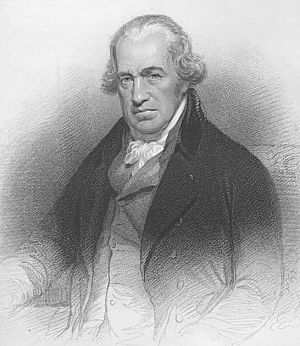
James Watt

An influential innovator of the 18th and 19th centuries


Without the steam engine where would we be today? The steam engine is, in the minds of many people, the most important innovation of the industrial revolution. The original function of the steam engine was simply to pump water out of the mines. But as time progressed, so did the steam engine. As early as the 19th century use of the steam engine spread to mills, locomotives, and even boats. Each of these things were extremely influential to the industrial revolution. Without James Watt, the improvements to the engine may never have been made. Watt revolutionized the steam engine which caused the use of the engine to spread to other industries allowing the industrial revolution to begin.


James Watt
James Watt was born on January 19th, 1736, in Greenock, Renfrewshire, Scotland. Watt was a Scottish inventor and mechanical engineer who was best known for his contributions to the steam engine. As a child Watt was home-schooled and rarely attended regular school. After several years of being home-schooled, Watt decided he would enroll at Greenock Grammar School, where he showed exceptional talent in math and engineering. When Watt was 18 years old he chose to reside in Glasgow, where he was intent on setting up his own instrument making business. His application for his business was denied by the Glasgow Guild of Hammermen, which meant he could not start his business. Later, the arrival of astronomical instruments to the University of Glasgow provided James an opportunity for work. After several years of working at the University of Glasgow, Watt was given the opportunity to start a small workshop within the university. Watt took up this offer and initiated his workshop in 1757.
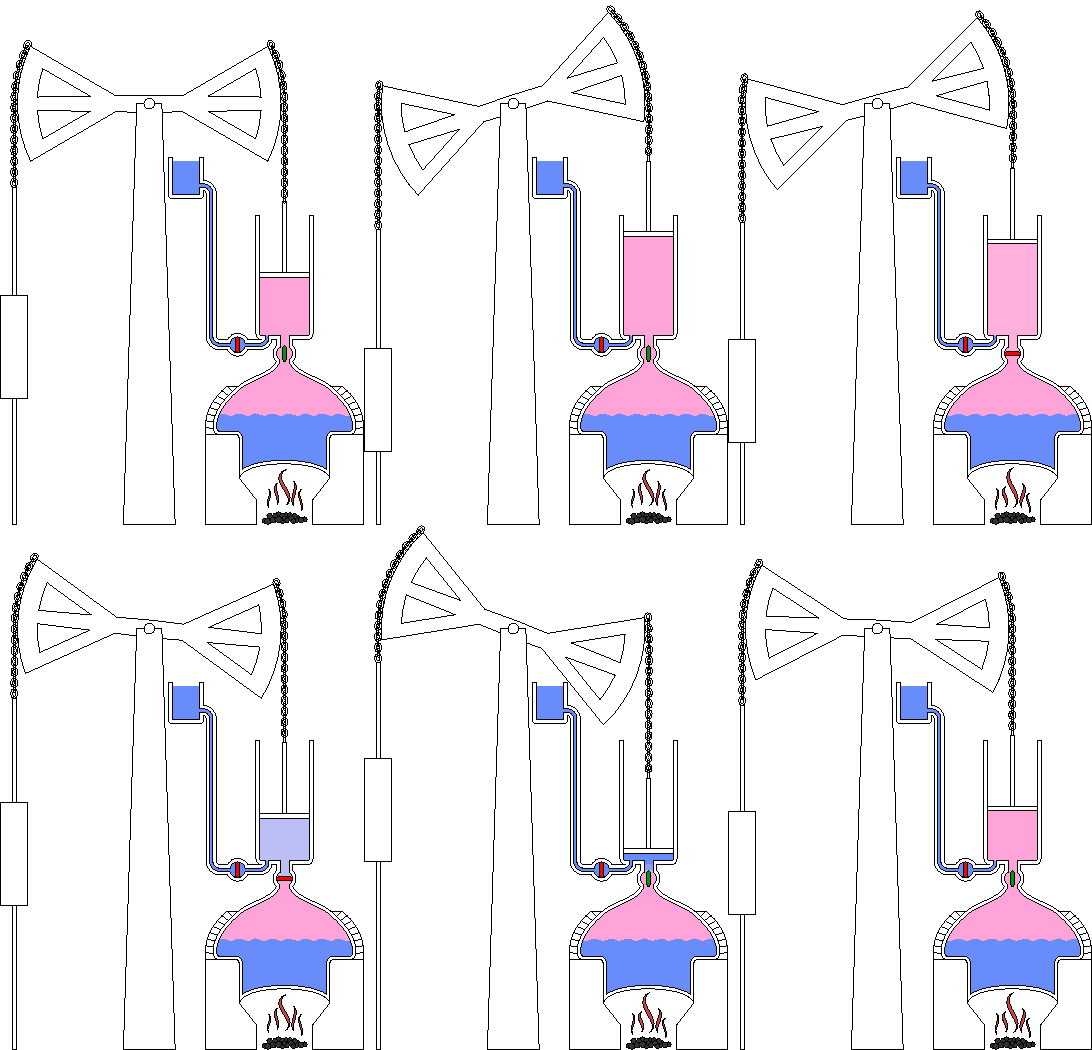
Animation of a Newcomen steam engine.

The first working steam engine was invented in 1712. This engine was called the Newcomen steam engine. In 1764, Watt was given a model Newcomen engine to repair. The problem the Newcomen engine had was that it consumed too much steam while doing its job. After examining the engine, Watt realized that the reason this engine consumed so much steam was because it cooled down to condense the steam after every stroke, and then reheated. Watt needed to find a way to condense the steam without cooling the main cylinder. He contemplated this issue for months and he finally concluded that he would design a separate, smaller cylinder connected to the main one. This second cylinder was meant for steam condensation. Having the two chambers connected allowed for less loss of heat. The steam would enter the first cylinder through an inlet valve; then the piston, propelled by atmospheric pressure, would push the steam out of the main cylinder and into the smaller, condensing chamber. This allowed the first cylinder to remain hot which prevented huge losses of steam.
Watt's separate condenser (left).

Following Watt’s successful invention of the separate condensing chamber, he decided he would attempt to build a full scale steam engine. He met a man by the name of John Roebuck, with whom Watt later formed a partnership. Roebuck agreed to back the production of a full scale steam engine. For a duration of four years Watt worked on constructing a full scale steam engine. Finally, Watt was able to get a full scale engine to work well enough for a patent. Watt and Roebuck were granted this patent in 1769. Roebuck offered to pay off all the debt in exchange for two thirds of the money that the engine made. Watt agreed to this because there was massive debt due to all the trial and error involved with the creation of the newly patented steam engine. Roebuck also helped Watt one more time before their partnership was over. He indirectly introduced Watt to Matthew Boulton, with whom Watt would later form one of the most significant duos of all time.


The Watt Steam Engine.
Boulton recognized the potential of the newly patented steam engine and attempted to acquire Roebuck’s rights to the engine. However, Boulton could not come to a deal with Roebuck and was unsuccessful in acquiring the rights. Later in March of 1773, Roebuck was in desperate need of cash. Boulton acquired Roebuck’s rights to the engine in that same year. The partnership of Boulton and Watt worked out much better than Watt’s partnership with Roebuck because Boulton hired craftsmen who were experienced and accomplished, which is something Watt had lacked in his partnership with Roebuck. In March of 1776, the Bentley Mining Company started the first Boulton-Watt steam engine. The Bentley Mining Company had taken a risk in removing a widely-used Newcomen engine and replacing it with a brand new Boulton-Watt engine. The new engine was a huge success. Emptying a pit 57 feet deep of water in less than an hour. This success caused the demand for Boulton-Watt engines to increase significantly. In 1795, Boulton and Watt opened the Soho Foundry to manufacture the engines. By 1800, 84 British cotton mills used Boulton-Watt engines.
Watt retired in 1800 and his partnership and patent also expired. The partnership was transferred to the sons of these historic figures. Even though Watt was supposedly retired, he continued to invent things to his deathbed. In 1816, Watt took a trip on a famous steamboat called the Comet, which was a product of his inventions. He died at age 83, on August 19th, 1819 at his home in Handsworth, Birmingham, England.
The steam locomotive.
James Watt was one of reasons the industrial revolution began. His improvements to the steam engine allowed use of the engine to spread to other industries. The industry that benefited from the steam engine most significantly was the locomotive industry. Steam locomotives were one of the most important innovations of the industrial revolution. The steam locomotive was the primary source of transportation for goods. Steam locomotives are considered the biggest leap in transportation technology in history. Without steam locomotives, factories were not supplied with the materials they needed to manufacture their products. And without steam power, factories were not as efficient. The steam locomotive allowed the industrial revolution to take place.  
Steam power also had a profound effect on the expansion of factories in the industrial revolution. Before Watt made the improvements to the steam engine, factories had to be located by rivers in order to power their machinery. The steam engine made it possible for factories to be located away from rivers because they provided an alternate source of power. Steam also provided a consistent source of power for factories, unlike water power which provided an inconsistent source of power due to floods, droughts, and other similar occurrences. Overall, factories were able to produce more goods at a more consistent level due to the implementation of the steam engine.
Without James Watt, would the improvements to the steam engine ever have been made? And without the steam engine, would the industrial revolution ever have happened? James Watt improved and adapted the steam engine so it could be used efficiently in multiple industries. Without those industries, the industrial revolution never would have progressed. James Watt was the reason the industrial revolution began. Without James Watt, we never would have evolved from our old ways of life. 


Important Dates:


1712 ~ Newcomen Engine Patented
1736 ~ James Watt Born
1755 ~ James Watt Trained in London
1764 ~ James Watt Discovers Problem with Newcomen Engine
1765 ~ James Watt Discovers Separate Condenser
1769 ~ John Roebuck and James Watt Patent the Engine
1774 ~ Boulton Acquires Roebuck's Patent Rights
1776 ~ The First Boulton-Watt Engine is Installed by the Bentley Mining Company
1800 ~ James Watt Retires at Age 64
1819 ~ James Watt dies, age 83


Monday, November 26, 2012

Medieval China–A Great Civilization


Medieval China; a Dominant Civilization
Paul Monheimer (with LOTS of help from KP)

What factors caused medieval China’s civilization to flourish? Trade throughout the Silk Road triggered and spread ideas. Magnificent emperors such as Kublai Khan ruled dynasties with precision and skill. And lastly, medieval China picked only a select few government officials by using the civil service test. In medieval China, the amazing Silk Road, outstanding emperors, and the imperial exam were main contributors to making China’s dynasties successful.

The Silk Road was an intricate and immense marketing system run through merchants and traders. Marco Polo, perhaps the most famous explorer of all time, traveled through all of China collecting ideas and spreading them throughout his travels along this path. The Silk Road also helped spread word of many ideas such as gunpowder and paper from medieval China. Sickness, religion, and philosophy traveled through the Silk Road as well, and that is how Buddhism got from India to China. In summary, the Silk Road started to mix cultural ideas during medieval China, and is known today as “the world’s first internet.”

Without such sapient leaders as the Khan’s, life would have been much more of a challenge in medieval China. Genghis Khan, one of the world’s greatest conquerors, defeated many people through potent army and strategy. Kublai Khan, his grandson, welcomed foreign merchants and enforced trade on the Silk Road. Many powerful emperors used the Yam postal service, an information delivery system run by messengers, during times of combat and battle. The many ways of the mighty emperors in medieval China made their civilizations run more fluently.

For many years, China’s government was formed by royal titles and leadership passing from father to son, but during the Song dynasty that changed. Instead of this, they used the imperial examination; a large test that was used to appoint a select few government officials. There were different stages of this test, so that the examiners could watch, and pull out a few exceptional scholars. Many people studied for years to take this, while only 5% of people passed the exam. These are the reasons why in medieval china the selection process of their government was so strongly built.

Medieval China was such an accomplished time for many reasons, such as trade on the Silk Road, wise emperors, and the imperial exam. They made many new discoveries through the Silk Road. The Khan emperors ruled with grace as they led armies and tested new ways of thinking. And lastly, the imperial exam selected only the most remarkable scholars. Combining all of these great advances from medieval China, one can clearly see how they affect many civilizations today.

Works Cited

Karpiel, Frank, Kathleen Krull, and Grant P. Wiggins. My World History. Boston, MA: Pearson, 2012. 
Print. 
"Marco Polo and His Travels." Marco Polo and His Travels. N.p., n.d. Web. 26 Nov. 2012. <http://www.silk-road.com/artl/marcopolo.shtml>. 
"Silk Road (marketplace)." Wikipedia. Wikimedia Foundation, 26 Nov. 2012. Web. 26 
Nov. 2012. <http://en.wikipedia.org/wiki/Silk_Road_(marketplace)>. 


Monday, October 22, 2012

Boundary Simulation Debrief

Please REPLY to this blog post.  DO NOT post to your own blogs.  In your reply, please answer the following questions as fully as you need to.  There is no limit to the length of your reply.

The following questions are about your role/feelings/participation in the boundary simulation activity you just completed.

1.  What was your group like?  Give a concrete example or two.
2.  What did YOU do to help your group achieve its goals?
3.  Is there any real life situation in the world today which reminds you of this activity?
4.  How did you feel during the activity?  Did you ever feel frustrated?  How do you feel about your group now?
5.  Was this activity helpful to you?  Why/Why not?

http://programmedevelopment.com/public/uploads/images/orange_figure_showing_chart_pc_1600_wht.png
http://www.lankachannel.com/icon/news/Debrief_News.jpg

Monday, October 15, 2012

7,000,000,000 and Counting


This response should be your longest so far.....and will be your longest of the project.

Mentally go through your typical day and think of all the ways you use energy and how your life would be affected if you no longer had access to energy.  Specifically, how would your life change without access to energy?
Now, think about the population in your neighborhood.  What problems will increase if more people move into the Portland Metro area?  
Finally, think about the article.  Were there parts that surprised you?  Were there parts you didn't understand?  By 2050, the world is projected to have 10 billion people.  You will be approximately 51 years old (scary, I know)  What problems do you think the world will be facing with that many  people?

Your response should be around 2 paragraphs (10 or so sentences.)  Use standard Geography and the Human Experience labels.  Yes, an image would be nice....


http://www.geography.learnontheinternet.co.uk/images/popn/world_pop.gif
https://blogger.googleusercontent.com/img/b/R29vZ2xl/AVvXsEiYXiPbUPw8wrx8vR7y30BW6vVPMGQSfXDGErv74xpd8Y-JumTSVjyv8G_M-M0fbvjAybSpG5GgodiJRrxY2Kn6Z9zLHntQCzTk7ExpMEv59-GkBibYdf_wRO8o4o6ahV1vqSBO1unHxB-N/s1600/images.jpg