Friday, February 24, 2017

The Fake News of the French Revolution ¯\_(O.O)_/¯


Marie Antoinette - EXPOSED


"Qu'ils mangent de la brioche" means let them eat cake in French. This was the famous quote spoken by the last queen of France, Marie Antoinette, who helped provoke a revolution upon learning peasants were suffering from widespread bread shortages. Because brioche was a luxury bread, enriched with with butter and eggs, the quote was said to reflect the princess's disregard for the peasants. With that callous remark, the peasants banded together to form an army, invaded the palace, and beheaded the monarchs and palace officials using guillotines.


Who knew cake could contribute to the start of a revolution? Nobody, and that is because it didn't. Marie Antoinette was actually very sensitive to the poor population of France, and she never said “let them eat cake.” The quote would have been highly uncharacteristic of her, as she was an intelligent woman who donated to many charities, despite her lavish lifestyle.

So, if she never said "let them eat cake," where did this rumor originate? It was first told by a spanish princess named Marie Therese. She allegedly suggested to the French, "La croûte de pâté,” let them eat cake. Later on, about eighteen others were blamed for the irritable remark, most famously, the philosopher Jean Jacques Rousseau. Whoever uttered those unforgettable words, it was certainly not Marie Antoinette
Now that we know Marie Antoinette was not responsible for the distasteful quote, why did the revolution even start? Marie Antoinette was only a small part of the revolution, as the actual revolution started because her husband, King Louis XVI, as he was found conspiring with foreign powers, later being charged with treason, and beheaded as well. Even if she hadn't said “let them eat cake,” the people wanted to contribute to the uprising around them, and they needed a reason to do so. An easy target like Marie Antoinette would destroy the monarchy. All in all, the entire let them eat cake shenanigan was merely the fake news of the French Revolution!

Thursday, February 23, 2017

Social Media in the 18th Century

Most people in our era think if social media as an app on a device that uses data, and allows you to communicate with friends, family and new people. But in the 18th century, that is not what social media was like. First of all, touch-screen phones had not been invented. In fact, people during that time period didn't have anything close to a smartphone. The only way they could communicating with people far away was through telegrams… Second of all, no one had come up with the idea of apps for  phones (Snapchat, Instagram, Tumblr, Facebook, etc…) because obviously, they didn’t have them.
Image result for social media in the 18th centuryImage result for social media
             Social media in the 18th century       V.S.      Social media in the 21st century


In the 18th century, there was a different widespread meaning for social media. They didn’t have any version of a device. So instead, they used coffeehouses and art salons to spread news, share ideas, and meet new ppl. The historian Brian Cowan describes English coffeehouses as "places where people gathered to drink coffee, learn the news of the day, and perhaps to meet with other local residents and discuss matters of mutual concern." This was a way for people to catch up on the current matters of the world, and be in a social environments!
Image result for coffee house in the age of enlightenment
In theory, English coffeehouses and Persian salons were almost as effective as social media. They allowed people to do similar things: communicate with multiple people, and hear about the hottest new gossip/ important world news.


In my opinion, social media then and now are both very similar, even though they were, and are not executed in the same ways. Social media is important to me because it allows me to meet new people, share things I find interesting, and build knowledge about many things. I use many apps, such as Instagram, Snapchat, Tumblr, Pinterest, and YouTube. They are all entertaining, and I learn new things!


The video linked below describes how coffeehouses and salons were used in the 18th century

Longboarding

Image result for surfingSurfing was first described in 1769 by Joseph Banks. It was an important part of Polynesian culture. It started as bodysurfing and then slowing evolved into standing up on a board and riding down the waves. You might wonder why people chose to get on a board and ride down a wave and the answer to this is adrenalin. Surfing slowly evolved from water to land and that how we got the skateboard.

Skateboarding evolved from a plank of wood with the bottom of roller skates on them to a full-blown culture. I longboard and skateboard because I think that they are both fun in their own ways. However, I recently started to like longboarding more because of the adrenaline.
Now I'm going to tell you how longboarding works. For longboarding, you need a helmet gloves and knee pads if you want to protect your knees. First I'm going to talk about freeride, freeride is where you do a ton of slides, you slide by turning the board sideways and sliding the wheels. Next I'm going to tell you about my personal favorite wich is downhill. Downhill longboarding is going as fast as you can down a hill and sliding as little as possible. This sport has evolved into a culture and a lifestyle. Related image

How Might The Universe End?


            Before I begin, I'd like to give you a bit of a content warning. I want to let you know that this is a very heavy topic. The matters I'll be discussing here may be a tad distressing to some people. Okay, moving on. One day in the far, far future, the Universe will die. Now, you may be wondering; how? and why? how do we know this? first off, the Universe is expanding, and has been expanding since the Big Bang. Also, the rate of expansion is increasing. The reason of this accelerated expansion? Dark energy. Dark energy is a weird phenomenon that scientists think permeates the entire Universe. Up until the year 1998, scientists thought the Universe worked a bit like a yo-yo, if you will. No matter how far down it goes, it always comes back up. They though the expansion must slow at some point. However, the expansion, like I said before, is actually speeding up. Now, where is this speeding up of the expansion coming from? We don't really know, but this is what we call dark energy. Albert Einstein first thought of this idea, and then decided it was silly. Now, however, astronomers think this idea is very plausible. The problem is, this is all extremely theoretical, and, we aren't really sure what the properties of dark energy are. However, there are a few theories, and they lead us to a few conclusions of how to Universe will end. 

Theory One: The Big Rip.            

            Since the birth of the Universe, it has been expanding. Not only that, new space is created everywhere in the Universe equally. (Weird, right?) This means the space between Galaxies moves apart, making them move farther and farther away from each other. The space inside stellar objects like nebulae and galaxies is also expanding, the gravity in such objects is strong enough to hold them together. However, the Big Rip theory states that one day, the expansion will be so fast and so powerful that the gravity of these objects will not be strong enough to hold them together. First, big objects like galaxies will be torn apart. Over time, stars, planets and black holes would too be torn apart, leaving behind atoms. When the Universe begins expanding faster than the speed of light, atoms too would dissolve. The Universe would then be a strange place, full of particles that would never be able to touch, whizzing around for, well, who knows how long?

Theory Two: Heat Death.           

            The Heat Death Theory states that over an extremely long yet finite amount of time, matter stays intact but degenerates into radiation, while the Universe expands forever. How does this work? One word: entropy. All systems tend to fall into the highest level of entropy. Think of it like a Latte Macchiato. When served, it generally has three regions, but over time, these regions will cool down, dissolve, and become one region. This also applies to the Universe. While the Universe gets larger and larger, and, along with it, matter slowly decays. After some time, the gas in the gas clouds needed to form stars will run out, and the Universe will turn dark. The remaining long lived stars will die, and black holes will degenerate and evaporate. (I know!) This is caused by a theory called "Hawking Radiation." Black holes are thought to take (drumroll, please), 10 to the 92nd power years. That's an almost incomprehensible number. I mean, the Universe is only 14 billion years old. Think about that for a moment. I could go deeper with this, but that's a whole 'nother blog post. All activity in the Universe ceases at this point. Entropy is at it's fullest capacity. The Universe is hereby dead forever. Unless, theoretically, after a mind-bogglingly long time, part of this dead Universe would be spontaneously jostled, leading to what's known as "quantum tunneling, which would result in a new Big Bang. Weird!

Theory Three: The Big Crunch + The Big Bounce.            

            If there is actually less dark energy than we think there is today, or if it slowly runs out over time, gravity will be the most pervasive and dominating force in the Universe. If this happens, the Universe will shrink, and the galaxies will get closer and closer together. Since a smaller Universe means a hotter Universe, the temperature will rise dramatically. It would get so hot that background radiation (the microwave radiation remaining from the Big Bang), will become so hot that stars would be cooked, if you will, from the outside. It will then get so hot atoms will tear apart. And it'll keep shrinking. Soon, all that we would be able to see would be the galaxy. Then it would shrink down to the size of the solar system. Then to the size of the earth, and, although this may sound strange, it will keep shrinking. It will shrink so small, the universe will be the size of a subatomic particle. There is one idea that gives me some hope, however. This is where the Big Bounce Theory comes into play. The Big Bounce Theory states that this expansion and contraction has happened an infinite amount of times, and will keep happening. The Universe will just keep expanding and contracting. Wouldn't that be nice?


            I haven't thought about this subject deeply enough to decide upon which theory I support. At the moment, though, the Heat Death theory seems the most likely. 


            When I think about all of this, though, I can't help but remember those first people who looked up to the sky and wondered what was beyond our vision. From the great minds of the Scientific Revolution like Galileo, Copernicus and Kepler, to Greeks like Hipparchus and Aristarchus. It is because of them that we know as much about the heavens as we do today.

Wednesday, February 22, 2017

How the Greeks have helped the way we see astronomy

                             Astronomy

  
     Have you ever wondered what the heck "Jupiter" means? Is it just me who gets Saturn and Neptune mixed up? Once you learn about who and what these planets are named after, you will never confuse and ponder what these names are supposed to mean.
  Let's take the hydrogen planet Neptune for example. Neptune is a rather strange and unique name, don't you think? Neptune is actually a Roman name for the Greek sea god Poseidon, who controlled the seas and oceans. Poseidon is the brother of the king of the gods, Zeus, whose Roman name is Jupiter. Most of the planets' names, except for Earth, are named after Roman gods, which are adapted from Greek mythology. 
  The constellations, too, are derived from Greek lore. The dipper-shaped constellation, Ursa Major, is a big momma bear named Callisto, and her son Arcas, her smaller counterpart, is Ursa Minor. In an attempt to save his beloved Callisto from the wrath of his wife and daughter, Zeus cast her up into the sky as a constellation of a bear, along with their son, Arcas. These constellations, which can be seen glittering brightly in the night sky, are just some of a whole plethora of constellations created and believed in by the Greeks. 
  In magazines such as Seventeen and J-14, horoscopes are all over the place; practically every issue of these magazines have a page that determines your future that month by your horoscope sign. These, too, are created by the Greeks, and every sign has its own special Greek myth. For example, if you are a Leo, you were born in the months of the Nemean Lion, who was killed, skinned, and worn as a cape by the infamous hero Hercules, and if you are a Scorpio, you were born in the months of the giant scorpion that stung Orion's heel. Quite delightful. 
  The ancient Greeks have greatly influenced how we see astronomy, and without their earlier discoveries and beliefs, we wouldn't have been able to understand space quite like we do now. To do your part to acknowledge their powerful influence on astronomy, remember that each and every single planet except Earth is called what it is today with the help of the Greeks, and that the stars that shine above you hold great symbolism and character that have built the foundation for our current understanding of space.  
   

Stained Glass

Choir hall
Have you ever gazed up in a church and stared at the stained glass that adorned the ceiling? Have you wondered how it was made or invented? Stained glass is an artwork that has dazzled us all throughout the ages.
Colored glass has been produced since the ancient times. The Romans and Egyptians manufactured many small glass objects such as vases, trinkets, or beads. Phoenicia was the main glass producer and spread the idea of glass making throughout the world. The origin of stained glass started in Syria during the Islamic period. They developed gilded glass that led to the production of stained glass.
Alabaster window
Indication of the first stained glass windows come from the 7th century when Saint Benedict Biscop hired a Frenchman to glaze the windows of his monastery. In the 4th and 5th century, early Christian churches had windows of thinly sliced alabaster, so the windows looked like stained glass but in shades of brown. Stained glass windows did not appear in churches until the introduction of gothic cathedrals.
Rose Window
Stained glass gained popularity in the Middle Ages, when it was used in Christian cathedrals and churches. This unique art form was used as an illustration to show scenes in the Bible, like the Garden of Eden or the Saint Mary. Stained glass quickly spread throughout Europe, as windows became larger and more elaborate. In France, a circular window, called the rose window, was developed. It was built of linked windows for a mandala effect.
Classical Style
There were two main styles that were used in the Middle Ages: Gothic and Classical stained glass. Classical glass was influenced by the Gothic style. Gothic was a form that used vibrant colors and usually depicted figures of Christ, framed in  floral patterns and designs. Classical stained glass used a more mellow color scheme, and the pictures were more refined.
Stained glass lost its demand during the Reformation and the French Revolution. Many windows were smashed by protestants and being replaced with plain glass ones. The French Revolution caused the destruction and neglect of many stained glass pieces. The Dissolution of Monasteries was especially damaging to the tradition of making stained glass. Because they were  “abused images”, Henry VIII destroyed thousands of windows. Only a handful of windows stayed intact. The traditional practice of stained glass was lost and would not be rediscovered until the 19th century.

light shining through the Nasir Mosque
Stained glass is an extraordinary type of art. It is both beautiful and practical, providing pictures of the Bible for context. I love seeing the brilliant colors of the mosaic-like artwork and looking at the colorful light that it sheds. Stained glass is a tradition of artwork that I hope never disappears.

Sources:
https://en.wikipedia.org/wiki/Stained_glass
http://www.houzz.com/ideabooks/9456207/list/flying-colors-stained-glass-through-the-ages-to-today

Who Invented the Telescope?

This has been a question many people have asked. There are four men who are involved in the answer to this question that we are still puzzling about today. Hans Lippershey, Zacharias Janssen, Jacob Metius and Galileo Galilei.


Hans Lippershey was an eyeglass maker and the first person to apply for a patent on the idea of a device that could magnify what you are looking at three times. People argued against him trying to patent this idea, saying that he stole the idea from another eyeglass maker, Zacharias Janssen. Jansen and Lippershey lived in the same town, and were both eyeglass makers, but there is no proof that  Lippershey made his telescope alone. In the end, Lippershey got credit for creating the telescope and Jansen got credit for creating the compound microscope. The topic of who created the microscope is debated as well, but as the article, “Who Invented The Telescope?” By Lauren Cox reads, “while Jansen is credited with inventing the compound microscope. Both appear to have contributed to the development of both instruments.”  meaning that both men appeared to have both worked on creating the microscope and telescope.


Soon another man, Jacob Metius was thrown into the mix. Jacob Metius applied for a patent on the telescope a few weeks after Lippershey did. The government soon turned down both offers for a patent because of counterclaims. In the end, Jacob Metius got a small reward but Lippershey was paid a lot of money to have his telescopes remade and sold or used.


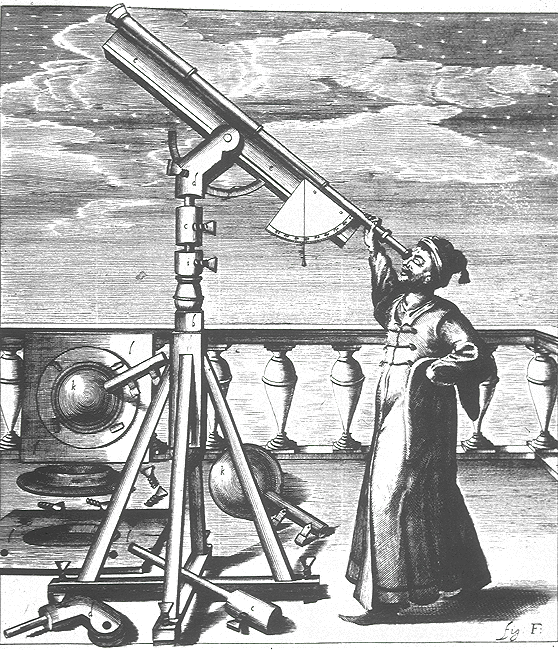
Lastly, Galileo Galilei was involved in this mess when he had heard about the first telescopes and created his own with a few tweaks and then presented it to the Venetian Senate, and in return they set him up for life as a lecturer at the University of Padua. Galileo was also the first to look at the sky and the stars with a telescope, resulting in the discovery of  the Sun’s sunspots and Jupiter’s set of moons as well was many other things, that you can check out here.


Lastly, where is my thought in all of this. Personally, I feel that there is so much more out in the universe that has not yet been seen and just like Galileo, I want to use something we already have and see the world and the universe in a new way as he used the telescope to look at the stars.


Four men who are all considered to be the creator of the telescope, but who actually made the first one? Many people have been wondering this, and many more to come are going to ask this question as well.


Sources:
Images:


Life among the early Mill Girls

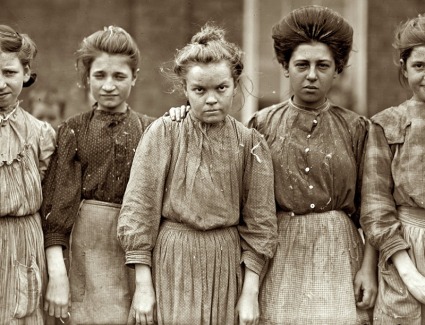
Harriet Jane Hanson Robinson was one of the key figures of the Loom and Spindle: Life Among The Early Mill Girls autobiography. She played a vital role in the women's suffrage in the United States.

           Harriet Jane Hanson Robinson, was born on February 8, 1825 and died on December 22, 1911. Harriet, like many other women, wanted to work. She felt an urge to work, she wanted to earn money for herself as an individual and felt it would be a valuable experience for her. She also knew that earning the extra money would be of great aid to her mother. In 1834 at the age of ten, Harriet began working as a doffer in the Merrimack Mill in Lowell, Massachusetts. The job of a doffer was to "doff" or replace full bobbins, or reels of thread with empty bobbins.  The hours were long and exhausting. The noise of the machinery was deafeningly loud, the belabored levers and the moiling gears were the worst part.  Little Harriet was obligated to work from as early as five in the morning and often until seven at night. Harriet worked six days a week and was paid $2, averaging three cents per hour. This was considered a fair amount of money to be paid, especially as women during this time period. The owners of the factories needed cheap labor . As this franchise grew the Lowell company was filled with "Mill girls," as they were called. Earning a customary wage for the first time in their lives was empowering to the Mill girls, it gave them a sense of confidence.
          Harriett arrived in Lowell as a young child. Her mother, widowed in Boston with her four young children, was barely able to feed them, let alone afford to care for herself. With an optimistic outlook as her first priority, she and her family traveled by canal to Lowell. She took a job of managing one of the boarding houses where the Mill girls resided. Compared to the conditions the family was living in while in Boston, this new life would hopefully be much more preponderant. But authentically, that "more preponderant life," never transpired the way she had orchestrated it to. An example of this,when Harriet was 11. The Merrimack Mills took a shot at saving money. In the process, they  cut part of the stipend that paid to board homes. This concluded that the people working would need to pay for their rooms and board out their own wages. A vast number of the people working were very enraged when they found out. They considered this a pay cut. There for they held a strike against this act.

          In the cessation, Harriet preached to her co workers her objections to the unfair terms that the company placed them in by having to  pay for their room and board.  She explained to them that they could do what they felt was right, but she would take a stand. She did in fact proceed to march and by her side were many of her fellow co- workers.  The crowd of girls  went to fight for what they believed in.
          
           More than 60 years later, Harriet Jane Hanson Robinson described this as the proudest moment of her entire life. Despite the fact that the strike was not a success, she still walked away feeling proud because she fought for what she believed in and never gave up.

         Nowadays, things are a lot different. I don't know if I would have ever been able to withstand that kind of work. In comparison to my day, the amount of hours that I spend at school compared to how many they spent working in the mills very different. For example, I spend on average around 7 hours at school, where as these mill girls spent close to 15 hours at work. Not only is this harder having to be there for so long, but I can guarantee ,that they didn't have a lot of free time. At school, we have lots of fun and exciting activities to participate in and even the subjects alone are engaging. There is almost always a new thing waiting for you in each class. On top of that, these kids were younger than I am and had a much more strenuous life on both their bodies and brains. I feel extremely thankful to be so privileged I couldn't possibly ask for anything better.

Work cited:
- "Harriet Hanson Robinson." Wikipedia. Wikimedia Foundation, 12 Feb. 2017. Web. 22 Feb. 2017.
- Harriet Robinson on Lowell Mill girls. Retrieved February 22, 2017, from http://courses.wcupa.edu/johnson/robinson.html
- Harriet Hanson Robinson facts (1983). In . Retrieved from http://biography.yourdictionary.com/harriet-hanson-robinson
- https://upload.wikimedia.org/wikipedia/commons/1/12/Harriet_Hanson_Robinson.png
- http://lowellmillgirls1.weebly.com/uploads/4/3/8/9/4389227/7560943.jpg?425
- http://newenglandhistoricalsociety.com/wp-content/uploads/2013/06/mill-girl.jpg


Tuesday, February 21, 2017

The History of the Paris Opera Ballet


The Paris Opera Ballet is a ballet company in Paris, France. It is proudly the first ballet company in world history. Alongside London's Royal Ballet and Moscow's Bolshoi Ballet, the Paris Opera is one of three most preeminent ballet companies in the world. The Paris Opera Ballet also has a school, for the kids who aspire to be in the company one day. I am a ballet dancer myself, so learning about the history of ballet really interests me. 

The Paris Opera Ballet was founded by Louis XIV of France, in 1669, along with it's school, the Paris Opera Ballet School. He was a fan of ballet since birth, and a dancer himself. Ballet originated in Italian and French courts, in the 15th century. Back then, at events and celebrations, they performed steps which are now ballet steps. Actually, sometimes, they would do dances that represent the food they were serving at the event! Louis XIV decided that people should have access to further dance education, so he opened the first ballet studio!

Charles Garnier was a French architect (6 November 1825 – 3 August 1898). He was the architect behind the Paris Opera Ballet and the Paris Opera House (where the company performs). He was the winner of many applicants to design and construct the buildings. During the construction, the unfinished material was used as a warehouse for goods, and a military prison. 

Now, Aurelie Dupont ( born 15 January, 1973) is the director of the company. She was named director in 2016, after Benjamin Millepied. She traveled through the ranks in the Paris Opera Ballet, and decided to take things a step further, becoming the director of one of the most famous companies in the world. The Paris Opera Ballet is still thriving to this day, and still a very well known company.


My connection to the Paris Opera Ballet is that I, as a ballet dancer, hope to make it into a very big ballet company, like the Paris Opera Ballet. Researching about this has expanded my knowledge of the history of ballet, which is very interesting. 


Works Cited
"Aurélie Dupont." Wikipedia. Wikimedia Foundation, 05 Feb. 2017. Web. 21 Feb. 2017.
"The Ballet School - Artists." Opéra National De Paris. N.p., n.d. Web. 21 Feb. 2017.
"Charles Garnier (architect)." Wikipedia. Wikimedia Foundation, 18 Feb. 2017. Web. 21 Feb. 2017.
"HISTORY OF BALLET |." HISTORY OF BALLET |. N.p., n.d. Web. 21 Feb. 2017.
"Louis XIV and the Birth of Classical Ballet." California Ballet Company's Blog. N.p., 24 May 2010. Web. 21 Feb. 2017.
"Opéra National De Paris." Opéra National De Paris. N.p., n.d. Web. 21 Feb. 2017.
"Paris Opera Ballet." Wikipedia. Wikimedia Foundation, 15 Feb. 2017. Web. 21 Feb. 2017.

Louis Pasteur


                                             Louis Pasteur

 Do you like milk, cheese and ice cream? These foods can all be eaten safely by most people because of Louis Pasteur. Pasteur is still regarded as one of the most prominent chemists in history. Louis Pasteur's work in the 19th century still impacts people’s daily lives today.
Pasteur was born in Dole, France, on December 27, 1822, although he was raised in Arbois, France. Louis Pasteur was not a talented student in class and no one believed he would amount to much. Outside of class he was very creative and was always drawing. His drawings from his early life are still kept in museums around the world. While he was working on his doctorate he was doing scientific research. He then became a teacher.
While being a teacher, he proved that foods spoiled because of microbes, a form of bacteria. People at the time  germs and bacteria came from dust. He proved that bacteria was everywhere.This may sound basic but at the time it was very controversial. They called this his “germ theory.” His work in germ theory then led to pasteurization. Without his work you wouldn’t have to wash your hands and be sanitary.

One of the many contributions Pasteur made to the scientific world was pasteurization. At the time, wine was the biggest export from France and its economy was very dependent on wine. There was one big problem. The wine was spoiling too fast. Napoleon III came to Pasteur to ask for his help in solving this issue. Pasteur worked for quite some time testing samples, trying to discover what was causing the wine to spoil. He eventually discovered it was the same microbes that caused food to spoil. Pasteur then created a process of heating the liquid and letting it cool, to prevent the liquid from souring.  This process was called “pasteurization” after him. Pasteurization helped prevent diseases such as typhoid fever, tuberculosis, and even polio. People still use this process today. Pasteurization is why we can drink juices, milk, and make butter without getting serious diseases.
At the age of forty-five, Pasteur became paralyzed on the left side of his body due to a stroke. But still he continued his work. While Pasteur was working many people were dying because of a disease called rabies. This disease is contracted by being bitten by some kind of diseased wild animal. What was so deadly about this disease is that the person who was bitten doesn't realize anything is wrong until it's too late. Pasteur made it his job to try to solve this problem. He came up with a vaccine that he had tested on rats, but was very nervous to use it on humans. When a young boy was brought to him that had been bitten by a rabid animal he had no choice but to try the vaccine. It worked. From there, future scientists and chemists were able to make a more advanced vaccine based off Pasteur’s work. The most important thing he learned was that if you inject a weaker version of the disease into the infected person it cured them. This theory was not new but it did prove it.
In general, milk around the world is regarded as a healthy drink. People take it for granted that they don't have to worry about getting serious diseases when drinking dairy and juice products. Indirectly,  people around the world are able to have pets wit
hout being worried about being bitten and dying a slow and painful death from rabies. Pasteur's contributions earned many medals and honors. Pasteur’s work still impacts many lives to this day. Thanks to Louis Pasteur’s countless lives have been saved.

Links:

Monday, February 20, 2017

Living in the Civil War and Living 150 years since then.

Living in the Civil war and Living 150 years since then.

Eleanor pulled the water bucket higher on her shoulders, the spring air teasing her hair in different directions. Her small town in Kansas was bustling with activity. The United States was just entering the Civil War. About a month prior, the South, or the states that seceded from the Union to make the Confederate States of America, had attacked Fort Sumter in South Carolina. Many men were choosing to volunteer for the war.
She lifted the bucket up further and kept walking. The door creaked open and Eleanor set down the bucket, started the fire, and was about to begin warming the water for dishwashing when Ma entered the room. Worry creased Ma’s brow, and Ma slumped down in a chair near the fire.
“What’s wrong, Ma?” Eleanor asked, rushing over to her mother.
“It’s Pa,” Ma said sullenly. “He’s gonna be in da war.” Image result for women's clothing during the civil war
A century and a half later…
Brianna let the warm water cascade down her fingertips. She slowly grabbed a glass cup, and started to wash the dishes. Warm water and soap ran over the plates, and little bubbles rose into the air above the kitchen sink. She glanced out the window at the city. Lights flickered in some windows. Brianna lived just outside Kansas City. She loved the bright city night lights, and the loud honk of car horns deep in rush hour traffic. She shut the tap off, dried her hands, and went upstairs to start working on HW.

Eleanor was feeling dread as she poured the warm water over the dishes. Pa was talking to John, Pa’s friend, and Ma was preparing supper. I can’t believe he’s in the war now. Eleanor thought. Fighting against the south side might be hard. Eleanor didn’t know exactly why Pa had chosen to go into the war, but she knew that he had gotten tipsy a week ago and made a bet with John about volunteering for the war. He had been thinking about volunteering for a while.
Eleanor’s brothers were out hunting, but she hoped they wouldn’t volunteer too. Now with her Pa soon to be gone, work would be harder. Her older sister, Mary, was at the bakery, working to make extra money for the family. Her younger siblings that couldn’t go hunting were probably sorting through the farm harvest of the day, preparing it for the market. She finished the dishes, drying her hands on her dress, and set out to call her siblings in for supper.
Image result for civil war
Brianna jumped up out of bed, her alarm clock beeping loudly. She still hadn’t gotten used to the noise, because it reminded her of the old war drills her father used to show her. Brianna’s dad had died a year ago in war. They had received a letter stating his date of death, along with other formalities. That’s why Brianna’s homework, researching the Civil War, was very close to her heart. It did sound hard, living back then. They had to heat water over a stove, and possibly bring water in from a well. Many men thought that being in a war would be better than working on a farm, and they thought that the war would only last for four or five months. They were wrong. The Civil War lasted for four years. The Civil War was boring, with a lot of sitting around. The soldiers didn’t have good food, because it had to be boiled for three hours, a claim stated by regulations. And death constantly hunted any day to day thought, hanging over soldiers like a black rain cloud, growing stronger and more prominent as all weather does before a raging storm.

A week had passed since Pa had left. Eleanor usually could sleep in till six, but that luxury was gone. Being the second oldest daughter, she and Ma were working very hard. They had to tend to the farm and cook and clean, doing chores all day. Luckily, Grandma could help out with watching the kids. Mary was earning a fair amount of money in the bakery to help pay off the debt for the plow. Eleanor’s back hurt and she was very tired, but work had to be done. The war wasn’t improving very much. The Confederate States, the states that wanted slavery to happen, were fighting back. Eleanor’s family, despite living near the Confederate States, didn’t agree with the south. They believed that slavery should be abolished forever because everyone was equal. Pa had sent a letter when he got to the war camp. He talked about how the work was hard, lacking good meals, and how his new wool uniform was itchy and uncomfortable in the spring heat.
Eleanor was working on a pair of wool socks for Pa in any spare time she had, which was usually in the evenings after supper.

Brianna finished her school project a week later. She made a poster about the project and eventually got her Masters in History. She went on to write a book about the Civil War after college.
Eleanor started a charity to soldiers in the Civil War. She and many others donated socks to the many men fighting for freedom of slaves. She stayed with her Ma and Pa, even after the Civil War ended in 1865, and went on to start a family of her own. Image result for american civil war drawings

Sources:
Ratliff, Thomas M., David Antram, and David Salariya. You Wouldn't Want to Be a Civil War Soldier!: A War You'd Rather Not Fight. New York: Franklin Watts, 2015. Print.