Friday, February 16, 2018

The Golden Age of Aviation

        I enjoy flying and am always fascinated about how a journey from the east to west coast of the United States that originally took about six months now takes less than six hours. But what caused this dramatic shift of travel time? What made an expedition that tests bravery, endurance, and health a matter of casual relaxation?
The Douglas DC-3 had the industry at a stalemate.
The Lockheed Constellation, another American offering.
     
        To be honest, it wasn't a very fast transition. Although people immediately saw commercial potential in what literally started in a barn at Kittyhawk, passenger aviation didn't take off until the 30s, and when World War II emerged, the entire industry was grounded as the focus shifted to building fighters and military transports. However, during the post war era, a golden age for passenger aviation began, and the industry reemerged. The number of passengers increased, and airlines started to thrive. But, the most impressive advancement was in the field of manufacturing planes themselves. The United States left the second world war with more experience designing and building cargo planes. They were able to modify their designs to allow for passenger transport, and by doing so cornered the industry. In fact, around this time, about 90% of the world's air travelers were flying aboard American-built Douglas DC-3s. Other countries– Britain for example– had been focusing on bombers and other aircraft not suited for carrying commercial payload during WWII, and therefore had to rebuild their industry. But in order to gain the spotlight, they had to do something incredible. Alas, the Comet was born.

        The accepted reasoning of aircraft propulsion was that jet engines did not produce enough thrust relative to the amount of fuel they consumed. But that reality was starting to slide, as piston engines were becoming larger and being loaded with superchargers to squeeze out what more thrust they could produce, and with these new efforts, their efficiency was starting to diminish. So the De Havilland company of Britain was given the task of creating the first commercial jetliner. During the design process, they used decoy designs to give the public the wrong idea, so when the final design of the Comet was revealed, the world was shocked. Even today, I consider its design to be awesome. Its sleek wings, elegant look and beautiful aerodynamics were straight out of the future. Its four ghost jet engines were integrated into the wing, making it look even more stunning. With this aircraft looking modern even today, you can imagine the impression it had on the public back then. Not only was it good-looking, but it was also more advanced. Instead of flying at the conventional altitude of 10,000 feet, it would cruise at 40,000 feet, where the air was thinner and weather was less problematic. But, to do so, it had to have a highly pressurized cabin, and while other planes had these kinds of cabins, no other flew so high.
A Comet 1, one of the original types.
     
        The Comet made its maiden flight on January 9th of 1951, and immediately started receiving orders from airlines all over the world. It cut travel times in half, and became renowned for its pristine service and passenger comfort. To fly on this plane was considered a luxury mostly done by upper middle class and wealthier individuals. This is one of the reasons I envy the travelers that flew on this plane.
     
        De Havilland was enjoying their new-found superiority in the industry, and produced several early models of the Comet. But within a year, things started to go wrong. Most travelers didn't question the safety of this plane, and when two Comets overshot the runway in 1952 and 1953, the pilots were blamed. However, De Havilland later corrected a wing fault that resulted in loss of lift. Not long after though, another Comet disintegrated in a thunderstorm just after takeoff from Calcutta, and in 1954, another accident occurred, this one far worse. While flying in perfect conditions near Rome, a Comet exploded during its climb. After these incidents, BOAC, the company operating the planes from Calcutta and Rome, grounded their fleet of Comets while an investigation occurred. but after no conclusions were drawn, BOAC resumed their operations as planned ten weeks after the incident. But, only two weeks later, another Comet suffered the same fate outside of Rome. With this, public confidence in the Comet shattered, and its Airworthiness Awards were revoked. De Havilland had no choice but to stop all operations of their once famed fleet. for months, an investigation was conducted, and the cause of the accident was revealed to be fatigue in the fuselage caused by pressurization and amplified by the square windows on the plane.
     
        Unfortunately, this was the end of De Havilland's superiority. While they rushed to correct the faults in their plane, other companies were catching on. The same year that the Comet 4 was released, Boeing released their 707 and Douglas began their jet era with their DC-8. Then came Tupolev's 104 and Ilyushin's IL-62. These larger, and less expensive options offered a further flight range, and therefore were easily able to compete with the original jetliner. The Comet 4 had just 76 deliveries to airlines, a fraction compared to over 500 DC-8s and more than 1,000 Boeing 707s.
Douglas DC-8 (556 Deliveries)
Boeing 707 (1010 Deliveries)

        Although it had its troubles, this plane's mistakes paved the way for the future of the industry. Boeing even admitted that they would have made the same mistakes if it weren't for the Comet. This aircraft may seem normal, but without it, transcontinental flight might still be a dream. The technological marvel of the Comet still inspires me and makes me wonder how humans can achieve such things. Sometimes, I wonder what the future will look like, and with that, transportation. What will the next generation of aerospace look like? Let's just say, "We're not there yet."

Thursday, February 15, 2018

The Future of Performing Arts

We all have seen or heard of Cirque de Soleil. But I am focusing on the German Wheel. I do German Wheel, next to no one has heard of it. German Wheel is something is a like two heavy hula hoops put together with it is very heavy and it also has two foot pedals with straps so you can go upside down. When I first heard of it and pretty much fell in love.

This photo is of Quidam the Cirque de Soleil show my coach
was in.
My coach was in Cirque de Soleil Quidam, it is a show that toured all around the world that featured German Wheel.
I have become obsessed with watching mesmerizing videos and learning new skills.
There is one hold up if someone is asking me about what sport I do, I can’t really say “yeah I do German Wheel” without getting bombarded with questions. I once had someone picking me up from practice, think I was learning how to speak German. I have grown to not even mention it to spare me from showing photos and explaining. SInce then I have been eager to learn to do more tricks, it is always exiting and never gets old.
German Wheel is such a modern art. It is futuristic and mesmerizing. It is a great way to practice balance, strength and flexibility. All ages can do German Wheel in someway.

Indoor Cats vs. Outdoor Cats


          About two months ago my family adopted two cats, Flutter and Cinna (as in Cinnamon). We had been planning to adopt one cat, but when we were informed that Flutter and Cinna had bonded our family could not resist adopting both. They love each other and are very sweet. They bathe each other, sleep together and most nights we hear a chorus of thumps as they play with each other. Recently we have been letting them go outside in our backyard under careful watch, and they love it. They have climbed trees and chased imaginary prey. Cinna even climbed into our neighbor’s chicken coop, though we quickly scooped him out. However our family often doesn’t have enough time to supervise them while they are outside so they don’t get to go outside as often as they would like to. Flutter has often looked outside trying to make us take pity on her Cinna often meows at the door, and once pulled down the curtains on the window of our backdoor. Someday we plan to let them roam in and out as they wish, but right now we are letting them explore new places bit by bit. When we let them go outside whenever they want I will be happy that they will have the freedom to do what they want, but I will worry about them. The street I live on isn’t very busy, but cars drive by frequently. Also I once saw a coyote running down the street perpendicular to mine. I don’t think that anything will happen to them, but the possibility is worrying.
According to the American Humane Society there are many risks of having outdoor cats 
besides the ones I already knew about, including getting diseases, accidentally eating toxins 
and getting stuck in trees while their owner doesn’t know where they are. Reading that 
list could make a loving owner keep their cat inside for the rest of its life. However according 
to another website I looked at keeping a cat indoors could lead to health problems as well. 
According to that  website, boredom can actually make cats sick, so indoor cats must be well 
entertained but according to Aspen Grove Veterinary if cats become too reliant on their 
owners for stimulation they may become stressed when their owner isn’t home. So there are 
varied opinions about whether cats should be allowed to go outside.


I think it is a difficult choice to make, but the decision is cat owners to make, and based off that
choice, know how to keep their cats healthy and safe. If only we could ask the cats what they
want. My cats are outside cats and though I may worry about them if they are safe it will be
worth it. And I think that they will be safe. My previous cat was an outdoor cat in three different
neighborhoods, including the one I live in now and he was fine. My cats are vaccinated for
diseases that are spread between outdoor cats and I believe that our neighborhood is very safe
for cats. My cats love exploring outside and I believe that they should have that freedom.

Wednesday, February 14, 2018

What it is like living with a twin

Living with a twin has its ups and downs. Everyone thinks it is so cool that I live with a twin but, to be honest, it's not always great living with someone the same age as you, same sex as you, play the same sports as you, has mostly the in same interests as you. You are basically with the someone for 24/7 it's living hell sometimes, they know everything about you, and sometimes you just get sick of it.
It's not all that bad though, and you always have someone there for you no matter what, you always have someone to help you with your problems. There are multiple stereotypical types of twins you can be. You can be those twins who can read each other's minds and feel each other pain. You can be the twins that are always fighting and causing destruction, or you can be the twins that are all of them like Douglas and me.
Douglas and I have are mood swings we can't stand each other sometimes, but we also have those times where we can't stop being nice to each other. I like it like that it keeps the balance in the house, trust me without some fighting the Eberwein Household would be an entirely different place.
Here are some Pros and Cons of living with a twin.
Pros:
  • You have someone there for you.
  • You can talk to them about anything.
  • You always have someone to hang out with and play sports with.
  • No matter what I will have a best friend for the rest of my life.
  • You always have someone to go on a double date with.


Cons:
  • Sometimes you just need your space, but you have your twin bugging you
  • You have the same friend group which is annoying because sometimes you just want to hang out with your best friend, but your brother is there butting in.
  • Things are always super competitive, so there's usually a lot of fighting.

Tuesday, February 13, 2018

Only Child vs. Siblings?

“You’re so lucky you have no siblings.” “You have no idea what it’s like to have siblings.” “Lucky
you, I wish I was an only child.” These are some of phrases I receive a lot. Yep, you guessed it, I’m an only child, and I hate it. Lots of people I know have brothers and sisters, and they complain a lot, but, so do I. I wish people would know how lucky they are to have siblings. I admit it, I definitely don’t know what it’s like to have brothers and sisters, but I definitely know what it’s like without brothers and sisters.

Related image
First of all, I’m lonely. Yes, when you have siblings you have someone you can play with, someone that you can trust instead of parents, and someone you can get and give advice to, and someone you can entertain yourself with. You can play soccer with them at the park or play together on a video or computer game. A sibling (depends on your relationship between them) could even be one of your greatest friends, and you’d get to hang out with them everywhere you go. You wouldn't be the only kid there. Furthermore, you have someone that is (usually) on your side, if that means you have to do something boring that your parents are fascinated by, but you and your sister hate it; at least you have someone to suffer through it with. If something even worse happens, and that affects your family a lot, you at least can share the pain with them, and know your not the only going through what you’re going through. And don’t get me started on how you can go to older siblings for advice on class projects that they’ve done and just growing up in general. All of that, I don’t have, I’m a lone wolf. In my house, it’s just my mom and me, and I only have my friends that live away from me and often have their own family/activity plans. 
However, I know that there are some benefits to being an only child. Like receiving all the attention, and getting all the benefits. That’s true, I often get what I like because I’m the only one my mother has to take care of. Imagine just walking with your child, and you happen to past an ice-cream stand, sure, it only costs three dollars, I’ll buy it. However, if you have three children it costs nine dollars, and they want different toppings and they can’t decide what flavor they want and I guess it’s pretty chaotic. I get a room all to myself and I can do whatever I want, and watch what I want to on the TV. Nobody will steal my things or blame me for doing something and get me in trouble. Also, food, especially sugar and sweets, disappears pretty quickly, and you always have to share it if you have siblings, but I don't have to worry about that.
But honestly, having siblings is a great thing, and people take that
for granted. Even though they are annoying and whining, or bossy and rude, you’ll always love them, and everyone always has a soft side, and it honestly depends on your relationship with them, you could agree not to take each others things, you could agree that if someone gives you something, you’ll share it with them, you could agree to take responsibility for your actions and you can agree that you’ll always try to work it out. You can scheme with your brother and play tricks on your parents even! At least you’re not the only one getting in trouble. Something even worse, is that everyone thinks we’re brats and selfish because we get “everything to ourselves,” but that’s not true. If we do something annoying, they say “Oh that makes sense, no wonder, she has no siblings,” or something like that. Lots of times people tell me that I have “only child syndrome,” explaining that I want everything to myself Or sometimes when I have go to places to meet my mom’s friends or workers, I’m the only child, and it’s really awkward, but with a sibling you have someone you can hang out with, and they’ll always have your back. This is why having a sibling is better than not having one. If you want to see some fun facts about why you should be thankful for your siblings, click here , if you want to read some more about why being an only child is bad, click here . I hope that if you're reading this you changed your mind and look at your siblings in a positive way, I am hoping that if you don't like your sibling you might think differently about them and perhaps learn to appreciate them. 

Winter Olympics 2018, PyeongChang


           The Olympics is the biggest sports competition in the world.  The Winter  Olympics happens every four years.  This year, the Olympics are a little more special for me, because they are being held in PyeongChang, South Korea.  
          You see, I’m half Korean, and so it has been really fun to watch the Olympics and see Korea on tv and hear them talk about its culture. 
          One of the most iconic parts of the Olympics is the Opening Ceremony and lighting the Olympic flame.  I enjoy watching the march of nations when the athletes from each country walk out together carrying their country’s flag.
          This year, South Korea and North Korea walked out together carrying a Unification flag.   This was meaningful for many Koreans, but there were also a lot of people who were not happy, because North Korea is still a dictatorship with some of the worst human rights in the world.  Many families were separated from each other when the Korean War ended and Korea was split into two, but as my Grandmother says, “We are all one people.”  When the Olympic flame was lit, two athletes from South and North Korea carried the torch together to the top of the stadium.  

          
          Another really cool part of the Opening Ceremony was when 1,218 drones with lights flew together in the shape of a snowboarder and then turned into the 5 rings that are the symbol of the Olympics.  I’m not sure who was driving each of the drones, but it was a world record for the number of drones! 

          My favorite sport is watching the figure skating.  Every country has a sport that it’s obsessed with.  Brazil loves Fútbol and India loves cricket.  Korea loves speed skating.  Korea has won 53 medals in the Winter Olympics and 42 of them have been in speed skating.  On Saturday, Lim Hyo-jun, who is a speed skater, won the first Gold medal for Korea.  The crowd was going crazy! (https://www.nytimes.com/2018/02/10/sports/olympics/south-korea-speedskating-gold-medal.html)  
          Just as cool, as I’m writing this blog, I’m watching Chloe Kim, my new favorite, win a Gold medal in the halfpipe snowboard for USA.  She just flipped 1080 degrees!  That's 3 full turns in the air!  She is an American who was born in California and whose parents are from Korea.
          So if I don’t respond to your texts or emails the next couple of weeks, it’s probably because I will be watching a lot of Olympics and doing a lot of cheering for the USA and for Korea.  I can’t wait to watch more ice dancing!


Monday, February 12, 2018

Origins Of Snowboarding

How Snowboarding All Began


When was snowboarding invented? Who invented it? How did s/he come up with it? These are all good questions soon to be answered. Modern day snowboarding is also like skiing, downhill, on a snowy mountain, but we all know that they are very very different.
In 1964, a surfer named Sherman Poppen invented the first snowboard. As a surfer, Sherman wanted to surf on the mountain as well as the oceans. So he built his first prototype for his daughter, Wendy. It consisted of a two skis bolted together to create a 1.20 meter board. A year later in 1965, he took his idea to the production line. He carried this out with a bowling ball manufacturer, the items themselves were then known as Snurfers (a snow surfer). Over one million snurfers were sold in the next ten years, Sherman then began to make a competition series. But then snurfers disappeared quickly and most people remembered them as an uncontrollable toy.
In 1970, an east coast surfer by the name of Dimitrije Milovich, had an idea while he was sledding. He developed snowboards in a new way. He experimented with laminating glass and gravel on the board, adding rudimentary steel edging, and also used nylon straps as foot holds. His company was considered the first ever snowboard manufacturing company called ‘winterstick’.
In 1980, a man named Jake Burton really got into the snurfing toy and kept on improving it. He wanted to be able to develop it as a functioning toy/item that people would actually like and use. He was the first person to develop good solid foot straps for the early snowboards. In 1977 he started his very own small company making ‘snowboards’ which was what he called them. He took a board and attached waterski bindings onto it. His company is still around today, now, it i known as ‘Burton Boards’.
In the same year that Jake started his company a guy by the name of Chuck Barfoot invented another type of board. Made of polyethylene, the board had no foot straps or foot traps but it featured a leash to control direction and speed.
During the time where these people had been making boards, snowboarding had been illegal in almost all ski resorts (only 7% in the US!!), people who loved snowboarding (anybody cool enough to realize it had potential) would have to sneak up the trails at night to snowboard so that they would avoid being seen at day and given penalty.
Snowboarding is now a popular sport and an Olympic Event as well as a hobby that many people enjoy, it's is also fairly well known that it competes with its rival, skiing. Though these rivals find much to bicker about, there are still many of us who think that one is not better than the other and just want to have fun on the mountain. This is how snowboarding was invented. What do you think the next extreme mountain sport people will come up with next?

Being the Youngest is not as Easy as People Think

 Most people think that being the youngest child in the family is smooth sailing. They think that they get all the attention, and all the stuff that their older siblings never got to have. Being the youngest child is a lot more difficult than it looks.
     When you're the youngest child in your family, you are always compared to your older siblings. For example, if you did poorly on a math test, your parents may say something like, "Your brother was always good at math." or "Your sister would have studied harder." Your parents aren't the only ones to compare you to your siblings, your teachers do too. If your siblings did well in class, they expect you to do the same. You always get compared to your siblings because they were the first to do things, so they set the standard for how well they do things, and you are expected to do just as well.
     When you are a first child, your parents hire babysitters who are fun and entertain you. But, if you are the youngest child, your parents just have your older siblings babysit you. Older siblings babysitting you are bossy, and they don't do fun things with you. They also can give you punishments or torture you just for the fun of it. They think that because your parents aren't there, they can do whatever they want to make you miserable.
     Overall, being the youngest child has some low points. While there are some struggles, there are the few high points that you get also. Sometimes my siblings can actually be nice to me and we can have a good time together. Being the youngest child can have conflict, but it does have some positive points.


Image 1
Image 2

Knowing Myself As a Learner

As a learner, I work better in groups because for me it is easier to have members of my group to lean on and rely on. For example, I really liked FAME and I think I learned better in FAME because I did not only learn the things I researched but I had a team I could learn from. Since I know myself and how I learn better in groups this unit Revolutions has been harder for me because I had to rely on my own research and planing my schedule of when I was going to complete certain assignments.

With Cultures being a researched-based class, it has been sort of easy because I can find the information I need and record it. It has also been easy being in a research-based class because I can remember information and understand what I research in depth. But it has not been all easy. I also have some struggles in Cultures. Some of my struggles this year are when I take notes. Sometimes I cannot pull out the big picture ideas from the tiny, not as important ideas. Cultures, being a research-based class, for me is a good way to learn because I am good at researching information and remembering it. Some strategies for researching I use are videos because they are easy and explain a lot since I am a visual learner, I also use websites with lot's of information. Finally, having a place to record the information,like an online document or piece of paper, is always helpful. Some ways I think I can improve my learning in this class are by slowing down and capturing all big picture ideas  and important details.


Image source: http://clipart-library.com/clipart/1293096.htm

Friday, February 9, 2018

New Place, New School, and Old Feelings

Let me start off by saying that I love Oregon. Really, I do. The people, the places, and the coast have all been fantastic, and most of all, I love my current school. This post will be talking about my experience here, what I think about it, the people, the community, and a lot more. Again, I love my current school. But, I will have a critical eye through all of this, and I will try not to be as biased as possible.
Image result for vermont commons school Okay, first things first, and I mean that quite literally. My first impressions of the school. Probably the most prominent of these were: This place is big. I've never gone to a school that had this large of a campus. And that campus is really beautiful (when it's not raining constantly). My old school was much smaller than my current school. Its total number of students from 6th to 12th grade was about double the size of the 7th grade. This also another reason why I feel the community here isn't as tight-knit as my old school.
I really love my current school and their priority of community. But with a place with so many people, so many grades, and such a large campus, it's really hard to replicate just how community-based my old school was. When you have, basically, a larger campus, nearly 6 times the number of students, and large families connected to those students, there's a limit just how... interconnected everyone and everything is. my current school's community feels a lot more... airy than my old school, but that's not always a bad thing. Another thing is how advisories are treated at my current school and my old school.
My old school tried to have students matched up with teachers of the same grade. Of course, that doesn't always work, they can't have one teacher for every subject for every grade, so there's definitely some overlap going on. But I was lucky, so I got Kris and Jory. Kris taught two classes of mine, Science, and Math, and Jory taught Humanities, our most prominent class. Because of this, I feel I was much more connected to Kris and Jory than Jeff and Katie, my current advisors. This is probably because they don't teach any classes of mine. And I'm not saying Jeff or Katie are bad people at all, in fact, they're amazing! But I just feel like I'm not as connected with them as my past advisors from Commons.
Image result for catlin gabel Going with the topic of teachers, let's keep with that. The teachers at my current school are, at the same time, very similar and different to the teachers at Vermont Commons. At my current school, the teachers are a lot less lenient than Commons. And this isn't always a bad thing. Sometimes, the students and our teacher would keep talking for longer than 20 minutes. At my current school, the teachers are more to the point, let's get this done. I feel this is especially true for Christa and Paul. Don't misunderstand me, Christa and Paul are absolutely wonderful, they just don't get off track as much, which is not a bad thing. Spencer and Dale are the exceptions, and they are awesome as well.
And another thing with the teachers is their bond with the students. At Commons, the students and teachers were mostly on the same level of connectivity, and positively felt they were as big, if not more, than the students and their families in terms of importance. But at my current school, the bond within the school is more with the students themselves than with the teachers and students together. Again, this is probably because there are so many students, and not as much faculty. Another reason for this might be that we had no breaks and a thirty-minute lunch at Commons, as opposed to my current school, where we have a ten-minute break, and a forty-minute lunch, so the students get to socialize more. I'm not sure which I prefer, but both are wonderful.
The last thing I want to talk about is Oregon and Vermont themselves, and how Oregon reminds me so much of my home state. The woods at my current school remind me so much of the place we used to do PE at Commons, The lake I live next to reminds me a lot of Lake Champlain if Lake Champlain was about a hundred times smaller, and my current school, despite the differences, really feels like Commons, and that's fantastic.
Thanks for reading my ramblings about a young boy and his experience with his new school. I really do appreciate it. Thinking that people outside this school will be reading this is both terrifying and exciting at the same time. If you want to visit Vermont Commons website, click here, and if you want to visit Catlin Gabel's website, click here. Again, thank you, and good day.

Vermont Commons Sign image via https://www.vermontcommons.org/mission-guiding-principles/
Catlin Gabel image via https://en.wikipedia.org/wiki/Catlin_Gabel_School

The Wonders and Aggravations of a Full-Time Violist

 In the past 8 years, I have been quite involved in the wonderfully exasperating galaxy of music! First the piano, then the violin, quickly followed by the viola. But, today, the piano is going to have to (or get to) be left out of the hectic world of string instruments. For the past few years, I have played the viola for the Portland Youth Philharmonic. A couple of years before that, I experienced the life of a violinist as well, though I managed to escape that role. In short, I have/had the best, and worst, of both worlds.

Image result for viola and violin
     I love it when I play the viola, particularly when I'm in orchestra, though practicing is always a chronic pain. Being in my orchestra means that you can not simple get into it and then start slacking off. Our conductor will often do "stand by stand" practicing where you perform only two at a time, and is mortifying if you mess up,. Also, every year at the end of the season, there is a "re-audition", determining if you: move up an orchestra, stay put, move down, or get kicked out if your age limit expires. Therefore, there are no "half-time" musicians; we are all "full-time" musicians. Anyway, our orchestral schedule goes like this: one hour of theory class, then roughly 2 hours of rehearsal with a succinct break in between if we're lucky; theory class starts at 5:30, and throughout the year we have 10 absences/late excuses for all events including the Christmas concert which is EXACTLY ONE DAY AFTER CHRISTMAS. That as an exception, orchestra is pretty amazing. After a long day at school (or, more accurately, long half an hour at home), I am able to sink into the couch, and enjoy some quality time with my viola. Some days, this can be sweet, cheerful, and serve as a luxury, involving me being quite content. Other days, my viola serves as a way to release anger. Either way, it serves useful. My viola/violin/string instrument teacher is exceedingly strict, with a loud demeanor, and a thick Asian accent. This proves an obstacle for some of her students to understand what in the world she is talking about, as she will often include bouts of Chinese into her scoldings. The common term, "vibrato", in the world of my teacher, is pronounced: fey-boo-la-toe. Most of her lessons include much shouting, which is a hot topic among us students. Our ideal bragging sessions include something exceptional, such as, "I only got yelled at once on my last lesson!" in which the rest of us will make sound effects of disbelief, and the student who got yelled at only once will proceed to smile proudly, attracting our glares. Nonetheless, this proves an effective way of teaching, and we all love her.
   
Image result for death waltz     Amidst all of this love and bonding, this impeccable utopia, there is one slight problem about my life as a violist. That little tiny flaw occurs every couple of Wednesdays when some people see me lug around a black, rectangular, instrument case as I wander in and out of school. They will remark something along the lines of, "Oh! I didn't know you played the violin," much to my exasperation. This, is when I jump in and attempt to kindly remark that I actually play the viola, then proceed to go over my weekly ritual of explaining what a viola is, then pointing out the differences from it and the violin. To prevent confusion, the viola section of my orchestra even have a short memorized definition of it for less musically adept citizens. It goes like this: "Yes, a viola is basically a violin, but bigger". An exact accurate comparison is given here: http://consordini.com/5-differences-between-violas-and-violins/  Even on Google, when I search up the word "violist" sometimes it will auto-correct to "violinist".There are many disadvantages on being a violist, and playing a string instrument in general which includes much taunting/jokes (a full list for your pleasure: http://www.mit.edu/~jcb/jokes/viola.htmlhttp://www.mit.edu/~jcb/jokes/viola.html), the absolute worst air travel, cringing at certain actors/actresses when they try and pretend to play a string instrument, and, of course, producing the most music in the entire orchestra with your 7 paged packet of music while the woodwinds section are enjoying their perpetual rest that could potentially be 132 bars long. Those are the pros and cons of being a violist.

     Then, there's the violin. While being a violinist suggests being the majority, having an easy clef to read, and constantly being able to chant viola jokes, it also implies that it is about 1 billion times harder to get into a decent orchestra, as there is a glut of violins. Because of this, many violinists switch to the viola, causing many beliefs that ALL violas are refugees of the violinists. In some orchestras, first violins tend to have snarky and arrogant reputations, which can actually be considered a stereotype for all first violins. And though I am totally biased against violinists, I have to say that this is not true.

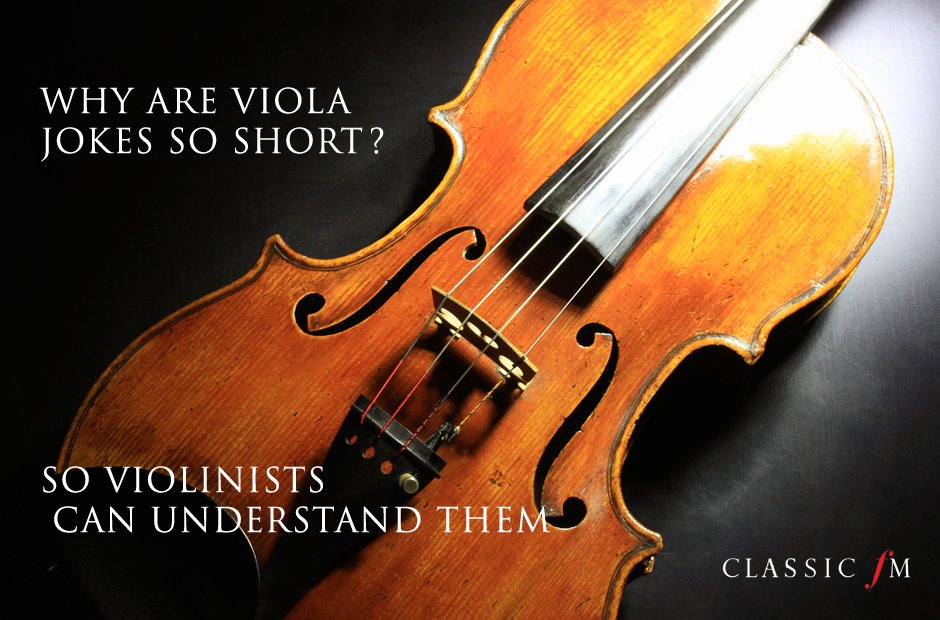
Image result for why are viola jokes so short     Violinists who make it into a good orchestra and happen to be a first violin are especially lucky, as they will have the melody in every single piece. Every one of them. They also tend to be favored by the conductors, for some reason. That being said, it isn't all that pleasant, either, to be a second violin, because you worked SO hard to get admitted into the orchestra, then you sit and watch the firsts have all the fun, knowing that the melody will never be yours.

     In conclusion, violins are lighter, always have the melody, are never misunderstood for being a viola, and are the favorites of the orchestra. But, I guess, that's all fine, considering that, ultimately, violas have sounded better, still do, and always will!

Dancing at my school

Being a Dancer at My School

I go to a private school in the U.S. and it amazing. At my school, we have a giant campus,
delicious food in the lunchroom, and many, many sports teams. Another thing about my school
is that athletes are often seen as “the best of us” as a student body. This seems great, right?
The only issue is that an athlete is someone who competes in a sport and out of that category,
the sports that are recognized are mostly ball sports. The only non-ball sport acknowledged is
track and field. Do you see the issue? I do. I am a dancer and consider myself an athlete.
As stated in the Merriam Webster Dictionary , an athlete is “a person who is trained or skilled in
exercises, sports, or games requiring physical strength, agility, or stamina.” Nowhere in
this definition does it say, “you must play a ball sport or be in a sport played by the school, to be an an athlete.”
Image credit
In physical education, we play ball sports, run, work out, and do one week of salsa
out of the whole year of physical education. The teachers explained that this is
because they needed something to put on the calendar to fill up one week and
one of our teachers can salsa dance. The salsa dance is almost everybody's least
favorite part of PE but its my favorite. This is because it feels like there are
actually skills being taught at or below my skill level.

Thursday, February 8, 2018

Trap-Neuter-Return


Trap-Neuter-Return, also known as TNR is a program instituted to try and control feral cat populations. TNR is humanely live trapping cats, taking them to a vet to be spayed or neutered and vaccinated and then returning them to their homes, the colonies they were trapped from. Cats that have undergone TNR posses an ear tip. An ear tip is the removal of the top quarter in of the left ear in a straight line.
The Process
The steps to TNR are:
  1. Get training
  2. Work with the neighborhood
  3. Establish a feeding pattern, count the cats and set out shelters and feeding stations.
  4. Find a holding space
  5. Arrange for spay and/or neuter, traps and transportation
  6. Actual Trapping
  7. Care taking
Many people ask why you should put feral cats back into the outdoors when they could be adopted. The answer is that they can’t. While most kittens and some cats are social enough to live with humans. In the past other less humane methods have been used to try and control feral cat populations. Some include trap and euthanize, adoption, relocation and cat sanctuaries These just do not work. Almost all, if not all lead to the vacuum effect. The vacuum effect is when cats that are removed from colonies are simply replaced by other cats. This means that any efforts made were in vain because while you have removed some cats they are just being replaced by other cats, which are most likely not spayed or neutered. With TNR you know cats are spayed or neutered and there will be less or no new cats in the area because the current cats will defend their territory. TNR also significantly reduces or eliminates unwanted behavior such as yowling, spraying, loud mating, and wandering. All in all TNR is a better and more humane way to eventually eliminate feral colonies